
Osprey Village hopes 'intentional neighboring' will be a win-win solution
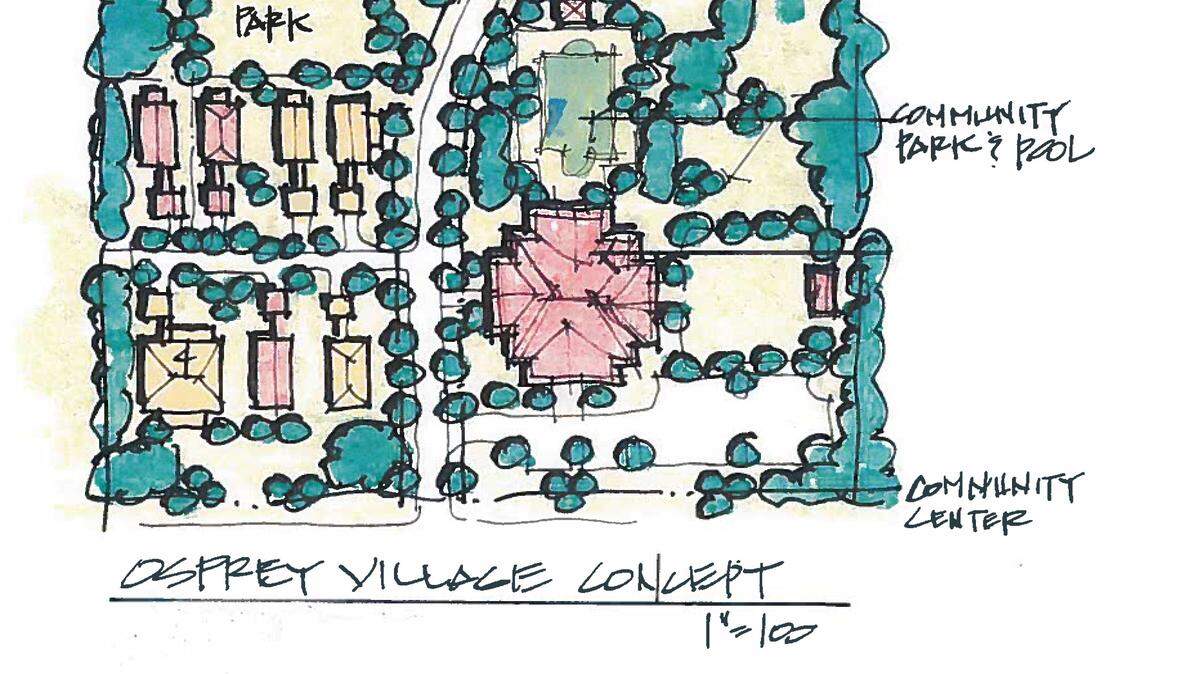
Osprey Village, a neighborhood being planned in Bluffton, will service special needs adults but will mostly be composed of retirees, caregivers and families seeking meaningful community connections.
The concept behind Osprey Village is called "intentional neighboring."
The question, though, is who will "intentionally" make themselves neighbors in a place where volunteer work could be required -- or, at a minimum, strongly encouraged -- where your neighbors will know your name and possibly your business, where someone else's need could be yours to address?
In many modern American neighborhoods, people don't take the time to get to know their neighbors. Families live far apart. Yards are fenced. The temperature is more pleasing indoors. And with busy lives and careers, many just want to come home, relax, watch Netflix and play on their phones.
But with a growing number of vulnerable populations -- the aging, those with dementia and children with autism, to name a few -- the idea of communities where the residents are truly connected are becoming sought-after, experts in the field say.
IT TAKES A VILLAGE
When Dr. Sue Levkoff, an endowed chair in the department of social work at the University of South Carolina who is an expert in gerontology, was studying abroad in 1971, her junior year in college, she lived on a ski slope in Morzine, France.
"I would ski down the mountain to my job at a creperie," she said. "There was a man in town named RiRi."
RiRi was developmentally disabled, and the people of Morzine kept an eye out for him. They checked on him and kept him safe.
In some ways, he belonged to everyone. His well-being mattered to the town.
"I'll never forget," Levkoff said. "He wandered around. Everyone knew him. People would feed him.
"I thought, 'That would never happen in the U.S.,'" Levkoff said.
The creators of Osprey Village envision a community like the one in Morzine where "neighbor helps neighbor."
They picture special needs adults visiting with older folks and helping them where they can, maybe sweeping their porches or vacuuming their living room.
They see older folks finding meaning in their lives as they plant gardens with other residents or take part in events like music nights or crafting, all the while knowing that their presence is welcome.
"It's going back to the village," Levkoff said.
She is not involved with Osprey Village, but upon hearing what the neighborhood hopes to achieve, said that a community of this sort could offer a solution for the aging as much as it would those with special needs.
"We are reactive (as a society)," she said. "We wait for the problem to happen, then we scramble to fix it."
Osprey Village is trying to get ahead of a problem they've seen coming for a while.
THE INSTITUTION
Between 40 and 50 years ago, when parents were told their child was intellectually or developmentally disabled, they were often given two options: institutionalize the child or take him home, where he would stay with limited or no enrichment services until he or his parents died.
Both parents and children could feel isolated in their communities.
"It's not like you're at the top of the guest list if there's a party," David Green said about being a parent of a child of special needs.
These days, the number of special needs adults in state-run institutions has dramatically declined nationally as advocacy has migrated to more inclusive and integrated living approaches.
Many states, have closed their institutions altogether.
In South Carolina, there are a number of options for special needs adults, including group living, referred to as "community training homes."
Beaufort County has seven such homes, two of which were recently opened, one in Lawton Station and one in Pinecrest, both in Bluffton.
Four residents live in each home.
The state and county try to place residents as close as they can to relatives, but there is a long waiting list and accommodations can't always be made.
The homes are in regular neighborhoods and are chosen with the idea that those with special needs will be part of the community.
Integration is key, says Bill Love, executive director of Beaufort County Disabilities and Special Needs Department in Beaufort.
"It's real easy to isolate people because of how they look," he said, which is why he hosts open houses at the homes and works to educate surrounding property owners. "They are homes like everyone else's. They're a family."
While the parents of Osprey Village support the option, they generally disagree with the concept and want to see a heightened version of it.
"(The residents in them) are more tolerated than integrated," Green said of group homes. "(The attitude is) 'I don't care if they live there, as long as they don't bother me.'"
To him and the other parents behind Osprey Village, "thriving" means their children are appreciated by those who live around them.
HOPE MEADOWS
Twenty years ago, Dr. Brenda Eheart created Hope Meadows, an intergenerational "intentional neighboring" development in Illinois that focuses on supporting the needs of families with foster kids.
Over the years, the concept has been featured on Oprah, on NPR and in numerous media reports nationwide.
Retirees move to the community with the intention of spending their golden years serving as foster grandparents at large.
The kids matter to the retirees, and the retirees matter to the kids.
"It's a place where older adults remain valued, needed and have a purpose," she said.
Eheart has replicated the model, under Generations of Hope, and has consulted with others who are trying to build similar neighborhoods, including Osprey Village.
"(It's) a lifestyle decision," she said of people who would choose to live at Osprey. "(In life) you need friends. And you need purpose. (With neighborhoods like this) they can have a purpose literally until they die."
Right now, no neighborhood exists that is quite like Osprey Village -- integrated specifically for the intellectually and developmentally disabled. And all eyes are on it to see if it succeeds.
Over the eight years since its inception, the group has received widespread support from local and elected officials and those in the special needs field, who are rooting for them.
"(Osprey Village) gives us an opportunity to be the way we should be," Love said. "To take care of each other and to help out and support each other."
Follow columnist and senior editor Liz Farrell at twitter.com/elizfarrell and facebook.com/elizfarrell.
This story was originally published February 6, 2016 at 2:00 PM with the headline "Osprey Village hopes 'intentional neighboring' will be a win-win solution."