
Column; 'Invisible' class was told to never say 'can't'
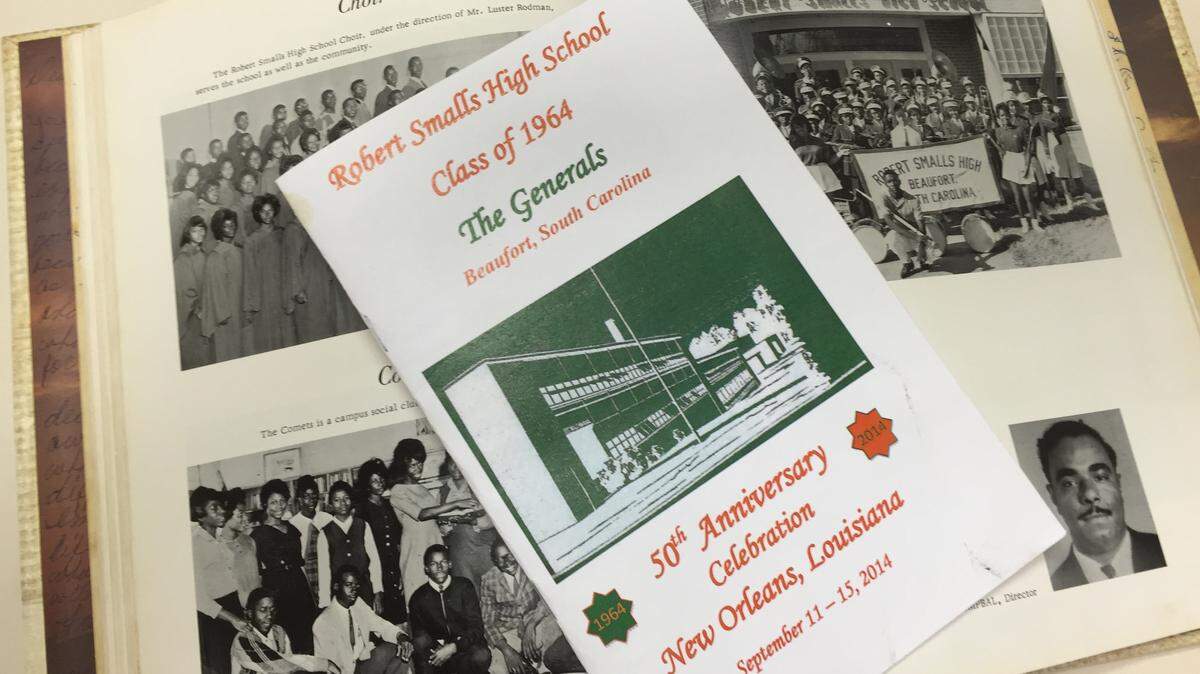
When the Robert Smalls High School class of 1964 graduated 50 years ago, not a word was printed in the hometown newspaper.
And even though Beaufort's all-black school closed decades ago with forced integration, those invisible seniors remain a community presence. More than 30 of them just returned from a 50th reunion celebration in New Orleans.
Now approaching 70, class members say they appreciate their school more than ever.
And they still march to the beat set by their Robert Smalls teachers.
"We were always told we were capable of doing anything we set our minds to," said class secretary Nora Brown Millidge. "And we really believed it.
"Our teachers told us not to let anyone tell us we can't do anything. They would not let us say 'can't' and we didn't want to let them down."
Their teachers included Herman Gaither, who became superintendent of the Beaufort County School District; John Gadson, who became the first black executive director of the Penn Center; Rosalie Pazant, who became founder of Beaufort's Original Gullah Festival; Eady Alston, whose husband, Kent Alston, brought Marian Anderson to town to inspire students when he was principal at Robert Smalls; and Arnold C. Mitchell, the coach they would name the gym for at Beaufort High School.
Among the 1964 seniors was Fred Washington Jr., who headed the county Department of Social Services office for years, and was a Beaufort City Council member and chairman of the Beaufort County Board of Education.
"Even though we're getting old, we want to do what we can to perpetuate the positive things the school can still do to instill values," Washington said.
The class of 1964 plans to raise $1,000 for the scholarships given by the Robert Smalls Association, organized by Vivian Pigler in 1976 to keep the spirit of the school alive. The association holds a reunion for all former students every third year. The next will be July 3-5, 2015.
Robert Smalls served students in first through 12th grade from 1925 until 1970 on the site of today's Beaufort County Courthouse. The school was named for the ex-slave from Beaufort who became a Civil War hero, a general and political leader.
Lula Parnell Lowe hosted her classmates in New Orleans. The five-day trip included dinners, shopping, a picnic, a trip aboard the steamboat Natchez and worship at her church. Classmates Willie Cooper and Maybelle White Scott sang a duet, and the full class closed the service with a song.
"It was a beautiful experience," Lowe said. "We are like a family."
Retired contractor Terry Harper of Burton acts as president of the 1964 alumni. The class meets every third Saturday for breakfast. They attend a classmate's church together every fifth Sunday. They gather for cookouts on Memorial Day and Labor Day weekends. They help sponsor the annual Martin Luther King Jr. Prayer Breakfast. They gave money for scholarships so local students could see a traveling Robert Smalls Exhibition last year.
This all started when classmates got tired of seeing each other only at funerals.
"We're all dying," Harper said, "but everybody says, 'Don't call me old. Don't call me old.' I said, 'OK, but you can be dead and gone and still ain't old."
They've already lost 38 of 120 class members. The ones who are left are determined not to be invisible.
Follow columnist David Lauderdale at twitter.com/ThatsLauderdale.
Related content:
- The Robert Smalls Association on Facebook
- The 2009 Robert Smalls Association reunion
- More David Lauderdale columns
This story was originally published October 2, 2014 at 7:29 PM.