
Lowcountry needs the wisdom of planting trees, not more clear-cutting
When “The Rise and Fall of South Carolina” is written, one man who will stand above most others is Roger Milliken.
He moved his family’s textile company headquarters from New York City to Spartanburg in 1958, and led the company for 71 years with legendary energy, drive and passion.
His executives took their briefcases to parties, always ready to be called. They worked Saturdays. Around town, people joked that Spartanburg would always be a great place for cardiologists for two reasons: The Beacon Drive-In and Roger Milliken.
Today Milliken & Company is one of the world’s leading textile and chemical manufacturers. It has 7,000 employees in six nations. Most incredibly, it has more than 2,500 U.S. patents and more than 5,500 patents worldwide, more than any other privately-held company in America.
Milliken developed the largest textile research center in the world, reaching well beyond old King Cotton. It “manufactures materials used in products as varied as flame-resistant gear for firefighters and the balloons in the annual Macy’s Thanksgiving Day Parade,” the New York Times reported. “One of its products gives Jell-O pudding its smooth creaminess.”
Milliken is known for its environmental stewardship and was recently named one of the World’s Most Ethical Companies for the 19th consecutive year. Its goal is to “recruit, educate, challenge and promote the best possible talent.”
Mr. Milliken, the New York Times wrote, “studied French history at Yale University and was known for quoting economic theorists like Adam Smith and Friedrich List.
”He was early in following W. Edward Deming’s principles on quality and process control. He wanted everything ‘Crafted With Pride’ and liked to say: ‘Good is the enemy of best, and best is the enemy of better’ and ‘The largest room in the world is the room for improvement.’”
In 1999, Textile World magazine named Roger Milliken the textile industry’s “Leader of the Century.”
When he died on Dec. 30, 2010, at age 95, he was buried beneath a one-word epitaph: “Builder.”
But the company he built may not be his greatest legacy.
A spiritual skyway
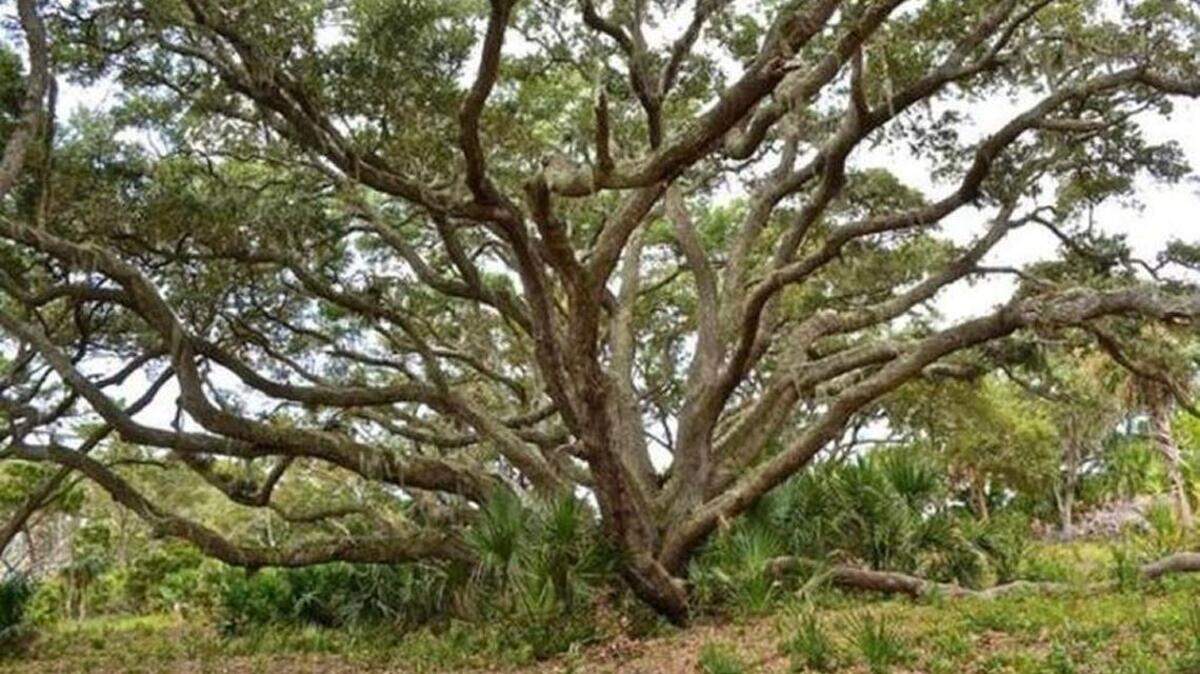
That legacy is crucial to the South Carolina Lowcountry at this juncture. It is a legacy of trees. Of planting trees. Of planting “noble trees.” Of educating people and individuals on the value of these trees, and as Mr. Milliken’s Noble Tree Foundation in Spartanburg does, helping them plant these trees all over the county.
As the Lowcountry foolishly turns to clear-cutting for housing development, Mr. Milliken’s wisdom tells us this, through the foundation: “Noble Trees are tall, substantial trees that, when planted wisely, will endure for generations.
“They are large, architecturally elegant trees that cast shade and become fixtures in a landscape.
“They are homes to birds, highways for squirrels, destinations for pollinators, food sources for animals, and anchors for tree houses and swings.
“Noble trees prevent erosion, support wildlife habitats, emit oxygen, decrease carbon dioxide and increase property values.
“These inspiring trees enhance everyday life and create memories for those who encounter them — some even call them spiritual skyways to the heavens.”
Wofford College
When the Milliken company came to South Carolina, it settled on a 600-acre peach farm.
Here, Mr. Milliken would soon not only have them inventing things, but he would use the guidance of landscape architect Dick Webel, his son Rick Webel, and horticulturist and professor at the University of Georgia Michael Dirr to turn this site into what the foundation calls one of the largest green spaces in the Southeast.
It has ponds, fountains and more than 500 different trees and shrubs, open to the public. It also has an arboretum.
Mr. Milliken also saw to it that the Greenville Spartanburg International Airport was a forested and beautiful place, making a pleasing first impression on visitors. And he did the same at Wofford College in Spartanburg. The Roger Milliken Arboretum at Wofford spans 195 acres, which the college says is a “purposeful design … to calm and soothe the soul.” It was recognized with the 2025 Heritage Tree of the Year Award by TreesSC.
Wofford President Nayef Samhat said, “Ahead of his time, Mr. Milliken … knew that the college’s buildings and grounds were a huge factor in the college admission process. He knew that first impressions matter to prospective students, so during his 48 years of service on the board of trustees, he brought landscape architects and giants in the world of botany to Wofford’s campus. Because of this commitment, thousands of trees and shrubs have been planted. What you see on our campus today is the ongoing evolution of their vision.”
What will future generations have to say about our clear-cutting? What value will it have to them?
Wofford College shines this light into Mr. Milliken’s incredible mind:
“Milliken was influenced by his godmother, (also his mother’s best friend) Beatrix Farrand (1872-1959),” its website says. “She was one of the founding 11 members of the American Society of Landscape Architects. Her campus design influence captured Milliken’s eye on the campuses of Princeton University and Yale University.
“It was Farrand who influenced the use of placing plant material close to buildings of Wofford’s campus. Milliken preferred the buildings be painted white to showcase the evergreen plant material.”
When Mr. Milliken died, what may be his true legacy — the legacy of trees — was best explained in a beautiful little book that his people distributed.
It should be required reading for all elected leaders and administrators in Lowcountry governments — and in our grade schools.
It’s called “The Man Who Planted Trees” by Jean Giono with wood engravings by Michael McCurdy and an afterword by Norma L. Goodrich. It is published by Chelsea Green Publishing Company in White River Junction, Vermont, and it can be read in half an hour.
It’s a story about planting, not chopping.
It’s about choosing between the rise — or the fall — of a great place.
David Lauderdale may be reached at LauderdaleColumn@gmail.com.