
Hilton Head’s oldest walls can talk, if we’re smart enough to listen
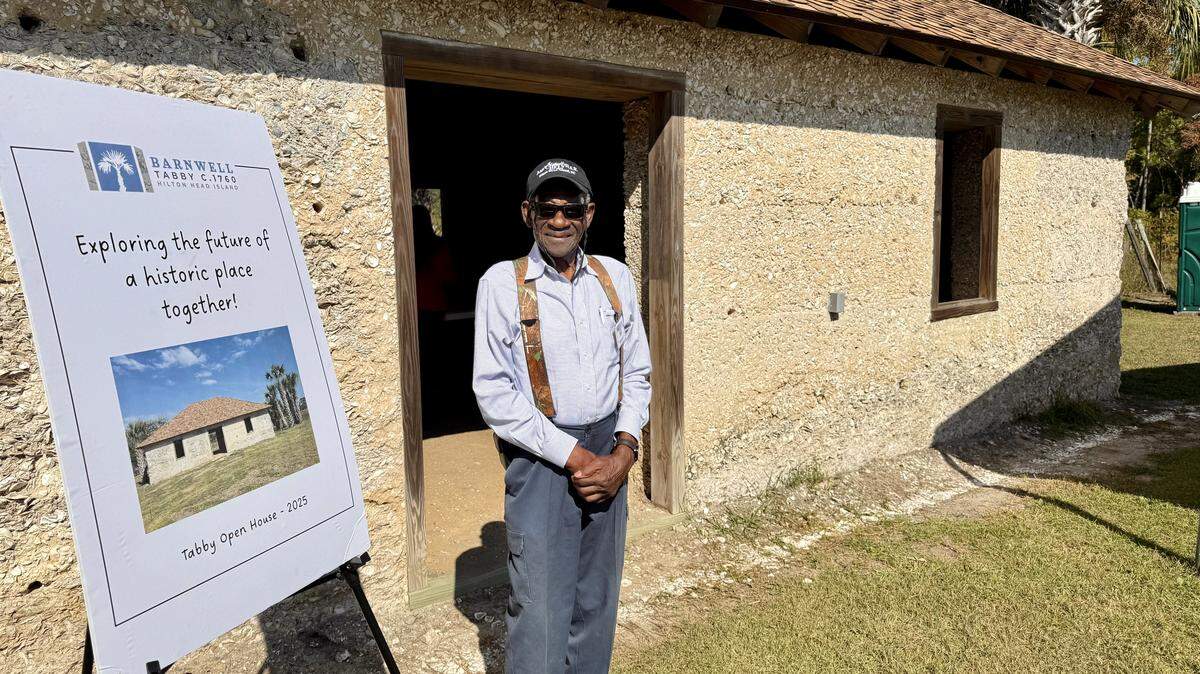
Some special walls are doing some special talking on Hilton Head Island.
And these walls have of late have had some surprising things to say.
The walls are made of tabby, an historic “concrete” made of lime, sand, water and oyster shells.
The walls form a rectangular building located in a fenced field on the north end of the island that has heretofore been better known as a place where goats and marsh tacky horses roam.
Once, there was a more stunning spectacle in this field at the intersection of Gum Tree and Squire Pope roads. A baby deer took up with the goats, and apparently thought it was a goat, but that’s not the story the tabby walls are telling.
Within the tabby walls is a dirt floor with a few rows of pews from the old Mt. Calvary Missionary Baptist Church sanctuary nearby.
The site has been researched and dissected in waves since 1973 by archaeologists, anthropologists, architects, tabby experts and historians.
They’ve shared various tales over the years, but the most common thing the walls have told us is, “Keep digging. Keep studying.”
The most surprising thing they’ve said of late is that this building is the oldest structure on Hilton Head, circa 1760 — long pre-dating the presumed antebellum-era construction.
Suddenly, the same walls that within this generation sheltered cattle and now rest near a waterfront timeshare complex, have a much bigger bully pulpit.
These walls now have a name, almost like a brand. The building is called The Barnwell Tabby. These old walls have their own website, a new purpose and a planned future, now being sketched on drawing boards.
The site is owned by Thomas C. Barnwell Jr., the 90-year-old leader of a prominent family on Hilton Head Island for seven generations dating to the early 1860s.
Barnwell is a successful developer of affordable housing, but he is also keenly interested in the island’s history. He thought about developing this prominent tract, but decided to save the walls to talk to us for another 200-plus years.
The family wanted to know who built the building, when they built it, what it was used for and whether it was part of the deep Gullah Geechee history of the island.
Protection of the asset was the first task, so the walls were restored and covered by a roof. The work was done in phases beginning in 2009, led by architect and tabby expert Colin Brooker and builder Rick Wrightman.
Archaeological digs had been done before, but in 2019, the family sought answers to their questions in a different fashion.
This time, the story of the walls was explored by a collaborative team including University of South Carolina Beaufort associate professor of anthropology Kimberly Cavanagh, archaeologist Audrey Dawson, geologist Tammy Rittenour of Utah State University, historian Eric Plaag and USCB undergraduates.
Their work produced new storylines, and a thirst for more research.
The Barnwells plan to open the site for more public exploration and teaching, but it will remain private property.
Now, on-site educational resource development at the site is being created by historian and archaeologist Katherine Seeber.
And in November, islanders were invited to a series of open-houses at the site to give their opinions on 18 plans for how the site might be enhanced for public access drawn by second-year University of Georgia master of landscape architecture students.
The walls built by enslaved Africans and Native Americans have a lot to tell, but what the building was used for is not fully known. It likely had a number of different uses over time. Was it a home? A two-story home? An agricultural outbuilding? A meeting place?
Whatever the walls end up telling, it will be important. The walls can fill in blanks about the Colonial era, and about the lives and contributions of the enslaved and freedmen on Hilton Head.
The Barnwells want the research to continue, and for the structure to become a symbol of the island’s Gullah Geechee heritage.
If we’ll listen to the walls, they’ll tell us the truth.
David Lauderdale may be reached at LauderdaleColumn@gmail.com.