
How a Hilton Head icon’s Sewanee degree could be the real ‘beacon to the nation and world’
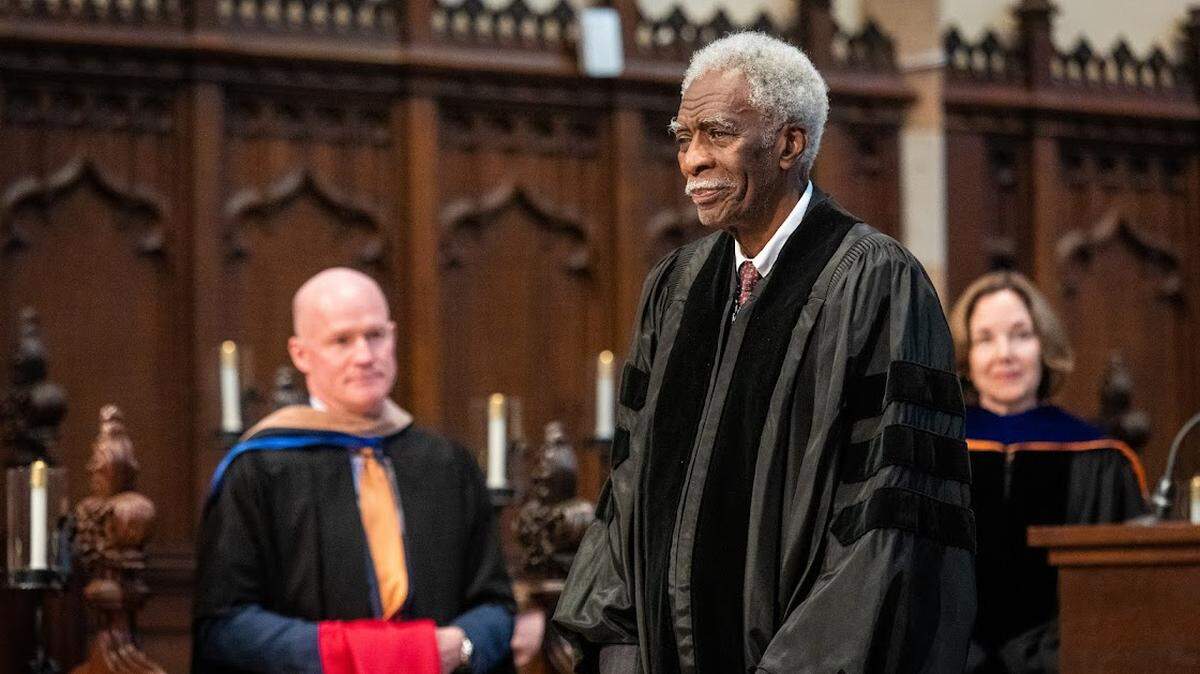
The imps of history would have to love this moment.
On May 14, Emory Campbell of Hilton Head Island — a champion of the Gullah culture that dates to enslavement to planters on the sea islands — was given an honorary degree at Sewanee, established by and for the planters at the University of the South in Sewanee, Tennessee
Campbell stood in this world of mahogany and stained glass, the white hair of 80 years on earth setting off his dark skin and black robe of academia.
He rose to hear a proclamation that reflected a personal knowledge of his unusual Lowcountry life.
“Soft-spoken, respected, beloved, this is a man of both physical and reputational stature,” it concluded. “In recognition of Emory Shaw Campbell’s lifelong commitment to articulating, preserving, and sharing the riches of a unique natural and cultural environment, the University of the South is honored to confer upon him the degree of Doctor of Civil Law, honoris causa.”
Back home and back down to earth, some 1,900 feet of elevation below Sewanee’s perch on the Cumberland Plateau in east Tennessee, Campbell said, “When that citation was read at that university, I tell you it was heart-warming.
“It was sweet, I tell you. It was really sweet.”
THE IRONY
By now, accepting honors is almost a part-time job for Campbell.
But he is not the first Black South Carolinian to receive an honorary degree from Sewanee.
Charles F. Bolden Jr. of Columbia, former astronaut and NASA administrator, has been there before.
He’s not even the first Gullah to make it.
Artist Jonathan Green of Beaufort County can claim that.
Still, there’s a lot to learn from the moment Sewanee honored Campbell’s 22 years as director of the Penn Center on St. Helena Island, his service as chairman of the Gullah Geechie National Heritage Corridor, his writings, teaching and all the rest to let the world know what his generation was slow to realize: The Gullah story needs to be heard.
It comes as Sewanee is taking a deep dive into its peculiar roots.
Its “Roberson Project on Slavery, Race, and Reconciliation at the University of the South” began in 2017 as a six-year study “to investigate the University’s historical entanglements with slavery, its legacies, and white supremacy.”
A summary of its conclusions to date says its founders in the 1850s “envisioned the University as a beacon to the nation and world, illuminating how the South of slavery was a modern and Christian society, advancing God’s designs for the world and rising to rival history’s greatest civilizations.”
It quotes a pamphlet written by two founders, including the Right Rev. Stephen Elliott of Beaufort, saying: “The world is trying hard to persuade us that a slaveholding people cannot be a people of high moral and intellectual culture. Never was there a grosser error than this.”
That could be proven with a university of about a dozen colleges, a business school, law school, medical school and Episcopal seminary.
John M. McCardell Jr., a Beaufort property owner and soon-to-be full-time resident, ended a successful 10-year run as vice chancellor and president of Sewanee in 2020.
He warns that “it’s rather too simple to say that the university was wholly, or even mostly, a part of the pro-slavery argument.
“If that had been the only reason for the founding of the university, which never opened its doors, by the way, until 1868, there would have been no reason for them to come back to the mountain (after the Civil War), impoverished in 1868 and get the place started.”
Nevertheless, Campbell, a long-time friend of McCardell’s, sees irony in this moment.
He said that about the same time Sewanee “was founded to substantiate the way of life of slavery and all of that, Penn School (later Penn Center) was founded to promote the ideas of the Constitution.
“We were diametrically opposed, those two schools, when you look at it. It’s an irony that I got connected to Sewanee because of my work at Penn Center.”
TELL THE TRUTH
A willingness to listen and learn is the key here.
When they first met, Campbell found McCardell to be “a breath of fresh air.”
“He was so interested in history. He was interested in the culture and the history.”
That was a quarter of a century ago at the Bread Loaf School of English, a summer writing program at Middlebury College in Vermont, where McCardell also served as president.
Later, McCardell brought Middlebury students and then Sewanee students to Penn Center to learn about the role of the Gullah and the sea islands in American history. More recently, Campbell would travel to Sewanee to speak with students there.
“Those kids are so curious about this history,” Campbell said. “I found that the Sewanee kids ask questions. They want to know the truth. So I wasn’t shy about telling my experiences in the South in the days of segregation and days of isolation on these islands, and even before that what I heard and learned about slavery. They were very open to learn.”
Campbell’s formal learning began in a segregated one-room school house near the rear entrance to Honey Horn Plantation. Both of his parents and paternal grandparents were teachers. His father was his teacher from third to fifth grade.
He hitchhiked to Savannah State University to become the first of the 12 children in his family to go straight to college and get a degree. He’d later earn a master’s degree.
With the Sewanee honorary degree, Campbell’s third, lessons are there for anyone willing to learn.
McCardell, a historian who once owned the Robert Smalls home in Beaufort, said it is important to grow out of the past.
“There’s a recognition that we are not the university of the 19th century South, and we once were but are no longer the university of the 20th century South. We’re the university of the South and the future of the South, not the past. That is the South we are the university of.
“I like to think that recognizing Emory Campbell and Jonathan Green attest to that.”
Campbell tells how his moment on the mountain could be a beacon to the nation and world.
“I’m hoping that we can convince enough people locally and particularly statewide on the value of diversity,” Campbell said. “And the value of knowing our total history, and being willing to talk about it, to tell these stories.
“I think the time has come in our nation’s history that we should be able to tell the truth.”
David Lauderdale may be reached at LauderdaleColumn@gmail.com.
This story was originally published June 5, 2022 at 5:00 AM with the headline "How a Hilton Head icon’s Sewanee degree could be the real ‘beacon to the nation and world’."