
Hilton Head-area ‘haves’ will have to give to the ‘have-nots’ to fix worker housing crisis
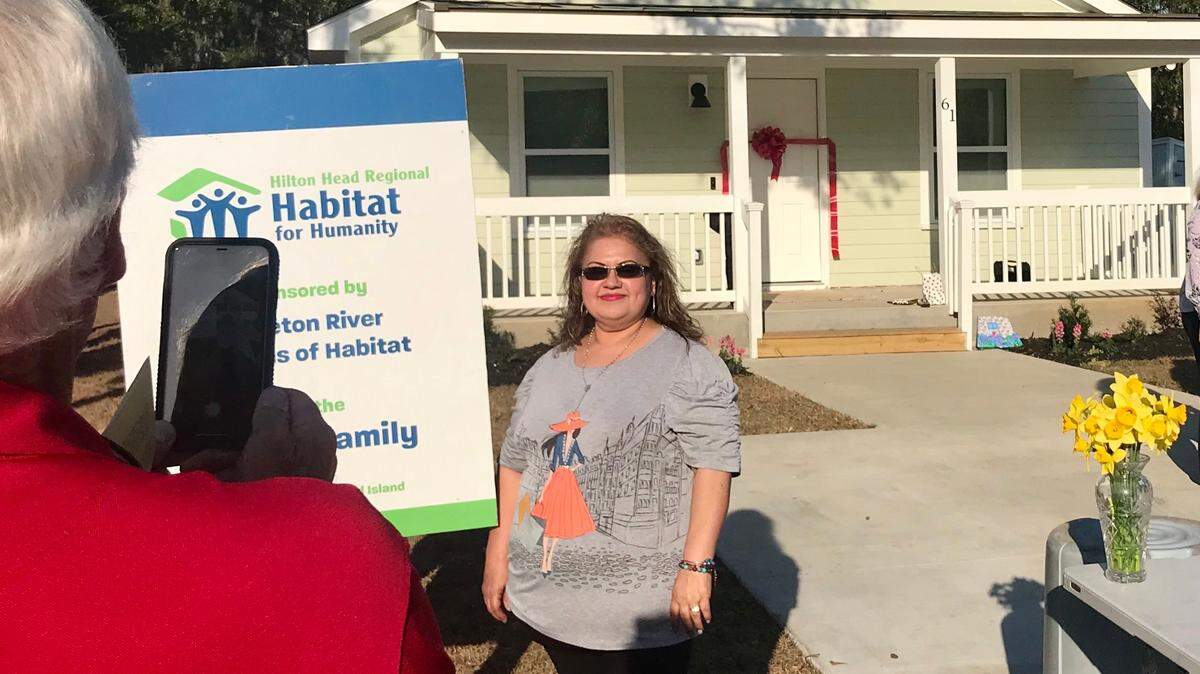
Irene Rivera considers herself blessed and calls herself excited.
This as she hoists oversized scissors to clip a red ribbon across the front door of her new home at 61 Alex Patterson Road on Hilton Head Island.
Her family and a small group of supporters stood by as her home was blessed Thursday afternoon in The Glen neighborhood, developed by the nonprofit Hilton Head Regional Habitat for Humanity on 14 acres donated by the Town of Hilton Head Island in 2010.
Irene Rivera is stepping into one of the last of the 36 homes to be built in the neighborhood off Marshland Road.
And then Habitat for Humanity will have to look elsewhere as Hilton Head enters a new bout of hand-wringing over its worker-housing crisis.
She’s a native of Mexico who has lived and worked most of her life in America, and is now employed at the Colleton River Club in Bluffton.
On Thursday, her hard work paid off as her home was blessed by the Rev. Robin Dease, pastor of St. Andrew By-The-Sea United Methodist Church and she was given an all-American sampler from the Lowcountry Chapter of the Embroiderers Guild of America and a welcoming gift from the Sun City Garden Club Ladies.
Habitat for Humanity
Since 1990, Hilton Head Regional Habitat for Humanity has built 115 “simple, decent” houses in southern Beaufort and Jasper counties, housing more than 300 people.
By comparison, a series of other initiatives by the Town of Hilton Head Island since it established an Affordable Housing Task Force in 1995 has resulted in a grand total of 19 units in the Summerfield development and 10 buyers getting some federal grant money to help with a mortgage down payment.
By far, the town’s most significant move was giving land to Habitat.
Now Habitat needs more land.
Habitat is not the only answer. And it takes a village to raise a Habitat home: volunteers with hammers and donors with checkbooks.
“We’re not a quick fix by any means,” Brenda Dooley, executive director of the Hilton Head Regional affiliate said.
It takes 12 to 18 months for a home buyer to make it through a process that involves sweat equity and financial training.
And Habitat is not for everybody. It addresses those earning 30 to 60 percent of the area median income. Some of the so-called affordable housing local governments are begging developers to include in the new neighborhoods sprawling across the Lowcountry are for people making 120 percent of the area median income.
This as one in eight people in South Carolina are living in housing that costs them more than 50 percent of their household income. It should be no more than 30 percent.
Habitat has only three more home sites available on Hilton Head. Hundreds of people will apply, all hoping to someday be as excited as Irene Rivera was Thursday.
Colleton River Club
Irene Rivera’s home was sponsored by Colleton River Club Friends of Habitat.
Colleton River is a high-end, low-density development with a golf course Pete Dye described as his favorite, and sunsets over the river that make residents think they’ve already landed in heaven.
A typical Habitat home of 1,100 square feet with three bedrooms and a bath might be swallowed up in the garage of some Colleton River homes.
But that doesn’t tell the story.
Irene Rivera’s home is a milestone for the “haves” of Colleton River.
They now have given $1 million to help hard-working people get into their own homes, sometimes moving out of situations where an entire family lives in a single room — or worse.
Colleton River homeowner Bill Spadafora said it started in 2003 with a letter to residents, asking if they would contribute to a Habitat home in Bluffton. They did, and they still do.
They’ve now sponsored 16 homes and given $100,000 for Habitat’s infrastructure costs to make The Glen come alive. Habitat had to build streets and a sewerage pump station.
“It’s not a handout, it’s a hand up,” Spadafora told the small group who came to see Irene Rivera’s dream come true with the oversized scissors. “You’ve got to work at it to get one of these homes, and the mortgage payments you make go into a fund to build another house.”
He told me Habitat should be doing multi-family buildings because land is so hard to come by.
Habitat has built out its land in Bluffton and now is looking to build on land in Jasper County.
But since the COVID-19 pandemic, donations are slightly off, building costs have soared, and it’s hard to get subcontractors because they’re all so busy, Dooley said.
I asked Spadafora how many other neighborhoods of “haves” have knocked on his door to find out how to raise $1 million for one of this community’s direst needs. He said none.
So we can talk about affordable housing into the next millennium.
Or we can make land available to a tried-and-true nonprofit.
And the “haves” in the community, more than the governments, will have to give to the “have-nots.”
David Lauderdale may be reached at LauderdaleColumn@gmail.com.