
Freshwater wetlands: The web of life crucial to Hilton Head environment | Opinion
One of my naturalist mentors made a statement many years ago that I thought was worth documenting for future reference. He said, “Man did not weave the web of life. He is simply a strand in it. Whatever he does to the web, he does to himself.”
This quote could be applied to the web of life identified in a wetland: abundance of waterfowl, songbirds, reptiles and amphibians, fish, mammals, grasses and other aquatic vegetation, and many endangered species.
I am concentrating on freshwater forested wetlands on Hilton Head Island and specifically those under the protection of the Hilton Head Island Land Trust.
The Land Trust is a nonprofit organization started in 1987. One of its missions is to protect and preserve critical natural habitat on Hilton Head. Through conservation easements, we protect over 300 acres of land (a conservation easement is a legal document between two parties that states that the land is forever protected and preserved).
Included in our conservation easements are Whooping Crane Pond Conservancy, Cypress Conservancy, and the Northridge Conservation Area.
The two conservancies are located within the gated community of Hilton Head Plantation.
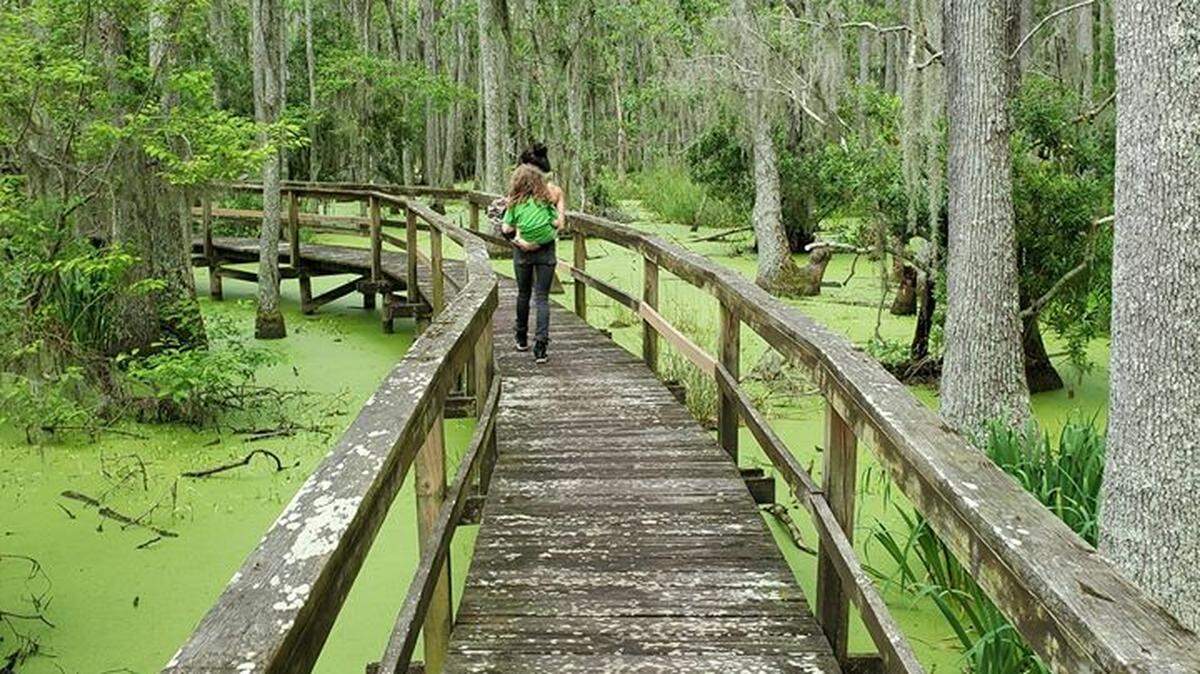
Whooping Crane Pond Conservancy contains 137 acres of old-growth hardwood forest, marshland and open water. It is the largest of the wetlands on Hilton Head Plantation. Interpretive signage is found along the 1,100-foot boardwalk, allowing visitors to view and identify the array of life around them.
Cypress Conservancy is a 51-acre wetland and home to old-growth bald cypress and black gum trees. It has the only large stand of bald cypress on Hilton Head. These noble trees are southern relatives to redwood and giant sequoia trees.
The Cypress Conservancy reduces the danger of flooding in Hilton Head Plantation by absorbing millions of gallons of stormwater. Interpretive signage is found along its boardwalk as well.
Since 1986, the Hilton Head Public Service District has supplied highly treated reclaimed water to restore Cypress and Whooping Crane conservancies, and in doing so has played a key role in the sustainability of Hilton Head’s environment.
Reclaimed water is the longest running and most beneficial green technology on Hilton Head.
The 64-acre Northridge Tract Conservation Area is located at the northern end of Hilton Head. This freshwater wetland supports live oak and black gum trees as well as two freshwater ponds.
The Land Trust has chosen to leave this land undisturbed. There are no trails; however, the borders of the land can be seen from U.S. 278 and Palmetto Parkway.
The wetlands that the Land Trust oversees must remain healthy habitats for future generations. Each strand in the web of flora and fauna we protect through proper management promotes an outcome that will continue to be positive for the future of Hilton Head.
Contact the Land Trust through its website (www.hhilandtrust.org) or Facebook (@HiltonHeadIslandLandTrust).
As a certified Master Naturalist, Carol Rivers conducts nature and history tours on Hilton Head Island. She is a board member for the Hilton Head Island Land Trust. She earned a BS in multiple science from Lemoyne College in Syracuse, New York, and an MBA from Union College in Schenectady, New York.