
We were taken aback by the use of the word ‘plantation’ on Hilton Head | Letters
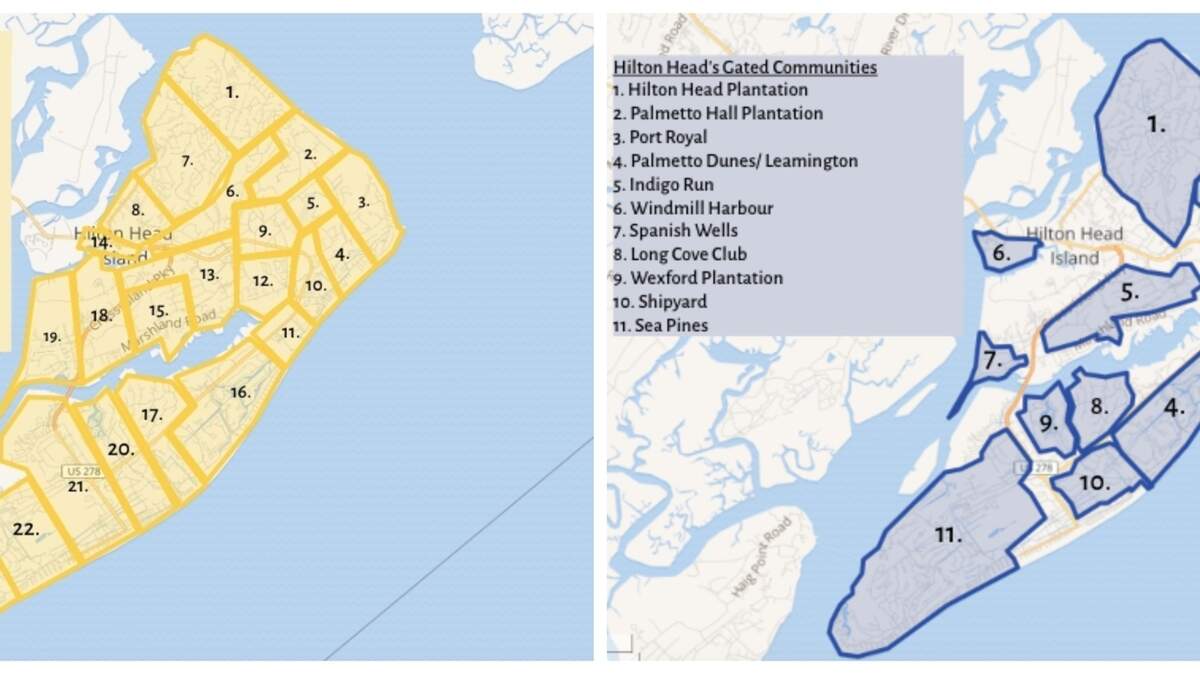
My wife and I first visited Hilton Head Island in 2007. Like many, we fell in love with it, returned frequently and bought a second home on the island. Unlike most, our year-round home is not in the United States; we are residents of London, England.
The first time we arrived on Hilton Head, I was utterly taken aback by the word “plantation.” My knowledge of American history is not as detailed as somebody born and educated in the U.S., but it is good enough to understand the connotations of the word.
As time has passed, I am desensitised to the term, to the point that it is as normal a word in my vocabulary as “278” or “Sea Pines” when on the island. Reading your recent article has made me ashamed of my ignorance and lack of sensitivity. My first, and gut, instinct was entirely right.
I am saddened at how often I have driven Pope Avenue/Squire Pope Road, without ever knowing of Pope or of the hundreds he enslaved.
Of course, no white person should be held responsible for the sins of their ancestors, but surely, we are wise enough to understand how the hundreds, if not thousands, of people of African descent must feel each day as they drive “Pope” Avenue, enter “Plantations” and, doubtless, see other references that I am too ignorant to know.
Might I suggest a change to “Hope Avenue” be a fitting act of progress?
David Lampkowski
Hilton Head Island
Changing racist attitudes: ‘We must start now’
I grew up in a racially segregated community and never knew any people of color throughout high school and college. I never interacted with minority populations until I entered the workforce. My parents were quietly racist and their attitudes affected me. As I began to relate with people of color, I began to experience their attitudes, cultures and mores. I tried to put myself in their positions. One never understands other people until you walk a mile in their shoes.
My greatest revelation and “eureka moment” came when I developed a close working relationship with a woman of color. She taught me tolerance, understanding, friendship, respect and Godly love. Her magnetic personality helped me overcome my previous racist attitudes, which I still must fight to keep suppressed.
So how do we as a society put aside hundreds of years of ingrained prejudice?
It must start now, recognizing that although we are different in color and culture, we are all human beings with the same desires, expectations, hopes and dreams.
Let’s work together to make our country truly a “United States,” where we can all enjoy the freedom envisioned by our Founding Fathers. They were not perfect and neither are we.
But we can and should “listen to our better angels,” striving together to live in peace and harmony, recognizing our differences but embracing our commonalities. Our whole society depends on each and every one of us acting as decent, honest and ethical citizens.
George R. Myers
Hilton Head Island
You cannot erase history
I searched the word “plantation” and came up with a definition that has no mention of slavery.
We can’t wipe the slate clean. We can’t say slavery never happened, just like we can’t say 6 million Jews weren’t killed in the Holocaust. We can’t say 9/11 never happened. What we can do is embrace our history and remember the good and the bad that the United States has done to become the greatest nation in the world.
It’s time to educate people on the opportunities there are in this country. I’m tired of hearing a white man killed a black man or a black man killed a white man. The truth is a man killed a man. One man is dead and the other must pay for the crime.
If meaningless change continues, our history will become revisionary and there will be no truth as to what happened.
I’m 72 years old and have seen lots of change in this country – some good, some bad, and some that didn’t need to be changed. George Santayana said a long time ago, “Those who cannot remember the past are condemned to repeat it.”
Those of us who have been privileged to be born in United States or have legally become citizens must take our history and learn from it or we will be doomed to repeat our mistakes.
I want to live in a country that can move forward, learning from its mistakes, not erasing them and pretending they never happened.
Michael Kalafer
Bluffton
We don’t need knee-jerk reactions on American history
I have been alive long enough to live through many crises and usually the reaction is swift and bold. But where do you draw the line until the pendulum slows down and returns to the middle?
Are we going to delete teaching anything about the Civil War in school? Are we going to rename every city in the South that predates the Civil War? Are we going to close down Mount Vernon and Monticello because those presidents were slave owners?
Are we going to close down Gettysburg? For that matter, are we going to rename Jamestown, where it all started?
I remember when Congress renamed Cape Canaveral to Cape Kennedy without consulting them. They were outraged at having their home renamed and eventually it was renamed.
The Washington Redskins still play football using that name.
Let’s understand that racial changes come from a state of mind, not obliterating history.
If history is viewed properly, it is not always to glorify something, it is to be used to teach and remind.
Remember the concentration camps. They are open as a grim reminder of what happens when people abdicate their freedom and is meant to teach, not glorify evil.
Knee-jerk reactions solve nothing but act as a salve. Knocking down a statue or renaming something makes a valid point, put does it really teach? That comes from a personal new awakening and a commitment to act on it.
John Gerstle
Hilton Head Island
‘Plantation’ word on Hilton Head not a smart choice
Back in the early- to mid-2000s, as an independent meeting planner, a client told me, “There’s no way the group would ever hold a meeting at a hotel or resort with ‘plantation’ in its name.”
This client would “book” a three- to four-night stay at such resort brands as Ritz-Carlton, Four Seasons, etc. This client represented senior executives from Fortune 500 companies who operated in the corporate public relations arena of their respective companies. This included IBM, Ford, Johnson & Johnson, General Electric, American Express, etc.
Plantation, not a new slur, time to go.
Diane Quinzi
Okatie
Beaufort City Council open to diversity
Recently I read in The Beaufort Gazette that a local black elected official was lamenting that there was no black person presently on Beaufort City Council, and no black person has held this office in 25 years.
I had the privilege of serving eight years on the Beaufort City Council and each of those years there was a black person on council. Alice Wright and Fred Washington were excellent members of council, both serving as mayor pro tem.
Also, I might add that there were three excellent women on council, which with the black members served to diversify the council.
My recommendation to my black friends and acquaintances in the city is that they encourage black leaders who are of high moral character, energetic, civil-minded and well-known in the community to run for City Council. Such a person would stand a good chance of election.
In defense of the at-large voting for city government, it is beneficial because each member of council is answerable to the entire city electorate.
Tony Bush
Beaufort
Bay Point development plan puts dollars over ecology
The proposed development of Bay Point Island is an invitation to disaster. Just another opportunity to ignore all ecological factors for the almighty dollar.
As residents of Beaufort County, we must use all means to voice our opposition to the opportunists whose financial interests override all other considerations.
Sandra Educate
Lady’s Island
Coronavirus shows too many me-first Americans
Like the movie “Groundhog Day” with Bill Murray, the coronavirus will keep repeating.
The spread and perpetuation of the coronavirus is not about political shortcomings. It’s about human nature.
We in the U.S. were gifted freedoms not found in many other countries and we continually abuse these freedoms to minimize personal inconvenience. People do not think of the greater good. In fact, they probably no longer understand what the phrase means.
Our society can generally be described as one with short memories, short attention spans, complacency bordering on smugness and a me-first attitude.
That is exactly why the the coronavirus will recur; possibly with a vengeance.
The more we ignore good practical common sense with regard to social distancing and appropriate use of face masks, the more the government will, by necessity, “infringe on our liberties.”
Bill Kuttruff
Hilton Head Island
South Carolina ignoring COVID-19 danger
My wife, 17-month-old son and I have had the extreme fortune of living on Hilton Head Island the last three months, rather than our small apartment in Hoboken, New Jersey. Right across the river from New York City, Hoboken is the fourth most densely populated city in America. This was a bad recipe for the spread of COVID-19.
On March 15, Hoboken closed restaurants and bars. Four days later it was all business. And two days later, on March 21, New Jersey was shut down. We lasted one more week before friends opened their hearts and offered my family their home on Hilton Head.
It has been a magical time, but the factors that drove us here originally are now causing us to leave. The numbers speak for themselves.
On a per-capital basis, the number of daily COVID-19 cases in South Carolina is three times higher than in New Jersey.
But what is far more alarming are the trends and behaviors.
If you compare the last seven days in South Carolina to the seven days that preceded the shutdown in New Jersey, the results are terrifying.
When New Jersey officials saw the data, they shut down the state. When South Carolina officials see data that is significantly worse, they do nothing. They have signaled that it is perfectly fine to live life as normal. But the situation is dire, with hardly any preventative measures in place.
As we leave, we hope this community takes the steps necessary to protect itself.
Jeffrey Schub
Hoboken, New Jersey
The ‘silent’ manipulation
Words are incredibly powerful. They frame perception through association, and present us with binary solutions to complex problems. Look at the words used in the present crisis, situation, pandemic, or current unpleasantness.
It is a little disheartening, upsetting or shameful if not revealing, that certain terminology has become accepted and widespread in these difficult days, challenging times or devastating pandemic.
First, what does the word “lockdown” mean to you? Prison bars, dark cells, forced containment? No wonder so many people are complaining about their rights being trampled.
So how about a “stay-at-home” order instead? That doesn’t sound nearly as Orwellian as a lockdown. But it’s still an “order.” How about “Stay-at-home guidance”?
What about the term “social distancing”? That implies isolation, loneliness and even rejection? Isn’t the term “physical distancing” not only more accurate but less aggressive, harmful and threatening? No wonder people are feeling isolated and depressed.
Then there is the “novel coronavirus.” That makes it sound a little quirky and cute? The word “novel” can also connote a work of fiction. Could that be why so many people think that the virus is really a hoax?
Ever since Sigmund Freud’s nephew Edward Bernays applied his uncle’s theories about the self to the fledging world of public relations, words have been subconsciously and more often consciously used to shape public opinion. A hundred years later, this challenge, issue, problem, threat, has become ever more important, urgent or desperate. It’s actually a matter of national security.
Howard Rankin
Hilton Head Island
Beaufort County voting done well
I would like to thank the Board of Voter Registration and Elections of Beaufort County and staff for a very smooth voting experience in the recent primary.
I am over 65 and my husband is also. We were able to obtain an absentee ballot for him easily and I was able to do early voting. I had a very short wait, the staff was very organized and professional and we even had disposable cotton swabs to touch the voting machine. I felt very safe in the voting site.
Perhaps the South Carolina staff could train folks in other states where it did not go well.
Laurie Haddock
Bluffton
How to submit a letter
Send letters to the editor by email to letters@islandpacket.com or letters@beaufortgazette.com.
Or you may submit a letter online.
Letters to the editor must be 250 words or fewer and include your first and last names, street address and daytime telephone number so we can verify the letter before publication.
You are limited to one letter per 30 days.
Letters may be edited for length, style, grammar, taste and libel. All letters submitted become the property of The Island Packet and The Beaufort Gazette.
This story was originally published June 18, 2020 at 9:34 AM.