
Our view: Deer-culling program is a help to the Lowcountry
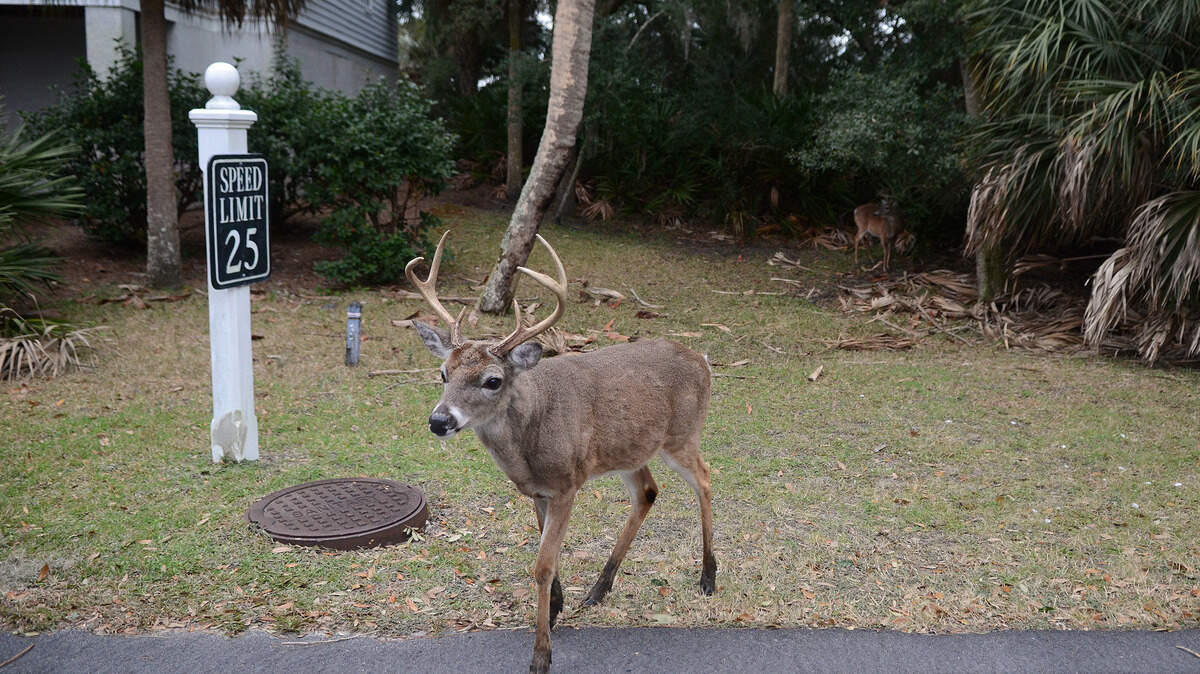
One of the joys of Lowcountry life is spotting deer and watching as they roam and graze.
Unfortunately, one of the drawbacks of Lowcountry life has been widespread development that has overtaken much of their habitat.
In the late 1990s, herds were forced into smaller natural areas, while fertilized golf courses and plantings brought a bounty of tender, nutritious food. With hunting no longer allowed in what was once a hunter's paradise, deer in many Beaufort County gated communities thrived.
Some residents fed them, and the deer lost their fear of people.
Car-deer crashes rose to more than 60 per year in both Hilton Head Plantation and in Sea Pines by 2001.
Sea Pines decided to take action and conducted studies for about six years on various ways to control the population. The studies and the S.C. Department of Natural Resources concluded that the most humane method would be sharpshooters taking out deer with sound-suppressed rifles at night.
Some residents and animal-rights groups protested and fought a lengthy court battle that ended in 2001 at the S.C. Supreme Court. DNR's program won legal standing, and the protests subsided.
Fifteen years since that case, car-deer collisions have dropped drastically in Sea Pines and in Hilton Head Plantation. Herds are healthy and acting more like wild deer.
The venison is donated to local charities to feed the needy.
Those indicators show the culling program has given communities a safe, humane way to strike a balance between people and deer.
Since the program began, 16 Beaufort County communities have participated, killing a combined 5,030 deer. Most of those kills were in the early years of the program. For the last decade, the communities have primarily been in maintenance mode, and some years they opt not to cull.
Overall, culling amounts to a small fraction of the deer harvested in the state.
For instance, in the 2014-15 culling season, 454 deer were killed in the program statewide. That compares to about 202,000 killed in South Carolina by traditional hunters in the 2014 hunting season.
Still, concerns remain for those who advocate methods other than culling.
A variety of deer-contraception experiments have occurred around the country, including one that ended in 2011 on Fripp Island. The contraception used has not been cleared by the FDA, so Fripp must wait on federal approval before it can continue its population control.
The contraception option isn't a viable one for Beaufort County's large gated communities, say local and state biologists.
But in time, scientists may come up with a cost-effective and reliable solution to control deer without killing them.
Until then, South Carolina's deer-culling program will be needed.
This story was originally published February 5, 2016 at 4:27 PM with the headline "Our view: Deer-culling program is a help to the Lowcountry."