
Billie Jean King deserved better from a South Carolina school district | Opinion
Living tennis legend Billie Jean King’s Lowcountry roots run deeper than those of many residents who have relocated to the southeastern corner of South Carolina in recent decades.
As the touring pro for the Shipyard Racquet Club during its first years on Hilton Head Island, she helped design the venue, celebrated its 1971 groundbreaking and hit tennis balls for hours on its courts while preparing for her famous, best-of-five “Battle of the Sexes” with Bobby Riggs.
That 1973 match was the most-watched sporting event of the time and was retold for modern audiences in a 2017 movie with Emma Stone and Steve Carell as the G.O.A.T. and the goat.
King took three straight sets. She won $100,000 and new respect for women. Riggs lost what was left of his dignity. At the time, 1 in 27 girls played high school sports in the U.S. By 1980, 1 in 3 did.
On Nov. 22, 2024, King’s 81st birthday, the Credit One Charleston Open, the oldest all-women’s pro tennis tournament in South Carolina and in the U.S., wrote on Instagram: “Your contributions to women’s tennis and your fight for equality have forever changed the game. Thank you for paving the way for generations of female athletes to thrive both on and off the court.”
Yet this month, Lexington-Richland 5 school officials pulled a biography on her from its shelves, requiring special permission to see it and showing her as much disrespect as Riggs ever did.
Despite King’s trailblazing past and state ties, the district restricted access to an illustrated, inspirational and age-appropriate book about her for 5- to 9-year-olds at several elementary schools because it briefly mentions that the woman who won 39 Grand Slam titles — 12 in singles, 16 in women’s doubles and 11 in mixed doubles — happens to be a lesbian.
‘Treat everyone equally’
There is a video of King reading the book aloud. It takes her 14 minutes and 18 seconds to read the thin book from cover to cover. Twenty seconds of that is spent reading a few lines about her realization she was gay, which happened around the time she defeated Riggs. A few seconds more is spent reading a line about the Presidential Medal of Freedom she received in 2009 “for being one of the first openly lesbian sports figures and for using sports to create social change.”
That means Lexington-Richland 5 Superintendent Akil Ross’ decision to pull the book from shelves after one parent complained — and to require parental consent from all the other families whose kids want to learn more about King — is because less than 3% of it was about being gay.
Ross decided that the book didn’t meet its age and grade level standards because the district’s health education standards “do not teach preferential lifestyles or romantic feelings.”
The district cited South Carolina’s 1988 Comprehensive Health Education Act, which says state schools’ sex education programs “may not include a discussion of alternate sexual lifestyles from heterosexual relationships including, but not limited to, homosexual relationships except in the context of instruction concerning sexually transmitted diseases.”
Typically, a book’s removal would come only after a formal challenge and a review by a panel of teachers, librarians and community members. Luckily for the district, which would likely have lost a lawsuit over the issue because it didn’t correctly follow its formal policy about book availability and because being gay isn’t illegal, Ross reversed course at a school board meeting.
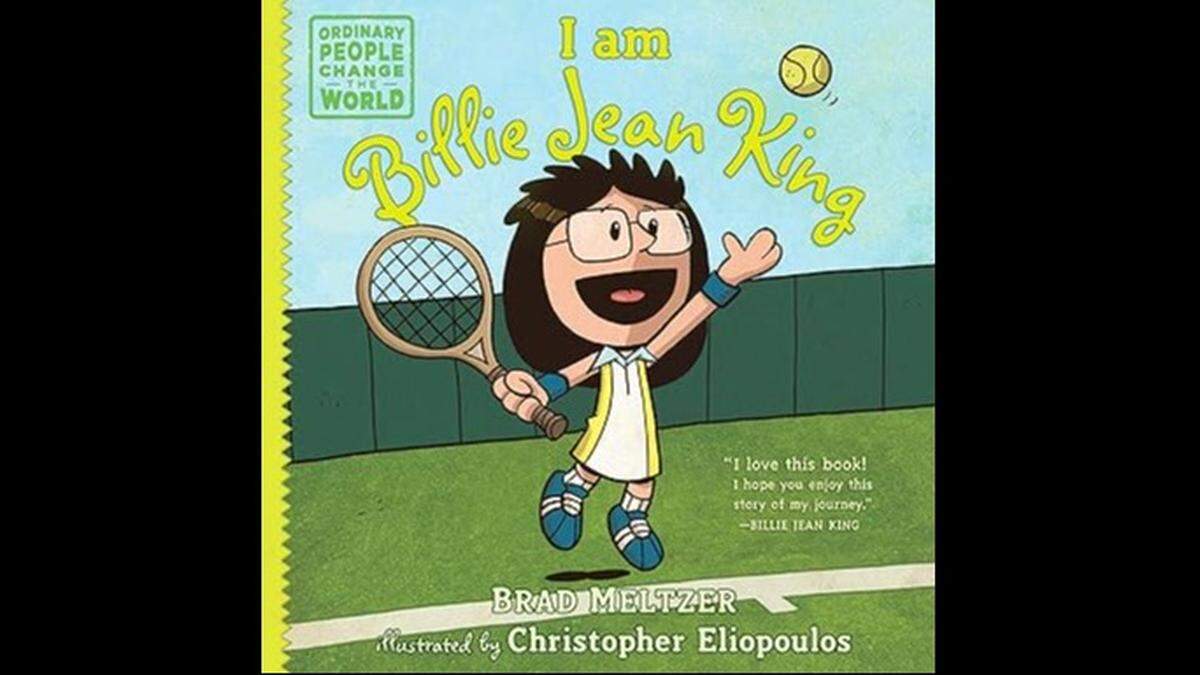
Written by Brad Meltzer and and illustrated by Christopher Iliopoulos, “I am Billie Jean King” is part of a series on famous people like Neil Armstrong, Lucille Ball, Marie Curie, Leonardo da Vinci, Albert Einstein, Jim Henson, Helen Keller, Jackie Robinson and George Washington.
The children’s biography of King is filled with beautiful messages such as “Fair play. It’s such a simple idea. In sports and in life, it means you respect the rules and treat everyone equally.”
And “Girls can enjoy sports just as much as boys. Today many dads encourage their daughters to play sports. But back when I was growing up, my dad was one of the first.” And “Often, the right teacher can change your life.” And “All of us are powerful in our own ways.” And “Real victory doesn’t come from points scored. It comes from how you treat others in the game.”
The book also has this description: “Being gay means that if you’re a girl, you love and have romantic feelings for other girls — and if you are a boy, you love and have romantic feelings for other boys.” Just below that, cartoon word bubbles from the King character in the book share this, “Eventually Larry and I stopped being married and I fell in love with a wonderful woman named Ilana. You can’t choose who you fall in love with. Your heart will tell you.”
‘Not how America works’
After The State reported on the book’s removal, Meltzer wrote on Facebook, “Billie Jean King is one of the great heroes of our time — and because of one parent, an entire community in South Carolina now can’t learn about her. My hope is that reason and common sense will prevail over fear and baseless hatred.”
He added, “And for those about to defend this in the comments: If you don’t want to read it, don’t read it. But you don’t get to force your views on what everyone else reads. By that logic, a parent can say they’re offended by the Bible and they would have to pull it from the library. That’s not how America works. Even Florida said this book was age appropriate. If you’re on the side of book bans or making books harder to read, you’ve revealed yourself.”
The post kicked off an interesting conversation about matches made in heaven.
A commenter asked Meltzer, “Legitimate question here — why was her sexual orientation even mentioned in a book for kids? They don’t give the first fuzzy squirrel’s tail about whether someone likes the same or opposite sex. They just want to know how the individual changed the world. I am certainly not for banning books, and I’m definitely not for censorship. That’s not how America works, at all. I just am asking a question.”
Meltzer replied, “We mentioned she’s gay because she is — and that made her a hero too at a time when people were afraid to say that. So historically relevant to the story. And at that age, there are plenty of people who have a gay relative for mothers or fathers. And I want them to know that their hero is the same. The same way Jewish readers want me to mention that Einstein is Jewish, or Frida Kahlo is Hispanic. Seeing yourself matters to people, especially in that historical context.
“But more important, if you’re against the mere mention of someone being gay, you’re treating that word as if it’s toxic or something bad. I do appreciate your open ear here. But she was the first openly gay superstar. That’s her story. Not mentioning it would be a serious omission. And just to be clear, in ‘I am Sally Ride,’ we didn’t mention she was gay because that wasn’t a primary part of her story. But it was for Billie Jean King. That mention may not matter to you. But it absolutely matters to the community. Again, appreciate the earnest question. Unlike the people who are writing that hiding something in another teacher’s office is the same as having something on a library shelf.”
Similar sentiments were shared among the eight people criticizing the restriction of the book at Monday’s school board meeting. No one spoke in favor of the restriction.
‘Conversations with kids’
Parent David Jenkins spoke of the state’s recent, nation-leading spate of book challenges. “It is disturbing that South Carolina is now known for the fact that we’ve banned more books than any other state, and it’s a race to the bottom. Reading is fundamental to a functioning society. And getting kids to read is difficult. Often all it takes is finding a book that speaks to them. But we are banning books. Has this improved scores in our district? Has it helped attract and keep quality teachers in our district? Has it reduced bullying in our district? All banning books has done is create outrage and division in our community. Please focus on improving our schools.”
Parent Annie Mahaffey added other context. “What about Cinderella or Beauty and the Beast? Why is it OK for a 5-year-old to ask about romantic feelings between Belle and the Beast and not between Billie Jean King and her partner? That is viewpoint discrimination.”
Former district preschool teacher Kathryn Brookins discussed a time her students brought in family photos for classroom display and one student had two mothers. She said she would have had to stop that student from sharing anything based on the district’s logic.
“The families and students that make up Lexington-Richland 5 are varied and diverse,” Brookins said. “All should be respected and treated with dignity. It is not the school district’s job to determine which families and individuals should be celebrated and which ones should not.
“It is unacceptable to make students feel like they themselves or their families are ‘less than’ just because they are or have parents who are part of the LGBTQ community,” she added. “In removing a children’s book just because there is a gay character, the district is implying that being gay is wrong and shameful. That may be the opinion of some individuals. But gay people exist, regardless of opinion, and their existence should not be censored.
“You said it’s up to parents to answer the question of what romantic feelings are in an age-appropriate way, and that’s fine,” she continued. “But why is it that you’re only banning a book with a gay character? What about the romance in Rapunzel, Snow White, Sleeping Beauty?”
Former Irmo Middle School teacher Reina Floyd, who still works in the district, shared a story about how her son read a book in fourth grade that mentioned a game of spin the bottle and “making out.” She didn’t feel it was appropriate for him so she talked to the teacher, who asked if she wanted it pulled from shelves. She said no, that this was a conversation for her family.
“I felt like it was using napalm when all I needed was some weed killer,” Floyd said. “Challenging a book is being used in such a way that avoids uncomfortable but necessary conversations between parents and teachers and librarians. Just because I didn’t feel it was developmentally appropriate for my fourth grader didn’t mean I wanted to keep it from fifth graders or maybe more mature fourth graders. Honestly, parents who are unwilling to have tough conversations with their kids should be grateful that such books are available for their kids.”
‘Effective immediately’
To his credit, superintendent Ross took responsibility for the decision and reconsidered it.
“I do like what the last speaker said,” he told the board. “This provides an opportunity for family discussion.” He said he would remove the book’s restrictions “effective immediately.”
Ross added that any family who does not want or is not ready for their children to have a conversation about what’s in this book could let the district know.
This was a public process working as it should in a public school system. A parent raised an issue about their family. The district did what it thought was best. The public weighed in. And the book was restored to bookshelves, readily available for those who want to read it.
Will there be a formal district challenge and might it eventually be elevated to a state board of education that has now banned 21 books and restricted one other for depictions or descriptions of “sexual conduct” to lead the nation in book bans this school year?
Is it possible that the phrase “romantic feelings” would even rise to that level?
Time will tell.
But as Billie Jean King showed 50 years ago, time creeps and sometimes leaps toward progress.
Game by game. Set by set. Match by match.
This story was originally published May 22, 2025 at 5:00 AM with the headline "Billie Jean King deserved better from a South Carolina school district | Opinion."