
Here’s how Beaufort County Council can shed its secretive image in a single vote | Opinion
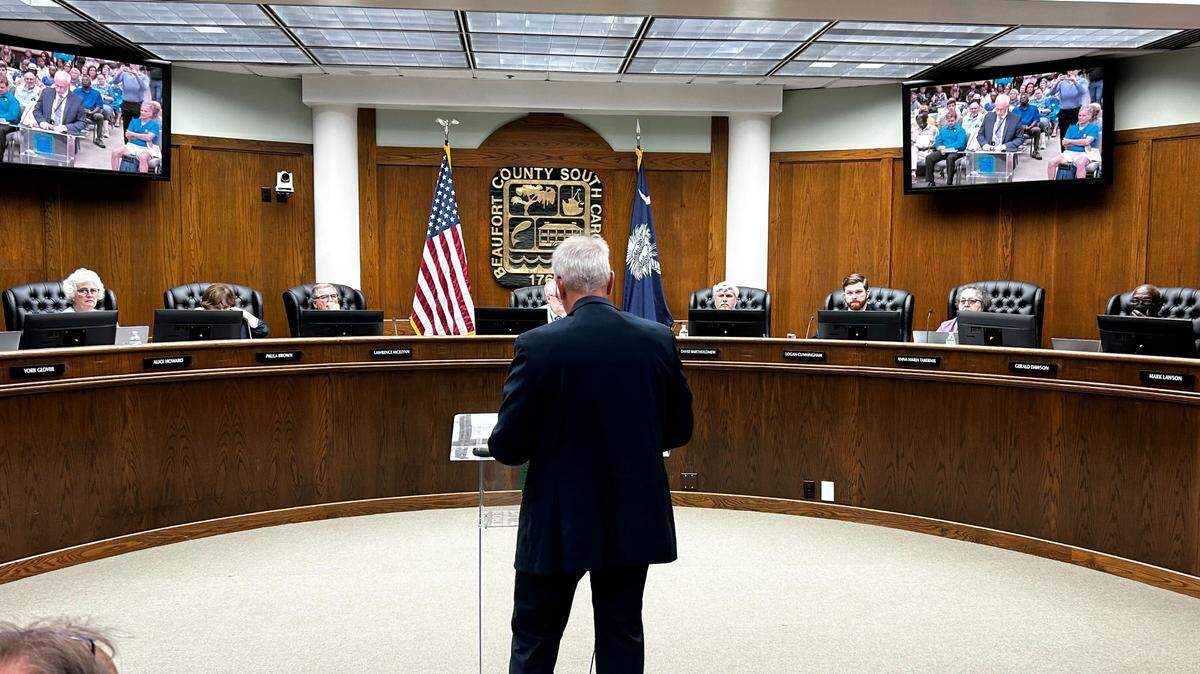
This year all I want for Christmas is for the Beaufort County Council to embrace open government and transparency, as required by state law. I guess there’s always next year.
The council I’ve called the most secretive in South Carolina is at it again. This time, County Council Chair Joe Passiment faces criticism for a private meeting of selected council members, Hilton Head Island Town Council members and government support staff. They met to discuss how to pay for the U.S. 278 bridge project that was put at risk after voters rejected a sales tax increase to help fund it.
County Council member Tom Reitz, who represents Hilton Head Island and thousands of residents who regularly drive the bridge, is upset he was not invited, so I called Reitz and Passiment to discuss whether Beaufort County is being secretive about public business.
Spoiler alert: It is.
Reitz said he just wanted the chance to attend the Friday, Dec. 6 meeting — and others like it affecting constituents. Passiment says the law prevented it because he invited five of the 11 council members and having a quorum of six would have made it a public meeting.
Both Passiment and Reitz acknowledge that the public’s perception is that the council is not always transparent. Yet when the chair says it is “as transparent as we possibly can be,” Reitz scoffs.
He’s not alone. Beaufort County has truly earned its “most secretive” moniker this year.
In the public portion of the council’s Monday, Dec. 9 meeting, Felice LaMarca, a real estate agent on Hilton Head, addressed the chair directly about the earlier private meeting: “You need to establish some trust with us, and Mr. Passiment, what happened Friday didn’t do that.”
Later in the week, Council member Paula Brown emailed her council colleagues to say, “The decision(s) made at last Monday’s executive session were a bit hasty, in my opinion. The issues we discussed should have been part of a public dialogue in an open meeting.”
Now Reitz is so fed up he says Passiment shouldn’t be re-elected chair in a vote set for Jan. 2.
“Some of us operate with transparency and honesty and obviously this meeting shows that some don’t,” Reitz said of the County Council and its Dec. 6 private meeting. “The council needs to make the change to show the people that we truly believe what we say and we say what we mean.
“We just have to stop this backroom dealing,” he added. “Have as many meetings as you want. I don’t need to go to all of them. But I should have the option to go when it deals with the constituents I represent.”
Passiment doesn’t see it as backroom dealing, and he bristles at anyone calling it secret. Rather, he said, it was a meeting of a council “subcommittee,” held without the council quorum that would require it to be public, so elected officials and staff could candidly discuss options.
The problem is that Passiment is misinterpreting the law, which is designed to ensure that public business about public money spent in the public interest is being done in public, not in secret.
“Tom Reitz believes we should have everything in public,” Passiment told me. “That’s fine, but that doesn’t mean it’s the right thing to do. There are times you have meetings because you have to get information out to each other before you bring it to council. It’s not any secret.
“That’s why we have committees,” he said. “Committees don’t have to meet in public.”
But they do. The South Carolina Press Association says it plainly in a Q&A about what’s covered by the state law mandating that records and meetings of public bodies be open to citizens and their representatives in the press: “Committee and subcommittee meetings are included.”
That means that Passiment was wrong when he declined to tell me the name of the “subcommittee” or the names of the council members on it. “I’m not telling you that,” he said. “That doesn’t have to be public knowledge.”
If you needed more proof that he and Beaufort County administrators are too intent on keeping matters from the public, there’s this: The administration launched an investigation into staff leaks of what may be sensitive information last week. Passiment said the probe will lead “wherever it leads.”
Following up private meetings with such a probe — while being criticized for failing to release a report on a real probe into employee misspending — only makes matters worse for a county that should focus on residential, business and infrastructure improvements, not on witch hunts and cover-ups.
Look, Passiment’s vision for Beaufort County is a good one. He says, “We’re growing but we’re not growing as fast as surrounding counties,” and “We could be left behind,” and “If you’re not growing, you’re dying.” He pushes back on those who say the county shouldn’t grow or change.
He values tourism and envisions growth in fields like healthcare and aerospace technology. He wants to ensure military members are “well taken care of in this county.” And he wants a plan for the U.S. 278 corridor project that was the subject of this month’s controversial meeting.
Passiment has what you want in a chair: a vision and the ability to articulate it. But he also has an aversion to the openness that residents demand and deserve. There are too many examples of it now. It’s time for Passiment to pass the torch. It’s time for transparency and a new chair.
The Beaufort County Council should elect a new chair on Jan. 2 and stop saying it is being transparent when it is not. Passiment would still be at the table and bring a lot to it. But someone who won’t hesitate to hold public discussions in public should lead them.
This story was originally published December 20, 2024 at 6:00 AM with the headline "Here’s how Beaufort County Council can shed its secretive image in a single vote | Opinion."