
Why I’ll vote ‘yes’ for the Beaufort County school bond referendum | Opinion
Beaufort County’s support for public education runs deeper than its treasured rivers, wider than its golden marshes — and for as long as there has even been such things as public schools here.
Native son Robert Smalls of Beaufort — an enslaved person turned Civil War hero and U.S. Congressman — can be called the father of free, compulsory public education for all in South Carolina. It’s with that legacy in mind that today’s beneficiaries should go to the polls on Tuesday, Nov. 7, and vote “yes” on a Beaufort County School District bond referendum.

The school board is asking for permission to raise $439 million to build, replace, upgrade, refurbish and make safer public schools across this growing county. It proposes to do that without a tax increase.
It wants — actually, needs — to keep alive momentum established by a $345 million referendum approved in 2019 by almost 70 percent of voters.
Beaufort County people are not pushovers. Voters resoundingly defeated referendums in 2016 and 2018 when they rightfully could not trust the superintendent or dysfunctional school board at the time.
Voters did the right thing then, and I expect them to do the right thing Tuesday with a resounding “yes” vote. For more than 150 years, big sacrifices and bold moves for education have been the norm here.
Smalls was elected to the Beaufort County school board before he served as a delegate to the 1868 state constitutional convention in Charleston. It was there that “on the issue of public education, Robert Smalls stepped to the front and led the convention,” says the second volume of our county’s history written by Stephen R. Wise and Lawrence S. Rowland.
The historians tell us that this hugely successful man who had very little education “offered a resolution that inserted an article in the constitution providing for ‘a system’ of common schools ‘to be open without charge to all classes of persons.’ ” He sought “six months of free public education per year for all children from ages seven to 14” and he wanted it to be compulsory.
That laid the constitutional foundation for the public school system of South Carolina, the historians say, adding that beyond the many lasting contributions of Smalls to the history of Beaufort County, “his contribution as a principal founder of South Carolina’s public schools was probably his most influential.”
Nobody said it was going to be easy, and it hasn’t been. But from the beginning, we have seen the public go farther than the accepted norm to provide for education.
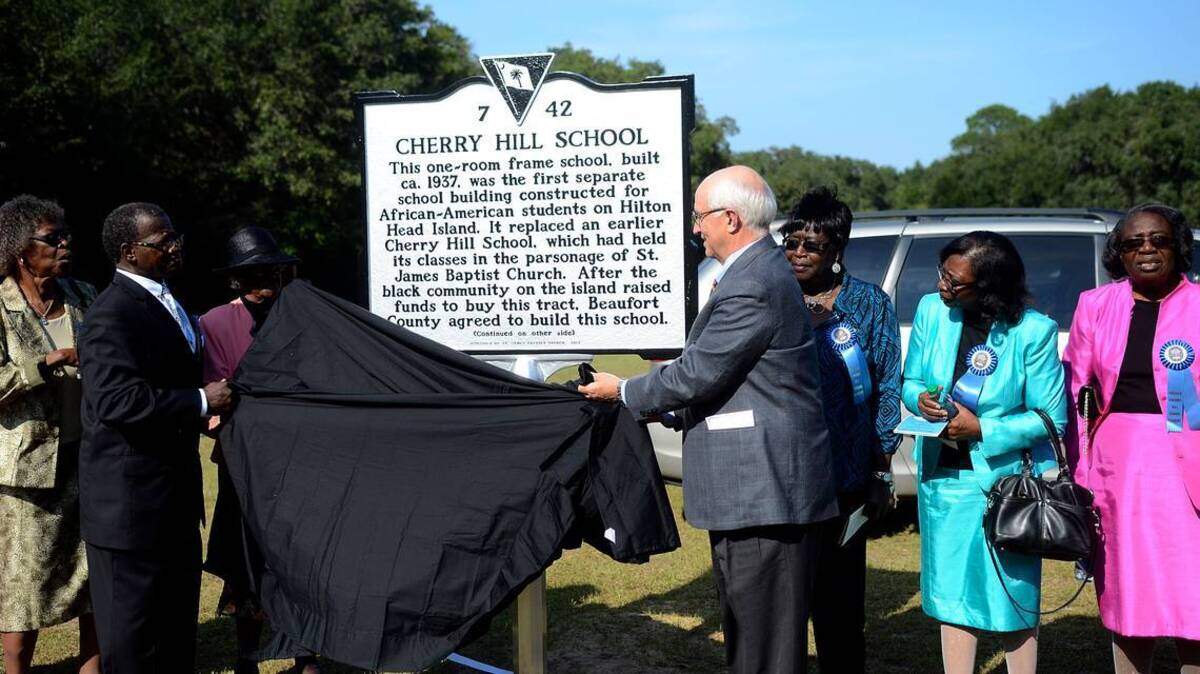
On Hilton Head Island, the small, wood frame Cherry Hill School stands as a rare, tangible exhibit. It was built by the county in 1937 to serve Gullah elementary school students of the Baygall and Cherry Hill area. But the county did not do that until the local cash-poor parents raised money to buy the land. Then, the parents continued to support it with maintenance and upkeep.
Those parents were following their forebears, who supported “missionary” school teachers from the Northeast to educate freedmen here during the Civil War by providing cut firewood, shucked oysters and a horse for transportation. And they followed the freedmen of the Mitchelville village that sprang up during the Civil War down the road, a village that pioneered compulsory public education.
In northern Beaufort County, the Christensen family underwrote an entire school campus that was eventually folded into the public school system as the Shanklin School.
Over the years, the public has chipped in for transportation, artists in residence, additional staff positions, school stadium construction, campus beautification, student mentoring, perks for the Teachers of the Year, discount cards for teachers in local stores, grants for innovative classroom projects, trips to the nation’s capital, extra support for theater and athletics, job-shadowing and career fairs, help with uniforms, after-school learning programs, and backpacks of nutritious food for the weekends.
And yes, it has required many a “yes” vote to keep up with an endless challenge — and one of our proudest traditions.