Is Saharan dust storm, Canadian wildfire smoke headed to Hilton Head soon?
Local and vacationing beachgoers, golfers and people walking the local paths can look up and see unexpectedly hazy Hilton Head skies accompanied by glowing red sunsets this week.
Smoke from Canadian wildfires and a massive formation of African dust riding the high altitude across the Atlantic will bring some unusual sunsets, slightly lower comfortable temperatures but lower air quality.
First to arrive, wildfires burning in three Canadian provinces are once again blowing down into the Lowcountry from now to the middle of the week. Once that smoke moves offshore later this week, it may be replaced with dust blown all the way across the Atlantic Ocean from the Sahara Desert, according to National Weather Service Meteorologist Douglas Berry.
Wildfire smoke has been moving through the upper levels of the atmosphere and into the region. The haze brought a red hue to the sky during sunsets and sunrises in the last few days.
Expected air quality levels
The U.S. Air Quality Index lists the area as having “moderate” air quality on Monday. This reading is generally acceptable, though members of sensitive groups and those that are sensitive to air pollution are encouraged to consider reducing their activity or shortening their time outdoors.
The smoke will largely stay above the ground and won’t affect visibility in the coming days, Berry said.
He expects this smoke to move offshore around Thursday, though the air quality readings may still be unchanged due to Saharan dust blowing into the Southeast United States with Florida at the center of the weather service’s forecasts.
The mass of dusty, dry air forms every year over the Sahara Desert, when “tropical waves,” or a long area of low pressure, forms from differences in temperature in the southern region of the desert. This system usually picks up around mid-June and lasts until mid-August.
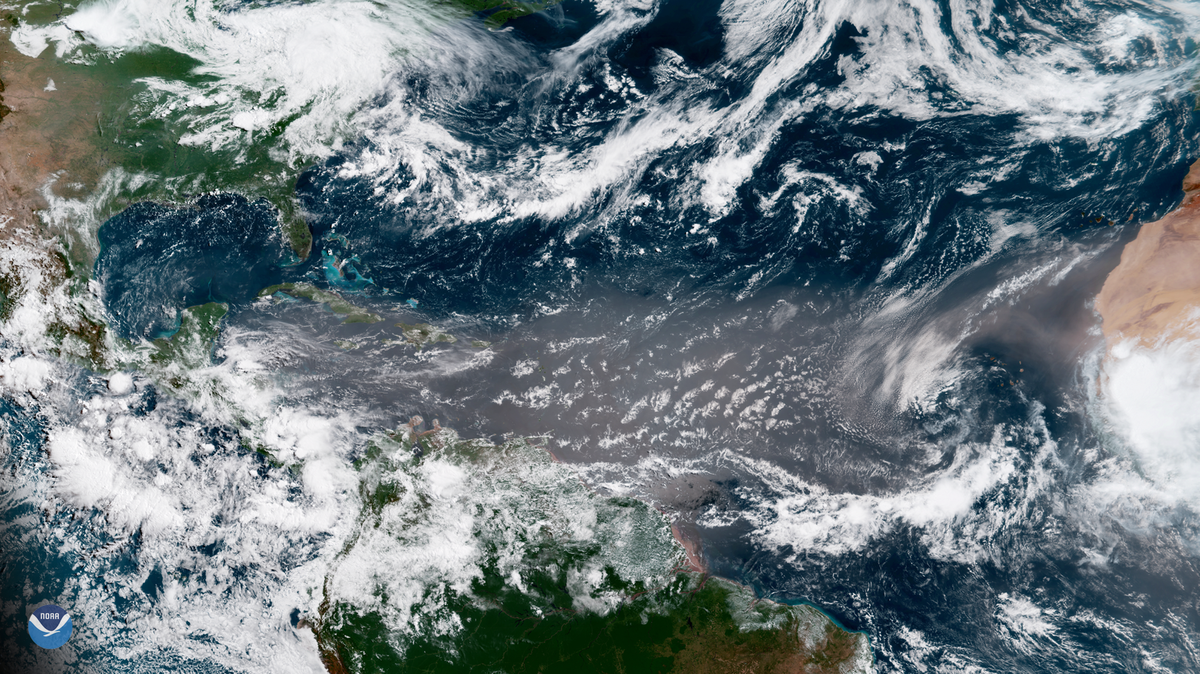
Using satellite images, researchers with NOAA noted this bout of dust start moving on off Africa in late May. At the moment the dust cloud is sitting over the eastern Caribbean and will likely reach Hilton Head on Thursday morning, according to Jason Dunion, a meteorologist who studies hurricanes and Saharan dust, said.
When the dust cloud blows over, anyone on a morning beach walk will be able to see a “brilliant orangey sunrise” and a hazy sky, Dunion said. Those interesting sunrises and sunsets occur because the dust particles are irregular shapes, and the cause the sunlight to scatter differently.
A long journey
The winds lift up to 60 million tons of dust. Those particles then begin their mile journey across the Atlantic Ocean. As they move, the dust creates a two-mile-thick layer high above the surface of the ocean, according to NOAA.
The clouds of dust often become as big as the lower 48 states, Dunion said.
“This [cloud] will have traveled 5,000 miles by the time it gets to you guys, which is pretty incredible,” he said.
The silver lining in the sky
The dry, warm air and strong winds propelling the dust can help suppress the formation of hurricanes and other tropical storms. Researchers think the dust itself makes it harder for clouds to form and fall as rain. The Saharan Air layer, which contains the hot, dry, dust-filled air, cuts through part of the atmosphere that needs to be moist for hurricanes to form. The surge of air that accompanies the dust storms also pulls apart storms that are in the process of developing. Data collected by weather balloons showed winds in that dusty air layer reached around 50 miles per hour Dunion said.
“That tends to rip the clouds apart,” he said.
In addition to limiting hurricane formation, the dust contains nutrients and minerals that microscopic plants at the base of the food chain need to live. So as the Saharan dust blows across the ocean, it these organisms use different components of the dust to grow and reproduce.
Should the dust survive the trip across the Atlantic, its first stop will likely be Florida and other Gulf states.
This story was originally published June 3, 2025 at 8:41 AM.