Update: Lee now a Category 2 hurricane. Here’s when coastal South Carolina could see impacts
While Hurricane Lee stayed in a steady state overnight and into Thursday morning, National Hurricane Center forecasters said significant strengthening of the storm would begin ramping up in the afternoon and into the weekend.
As of 11 a.m. Thursday, it already had.
Lee reached Category 2 hurricane status before noon, packing 105 mph maximum sustained winds. The storm was moving 15 mph west-northwest about 870 miles from the Northern Leeward Islands, an 11 a.m. center advisory said. The Leeward Islands are a cluster of islands situated where the northeastern Caribbean Sea meets the western Atlantic.
Lee is expected to reach its peak intensity this weekend, with its core moving north of the northern Leeward Islands, the Virgin Islands and Puerto Rico. Tropical storm conditions could effect some of those islands over the weekend.
“The question doesn’t appear to be if RI (rapid intensification) continues, but rather how strong Lee will get, and how quickly will it get there,” a center report said Thursday.
Forecasters predict that this weekend, swells spawned from Lee will reach parts of the Lesser Antilles, the British and U.S. Virgin Islands, Puerto Rico, Hispaniola, and the Bahamas and Bermuda on Friday. The increased wave heights can cause life-threatening surf and rip current conditions.
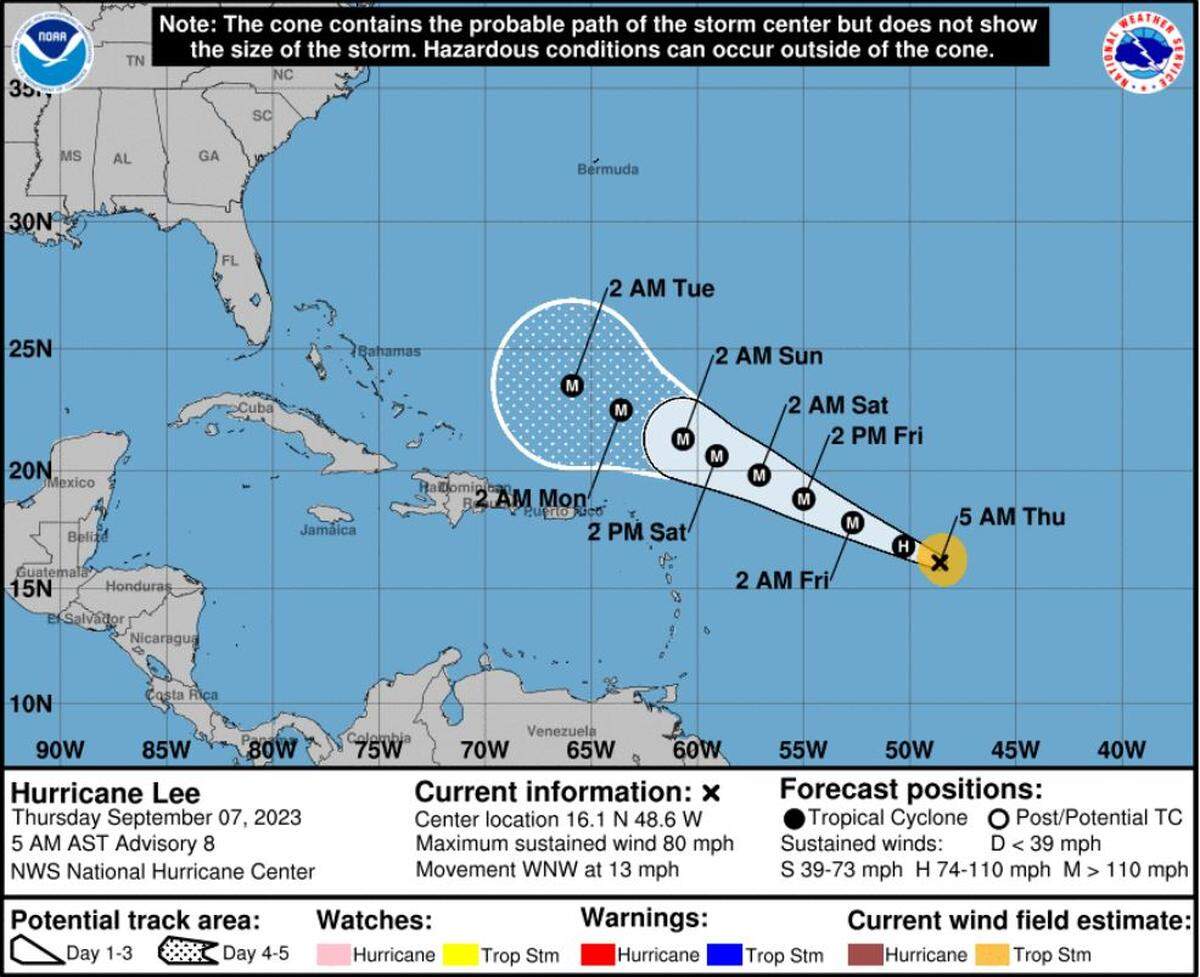
Within the next two days, forecasters say Lee’s winds could reach at least 157 mph, which would make it a Category 5 hurricane.
“Fluctuations in strength are likely from days 3 to 5 due to potential eye wall replacements, but Lee is still expected to be a dangerous hurricane over the southwestern Atlantic early next week,” a 5 a.m. National Hurricane Center discussion document said. Thursday
Will Hurricane Lee impact South Carolina?
The National Weather Service’s Charleston Office said between Friday and Tuesday, “there could be a considerable change in seas due to long period swells arriving from distant Tropical Cyclone Lee well off shore.”
Part of Hurricane Lee’s track depends on “how strong and expansive the Bermuda-Azores high is at the time,” said Jonathan Erdman, a senior meteorologist at weather.com. Ultimately, the high pressure system acts as a “steering wheel” of the hurricane.
If the Bermuda-Azores high is weaker and less expansive, it means the hurricane could re-curve into the central Atlantic and not threaten the United States’ mainland. But if the high is stronger, more expansive and builds westward, it could move the storm farther west and “become a threat” to parts of the United States’ East Coast.
Still, it’s too soon to know whether Lee would cause any destruction. Many spaghetti models — a data visualization method that shows possible storm tracks — show the storm curving north in the Atlantic and staying far from shore. The closer together those lines are, the higher the confidence in track. Current models depict Hurricane Lee moving northwest and leaving Bermuda more at risk than the United States.
Still lingering
What was labeled a disturbance in the tropical eastern Atlantic early Thursday morning, strengthened into a tropical depression before noon. Tropical Depression 14, 150 miles west of the Cabo Verde Islands has maximum sustained winds of 35 mph and is moving 17 mph. west-northwest.
National Hurricane Center forecasters believe the depression will gain enough strength later Thursday to be deemed a tropical storm. If so, and if no other storm beats it to the punch, the tropical storm would be named Margot.
This story was originally published September 7, 2023 at 9:29 AM.