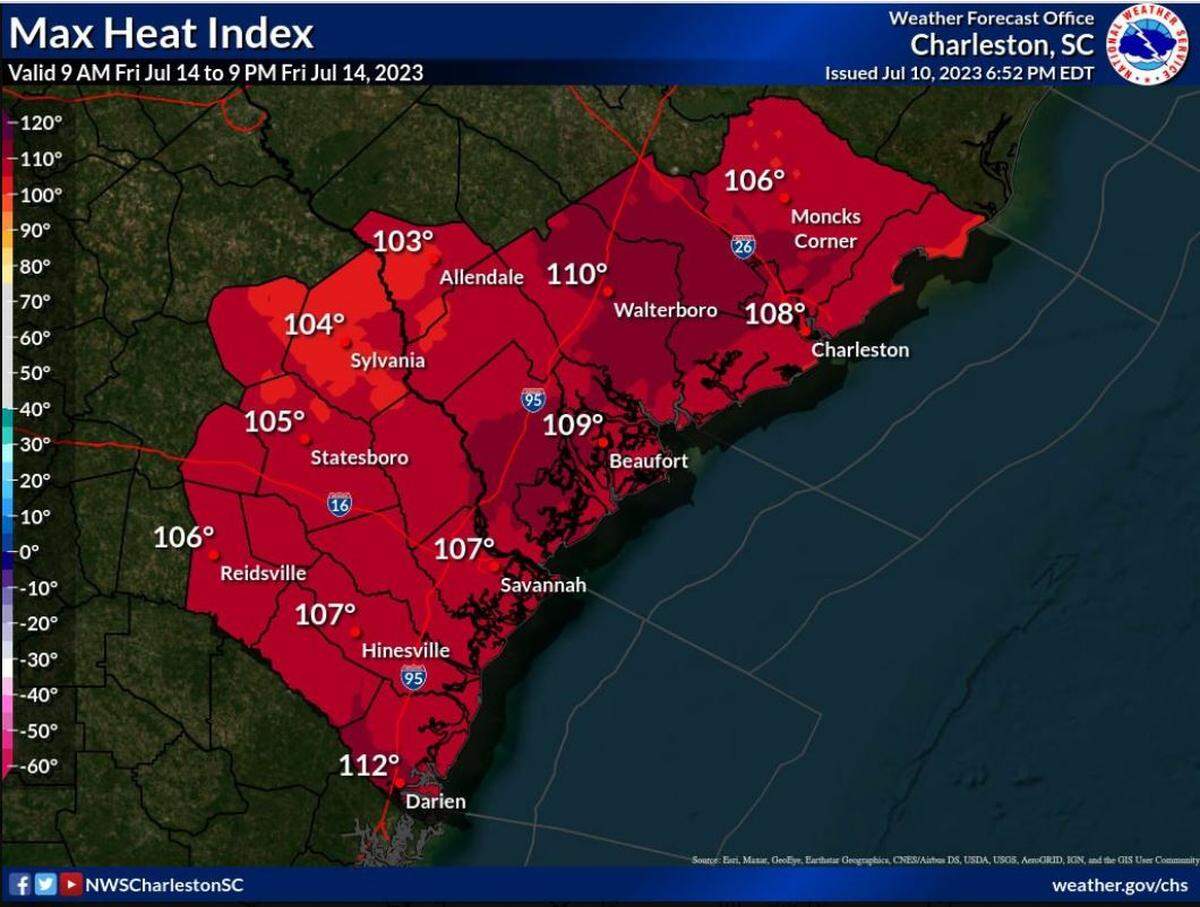
‘Be cautious.’ Beaufort County is going to heat up more this weekend. Could it feel like 112?
Relief from blistering temperatures in the Lowcountry isn’t coming any time soon. Not even in the evenings.
A slightly hotter-than-normal and muggy weather pattern will settle into Beaufort County starting Friday and lasting through Tuesday, with weekend heat indices that could make it feel like 112 degrees.
Sunday will reign as the most oppressively hot day, reaching highs between 96 and 97. Once the heat index pushes to 110, the National Weather Service sends out a heat advisory. The service classifies a heat advisory as a maximum heat index temperature expected to be 100 or higher for at least two days, and it’s accompanied with evening air temperatures that do not fall below 75.
If the NWS Charleston Office’s predictions hold, it’s possible the service will issue heat advisories, most likely between 11 a.m. to 8 p.m., said Meteorologist Douglas Berry. And the advisories are nothing to ignore.
The effects of heat can be pernicious, particularly when coupled with humidity.
Maybe a beach-goer feels the warmth but is duped by the harm its caused because of the ocean breeze, which tends to trick the mind that it’s slightly cooler. People who spend too much time in inferno temperatures risk heat exhaustion and, even more seriously, heat stroke.
“You have to be cautious,” Berry said of heading to the beach during an advisory.
That means staying hydrated, rescheduling outside tasks to the early morning or evening, avoiding the beach at peak temperature hours, lathering on the sunscreen and trading hours baking in sun for sitting in an air conditioned room.
Excessive heat is insidious and kills more people most years than hurricanes, floods and tornadoes combined, according to the Scientific American.
During dangerous heat, check on neighbors and friends, particularly the elderly, people with chronic conditions, pregnant women and infants. Children and pets should never be left alone in cars. Since the beginning of the year, 11 children have died from vehicular heat stroke in the United States. That’s three more pediatric deaths in about a week’s time.
On Tuesday morning, over 40 million people were affected by heat advisories, mostly covering Miami and broad swaths of Texas, according to the NWS and the National Oceanic and Atmospheric Administration.
Sure, the South has long been hot in the summers. But the Intergovernmental Panel on Climate Change’s 2021 report on the physical science basis of climate change showed extremely hot days have become more persistent and intense since the 1950s in most regions across the world. That trend is expected to continue with climate change driving an increase in hot days, the report said.
In the Lowcountry, local meteorologists say the area is forecasting temperatures “a little bit” above normal for this time of year. However, this week won’t have any record-breaking days.
Evenings won’t be the cool down some hope for, only dropping to the upper 70s, Berry said. And if you want relief, you best bet on rain.
Heat exhaustion vs. Heat stroke
The Centers for Disease Control and Prevention urges people to learn signs of heat exhaustion and heat stroke. Both conditions require that the person move to a cooler place, have cool cloths placed on them or get in a cold bath.
People experiencing heat exhaustion can sip water, but medical help is needed if they’re vomiting, symptoms are worsening or last longer than an hour. A heat stroke victim is a medical emergency that requires a 911 call. The person should not be given anything to drink.
Heat exhaustion:
- Heavy sweating
- Cold, pale and clammy skin
- Fast, weak pulse
- Nausea or vomiting
- Muscle cramps
- Tiredness or weakness
- Dizziness
- Headache
- Fainting
Heat stroke:
- Body temperature of 103 or higher
- Hot, red, dry or damp skin
- Fast, strong pulse
- Headache
- Dizziness
- Nausea
- Confusion
- consciousness
This story was originally published July 11, 2023 at 12:48 PM.