Suit filed to stop massive data center near nationally renowned nature preserve in SC

Landowners opposed to what their attorneys say would be the state’s largest data center are suing to stop the venture over concerns it will disrupt their rural community and hurt the ACE Basin, a nationally known nature preserve in South Carolina.
The Southern Environmental Law Center filed the suit in state court Friday on behalf of Miles Crosby and Jennifer Singleton, who are among hundreds of Colleton County residents who have spoken out about the data center planned by Eagle Rock Partners. The suit, which challenges an ordinance making it easier to build the data center, names Colleton County as the defendant.
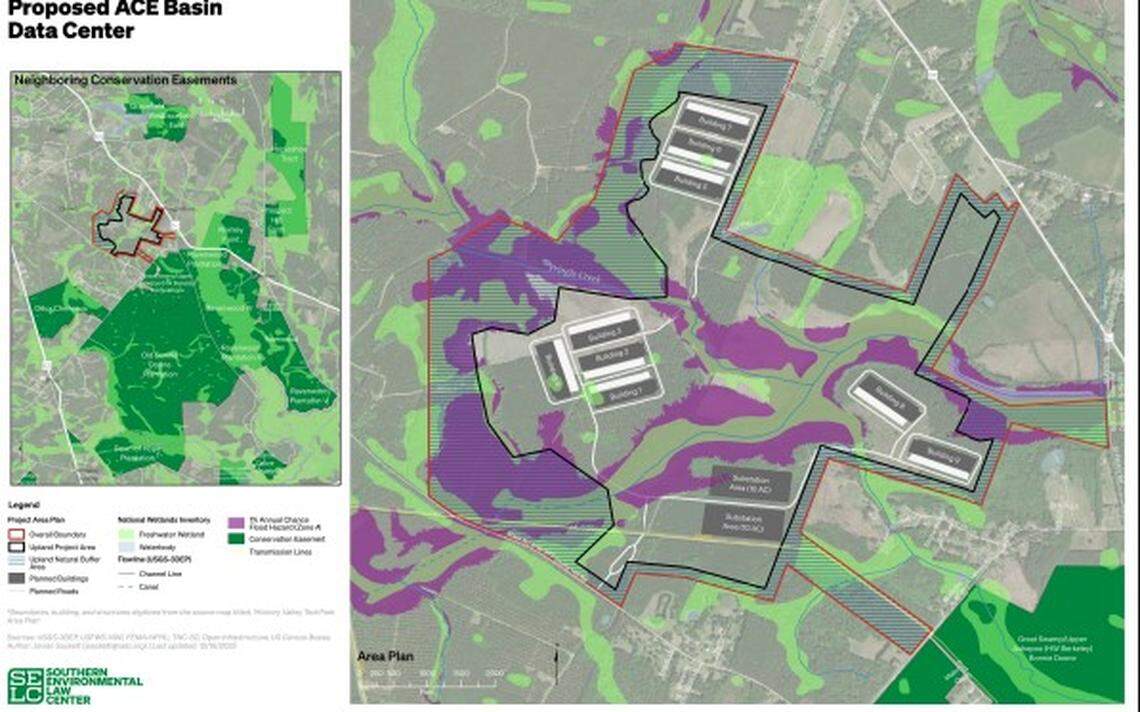
As proposed, the data center would be built on 859 acres of private land. The property has not been protected from development but is near properties that have been preserved in the ACE Basin. The nine-building data center campus would disturb more than 400 acres of forests and some wetlands, the lawsuit says.
Crosby and Singleton live on property near the proposed data center outside Walterboro. Crosby’s land could be surrounded on three sides by the data center, while Singleton’s is across the street, court records show. The data center would hurt wildlife and limit hunting opportunities for the private landowners, while also limiting their chances to hike, the suit alleges. Singleton says she retired to her property because of the natural surroundings. Crosby’s family has lived on the land since the 1940s, the suit says.
“As a lifelong Colleton County resident, I’m seriously concerned about the harm the data center construction would have on our rural community, local wildlife and the environment,’’ Crosby said in a news release from the Southern Environmental Law Center. “We cannot allow this ordinance to threaten our star-filled night skies, natural quiet, and enjoyment of landscapes with light, water and noise pollution,’
Colleton County officials were not available for comment. Colleton is a small county of about 40,000 people roughly between Columbia and the Charleston-Beaufort area.
The data center has been proposed as developers seek to locate more of the energy-consuming operations across South Carolina. The Eagle Rock data center would be the largest in the state and possibly one the biggest in the country, the law center says.
Data centers are facilities that support the internet and artificial intelligence by processing, storing and distributing large amounts of data, according to the lawsuit. South Carolina has about 40 data centers of various sizes, state environmental regulators say. Major environmental concerns about data centers are their need for large amounts of water and electricity.
In Colleton, the data center is projected to need as much as 1,000 megawatts of power, an amount that is roughly half of the energy that would be provided by a planned natural gas plant just down the road in Canadys, said Emily Wyche, an attorney for the law center. That is enough energy to power 800,000 homes, the lawsuit says.
But many see data centers like the one proposed for Colleton County as vital to the future economy. The Legislature last year dropped increased oversight of data centers from the final version of a sweeping bill intended to encourage more energy in South Carolina.
In an email Friday afternoon, Eagle Rock principal Terry Rennaker said the Colleton County data center will bolster the local economy and expand the tax base, which will help pay for schools, roads and other public services. He also said energy needed for the data center would be paid for “by us,’’ instead of ratepayers. The data center site is on land long used for industrial-scale timber production and would be setback from wetlands, he said.
Rennaker’s email emphasized that the Colleton data center would not place great demands on water because it would use a “closed loop’’ system, which typically means water is recirculated.
“We are committed to working collaboratively with Colleton County leadership to protect the watershed and will fully comply with all applicable environmental laws and regulations,’’ the email said.
At issue is the Colleton County Council’s vote in November to make special exceptions in a rural zoning law for data centers. When residents learned of the Eagle Rock data center plan, they packed a public meeting last month to protest the council’s action.
Wyche said the special exception isn’t legal or warranted and is in an area of South Carolina defined by its rural character. The location of a data center in Colleton would lead to industrialization and hurt the environment, she said.
“This zoning ordinance opens up a treasured and rural part of our state to industrial development and all the pollution and degradation that comes with it,’’ Wyche said in the news release. “Data centers don’t belong in the rural ACE Basin. Colleton County should be continuing the legacy of conservation in this area, not selling it to the highest bidder.”
The ACE Basin is a more than 350,000 acre area of forests, swamps, rivers and wetlands, of which more than 200,000 acres have so far been saved from development. The ACE -- named for the Ashepoo, Combahee and Edisto rivers -- is being protected through a combination of land purchases for the public and conservation easements, which are agreements with private landowners not to develop their property. The effort to protect property in the ACE is often touted as a national model for the preservation of natural landscapes.
Specifically, the lawsuit says the county failed to properly notify the public about exceptions for data centers when the council changed the law. The suit also says the ordinance violates state law because it is not in agreement with a comprehensive plan for the county and it violates the county zoning code.
This story has been updated with comments from Eagle Rock and information on the ACE Basin, as well as clarifying information about private landownership and the size of the data center compared to others nationally.
This story was originally published January 9, 2026 at 2:51 PM with the headline "Suit filed to stop massive data center near nationally renowned nature preserve in SC."