
Decades ago, a Murdaugh patriarch was the ‘brains’ behind a Lowcountry criminal enterprise
First of two parts
Minutes after his girlfriend was hurled to her death in a swirling Lowcountry creek, Anthony Cook spewed expletives about the young Murdaugh man he alleges was driving the boat.
“He ain’t gettin’ in no f---ing trouble,” the Hampton County teen blurted toward a Beaufort County Sheriff’s Office deputy in those chaotic wee hours three years ago.
Six young people were in the boat owned by Murdaugh’s father, Richard Alexander “Alex” Murdaugh of Hampton County, then a powerful attorney who also volunteered in the 14th Judicial Circuit Solicitor’s Office that his father, grandfather and great-grandfather ran for 86 years.
After the crash, the Murdaughs went to work immediately with a tried-and-true formula of brute power over the norms of authority.
Alex Murdaugh and his father, Randolph Murdaugh III, who has since died, were buzzing through the emergency room at Beaufort Memorial Hospital trying to manipulate a story line among crash victims.
In sworn testimony, Connor Cook, a boat passenger along with his cousin Anthony, would later say Alex Murdaugh told him that night to “keep my mouth shut and tell them I didn’t know who was driving and that he’s got me.”
That was only the beginning.
Today, Alex Murdaugh’s wife and the son who was on the boat were murdered, and Alex Murdaugh is in jail under $7 million bond, accused of 71 counts of stealing a total of $8.9 million from clients, associates and his law firm, as well as three other charges in an alleged botched murder-for-hire scheme.
It has turned the eyes of the nation to the low bottom of South Carolina. They wonder how our so-called justice system got this way.
Here’s how.
Fair warning came 66 years ago.
The family’s power could have ended when solicitor Randolph “Buster” Murdaugh Jr. — Alex’s grandfather — was indicted with 29 others in a federal case of widespread public corruption.
But by hook or crook, Buster Murdaugh didn’t “get in no f---ing trouble.”
COLLETON WHISKEY CONSPIRACY
Buster Murdaugh was a living legend in the poor southern reaches of South Carolina’s Lowcountry.
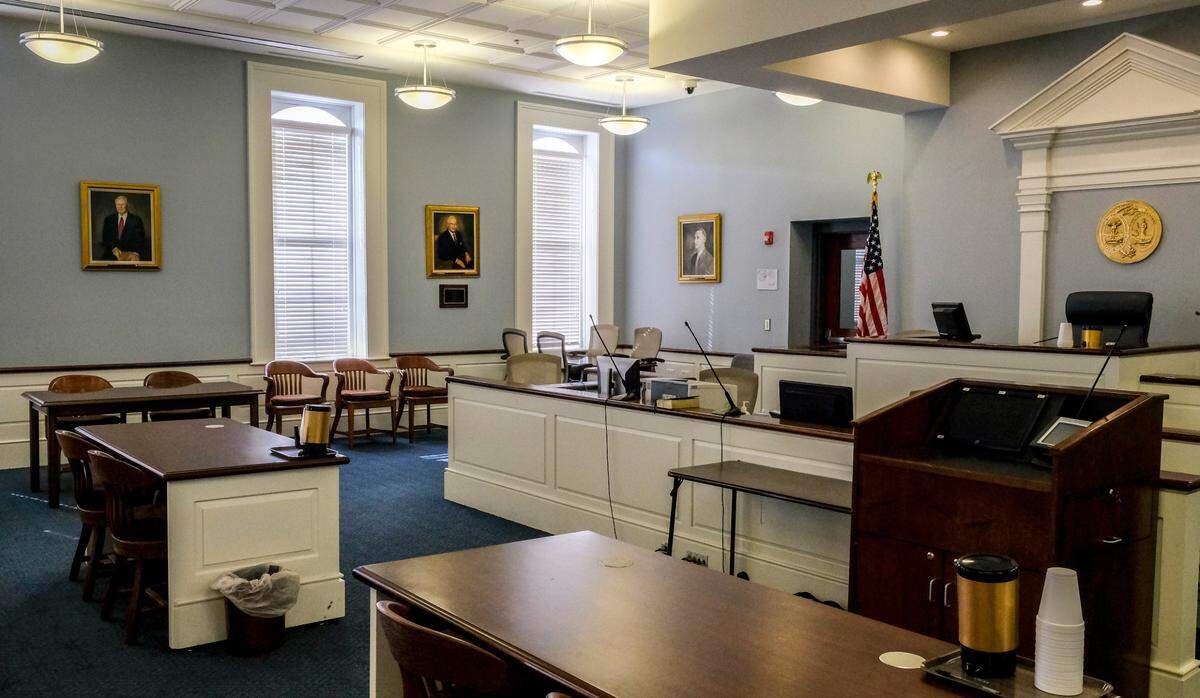
He died in 1998 as an honored man whose portrait hangs in the Hampton County Courthouse along with his son’s, Randolph Murdaugh III.
Buster Murdaugh was a stocky, outgoing man, the alpha dog in every courtroom in the circuit — and that included the judges.
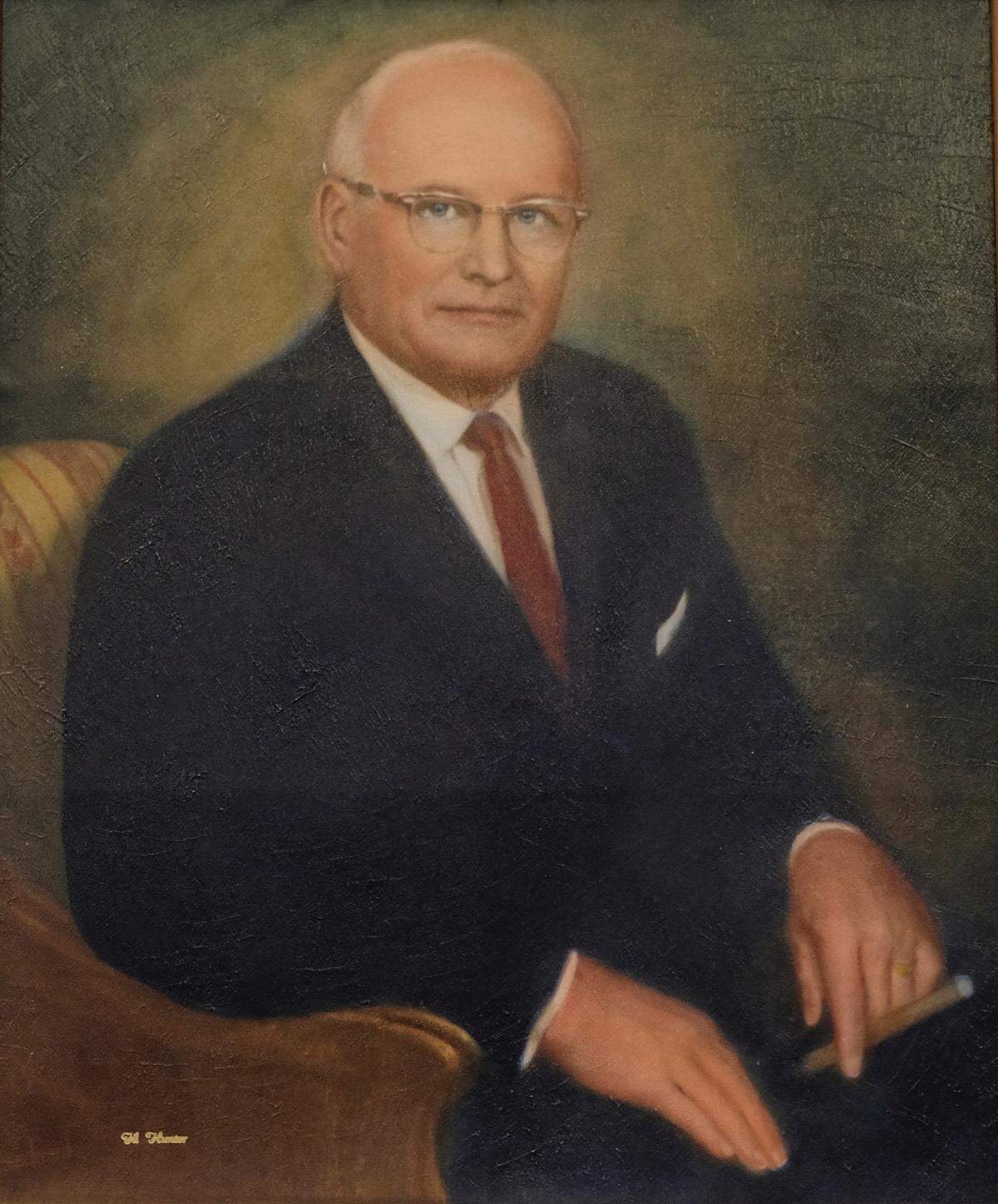
He was known for courtroom theatrics, a mouth constantly full of chewing tobacco, and unquestioned control of all criminal cases as chief state prosecutor in Hampton, Colleton, Allendale, Jasper and Beaufort counties from 1940 to 1986.
With his pockets filled with indictments, he controlled what went to trial and what didn’t, as well as when and why.
But in June 1956, the tables were suddenly turned on Buster Murdaugh. He was indicted by a federal grand jury in the bombshell “Colleton Whiskey Conspiracy.”
Law enforcement in Buster Murdaugh’s 14th Judicial Circuit was revealed to be a criminal enterprise.
The grand jury’s initial indictment list of 26 people included the Colleton County sheriff, three of his deputies, two former deputies and a magistrate judge, along with a host of bootleggers and businessmen. A second magistrate testified he was involved, but was not charged.
When Murdaugh was added to the indictment list later, he was accused of being part of a conspiracy that directed and personally profited from the flow of illicit whiskey on a grand scale in return for payoffs.
Testimony poured out in great detail, as The News and Courier newspaper in Charleston reported, showing defendants taking bribes, manipulating fines and staging friendly raids to falsely make it look like law enforcement was doing something about the rampant crime.
Also clinging to the case were accusations of tampering with jurors and witnesses, even the U.S. district attorney. The two key prosecution witnesses had to be protected by federal marshals during the trial.
Testimony showed that none of the corruption happened in a vacuum. Many hands were in the till. Disregard for the law was blatant. And the dirty laundry was aired for all to see.
JACKASS POND TO THE COURTHOUSE
The distillery that drew the U.S. Treasury Department’s Alcohol Tobacco Tax Division into what became a five-year investigation was operating in an open field three miles outside of Walterboro, the Colleton County seat.
It was so large people referred to it as “Schenley’s” — the name of one of the world’s largest legal liquor producers at the time.
Prosecutors said the conspiracy thrived with 32 moonshine stills that produced 90,000 gallons of illicit liquor over its investigation period.
Charleston was plodding through an exceptionally warm September when the fast-paced, two-week trial enthralled the Lowcountry — even as another “trial of the century” was taking place in Beaufort for the Marine drill instructor who led his recruits into Ribbon Creek on Parris Island, killing six.
Assistant U.S. Attorney Arthur G. Howe of Charleston called the Colleton whiskey scandal “the most important case ever tried in South Carolina.
“It reaches to the crux of our government and our way of life. It reaches from the swamps of Jackass Pond into the Colleton County Courthouse.”
And, many would say, it reaches into 2022.
BUSTER MURDAUGH NOT GUILTY
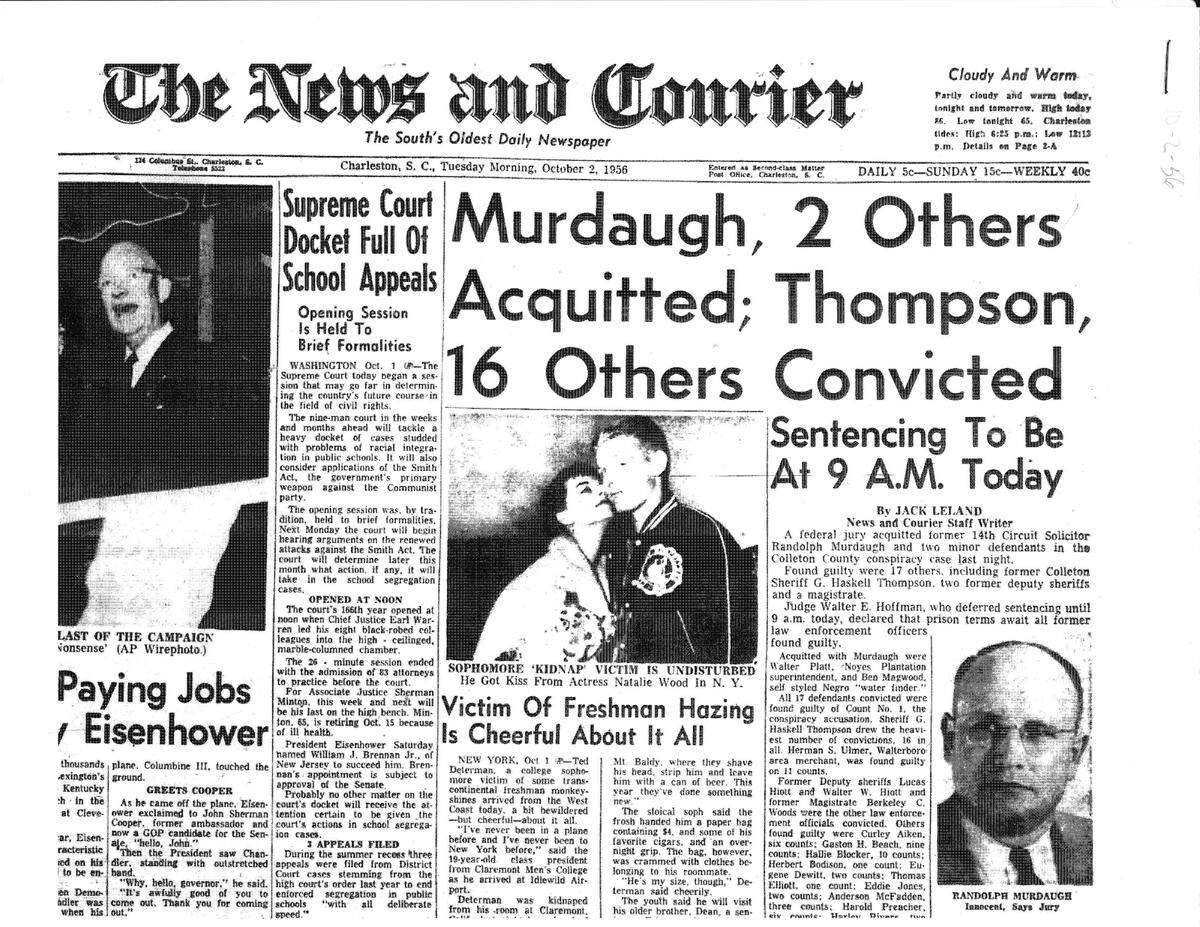
Buster Murdaugh walked away from Charleston’s famed “four corners of the law” a free man, even though prosecutors said he was the brains of the entire operation.
The jury acquitted only Murdaugh and two minor players in the conspiracy: a plantation property manager, and a man from the Green Pond area who could find underground water supplies for bootleggers by using a dogwood branch.
But visiting federal district judge Walter E. Hoffman of Virginia saw enough to call Murdaugh “grossly unethical.”
And a week after the verdict, a first cousin of Buster Murdaugh — a man named Alex G. Murdaugh of Orangeburg — was indicted on charges of attempting to influence a juror in the trial, according to news stories. He was found not guilty the next year, but testimony established that he met with the juror — who ended up being the jury foreman — and told him his cousin was charged only for political reasons.
A number of other irregularities were reported by the Department of Justice after the trial.
Taken as a whole, the gavel-to-gavel coverage in The News and Courier (Now Post and Courier) by legendary Charleston journalist Jack Leland shows how a community can find itself in a cesspool.
There was a feeling of impunity, that any legal trouble could be fixed.
Leland’s stories show jury manipulation, threats against witnesses, greed among the accused, state laws and legal practices that encouraged corruption, and a local grand jury kowtowing to Buster Murdaugh.
It was said in court that the Hampton County Bar Association had tried unsuccessfully to get Buster Murdaugh disbarred six years earlier for allegedly stealing from clients.
Murdaugh’s single indictment charged that he conspired with a man to move an illegal whiskey still from Hampton County to Colleton County to avoid interference by local officers.
Murdaugh was found not guilty, but testimony showed him to be up to his neck in the conspiracy, even taking a cash payout in a courthouse hallway.
Bootleggers, who had to get permission from law enforcement to go into business, paid authorities in cash and/or cases of moonshine liquor bottled in clear fruit jars.
The prosecution leaned heavily on the testimony of a deputy who turned state’s evidence.
And a little blue notebook.
‘DON’T SHOOT NO MORE’
The scandal literally exploded shortly at 4 a.m. on Nov. 15, 1951.
A federal investigator just getting into the case raided an old barn near Walterboro. He discovered a hefty 1,500-gallon metal distillery, about 1,100 gallons of untaxed liquor and some 12,000 gallons of mash.
Reporter Jack Leland described the action as it unfolded like a grainy black-and-white movie.
The federal agent entered the dark barn, leaped over a man who was asleep on a pile of charcoal, then grabbed a second man as a third one burst through the tar-paper side of the barn and ran to a house about three-quarters of a mile away.
“I ran to the back door and this man Dock Freeman jammed a pistol into my stomach and told me to stop real still,” the agent testified. “I told him who I was and started to reach for my badge in my pocket.”
Freeman said: “If you put your hand in your pocket I’ll blow your f---ing heart out.”
The agent dashed to his car to get a shotgun.
“I saw a man appear at the window with what looked like a shotgun,” he testified. “I fired at him. Soon he appeared at another window and I fired again.”
Freeman, wounded in the stomach and head, staggered onto the porch, calling out: “Don’t shoot no more, you’ve got me.”
Suddenly, he turned and ran back through the house. The agent heard a car start. When it came racing around the house, he shot out both left tires.
After sending Freeman to the Colleton County Hospital, the agents dynamited the still.
What happened that night would blow up again and again in the face of the conspirators.
‘WE FELL OUT OFTEN’
Buster Murdaugh rushed to the scene.
Prosecutors said it was because he was worried bootlegger Dock B. Freeman, who had moved to these parts from Georgia, would talk to the feds. But the Jasper County sheriff testified it was typical for the solicitor to report to the scenes of unusual shootings, no matter the hour.
Edith Thigpen Freeman, Dock’s wife, had left her husband, who was living on the swampy side of the law. He’d already been arrested eight times for making moonshine. And by the time the Colleton conspiracy trial rolled around five years later, Dock Freeman was locked up in the federal penitentiary in Atlanta.
“I have never helped Dock make whiskey,” Edith testified, “but I never reported him to an officer.
“We fell out often. It was so hard on the two children, him living like that. But that’s all he knows. He can’t read or write. My first child was five weeks old when I first knew he was in that sort of trouble.”
Edith Freeman returned to Colleton County after the shootout, and would end up swatting down a thick cobweb of corruption in the Lowcountry.
She knew that her husband paid hundreds of dollars regularly to law enforcement so that he could produce illicit whiskey without interference.
And after his still was dynamited, Dock Freeman kept up his schedule of paying the deputy who was the “collector” for the sheriff.
But it turned out the sheriff had not expected the payola while the still was down, and it was discovered the deputy was not giving other parties in law enforcement their share.
That’s when Edith Freeman started penciling in their payoffs in a little blue spiral notebook, evidence that would turn the case.
And she discovered something else that pointed to a sick level of Lowcountry corruption: $13,000 in cash was missing from an old Navy pea-coat that was in the house when the raid took place.
She would never see that money again — or maybe she did.
MEETING MR. MURDAUGH
Edith Freeman kept cash savings pinned inside her dress.
According to testimony reported by the News and Courier, she had entrusted $13,000 to her husband when she left him. She testified $5,000 belonged to her and the rest was moonshine income.
When Dock was in the hospital after the shooting, he told the sheriff about the money.
Edith Freeman testified that two deputies told her they went to the house to retrieve the money and persuaded the federal agents to let them search the place. A deputy later told the sheriff he couldn’t find the money, she said.
She assumed the federal agents found the money, and asked the sheriff to help her get it back. He said he would ask solicitor Murdaugh to help her.
“I had never seen Mr. Murdaugh before,” Edith Freeman testified. “He came to see me and we sat in a car and talked.”
She was put out with the sheriff because she felt her husband was paying for protection that he didn’t get. She said she wanted charges brought against the federal agent who shot Dock. And she told Murdaugh about the missing money.
When her husband’s hospital bill came due, she asked the deputy they dealt with for some money to pay it.
“He let us have $500. When we got it, Dock and I were looking it over and I suddenly realized it was folded just like the money I used to keep pinned in my dress. We told (the deputy) about it and he said he’d gotten it from the bank and wanted to take it back to the bank. We kept it.
“Later, Mr. Murdaugh also asked if we would give it to him. He said he would have the FBI trace it but we still kept the money.”
She testified that later, when the deputy and Murdaugh knew about her little notebook listing payoffs, the deputy asked her to give the notebook to him or burn it, and that Murdaugh asked her to give it to him. She refused, and later gave it to federal agents.
‘BUNCH OF BUZZARDS’
When Dock Freeman got out of the hospital, they needed $5,000 for his legal defense.
She got $2,000 from the deputy and sold her car and other property for the rest, she testified.
The News and Courier reported that on cross-examination by Murdaugh’s lead defense attorney, Henry H. “Hap” Edens Sr. of Columbia, Edith Freeman admitted that she “was ‘very much hurt’ when Murdaugh treated her brusquely at his office in Hampton and later refused to see her at all.
This occurred, she said, when she went to Hampton in an effort to retrieve a bill of sale for her automobile that she had given to Murdaugh.
In closing arguments, Assistant U.S. Attorney Arthur G. Howe of Charleston said, “She went up there to get back the only car she had left after that bunch of buzzards, vultures and so-called law enforcement officers had taken her to the cleaners.”
He also told jurors: “This case wouldn’t have broken, perhaps, except that these law enforcement officers and payoff takers got too greedy.
“They couldn’t be satisfied with getting part of the payoffs. It was then that this illiterate bootlegger, Dock B. Freeman, got suspicious and decided he’d better keep a record of his payments so they couldn’t shake him down twice. That little notebook resulted and started it all.”
Edith Freeman testified she could never prove who took their $13,000 cash, but she suspected the local officials.
The judge overruled U.S. District Attorney N. Welch Morrisette Jr.’s request that the jury hear testimony that Edith Freeman had been approached a week before the trial in Augusta, Georgia, where she lived, by a lawyer who said he could fix up her husband’s probation through a “friendly politician” if she would testify for the defense.
Edith Freeman was not the only person afraid she’d be double-crossed by the Colleton conspirators.
‘I’LL HELP YOU’
Riddick Herndon was a 44-year-old retired U.S. Marine Corps master sergeant when he fingered Buster Murdaugh as a key figure in widespread public corruption of the 14th Judicial Circuit.
He was described by the Charleston newspaper covering the “Colleton Whiskey Conspiracy” trial as a “slightly bald, wiry and hawk-nosed former deputy sheriff.”
As a volunteer Colleton County deputy he witnessed and participated in the bootlegging conspiracy.
After serving in the Corps for 20 years, Herndon came home to Walterboro with a $145 monthly pension.
He was repeatedly hammered by defense attorneys who said he cooperated with the government strictly because he would lose his pension if convicted of conspiracy.
Visiting federal district Judge Walter E. Hoffman of Virginia warned Herndon before he testified that any promise of immunity from prosecution he might have been offered wasn’t “worth the paper it was written on.”
But Herndon said, “I will testify regardless of what happens and without regard to any promise of immunity.”
He said that after retirement he became a fishing and hunting buddy of the Colleton County sheriff, while living as a bachelor with his parents, who worked at the county jail.
He testified that in 1952, the sheriff asked him to go on a still raid. After the raid, the sheriff told him he could have two cases of seized whiskey for his “share.” The sheriff allegedly sold the whiskey and gave him $36 for it.
“I had never had any connection with illegal whiskey before that and I was very much surprised that such a thing was going on,” he testified.
From there, he would become an unpaid special deputy, and the sheriff’s “collector.”
Monthly collections ranged from $15 to $100, either in cash or whiskey, from distillers and retailers. Total collections were about $500 a month (equivalent to more than $5,000 today). He said he kept 20% and turned the rest over to the sheriff.
Herndon testified that in early 1955, rumors were rampant that a federal grand jury was about to return indictments against a group of Colleton County officials and citizens.
He said he heard that the sheriff and a magistrate had gone to see Murdaugh in Hampton, and he was afraid the sheriff was “getting ready to double cross me.”
So he went to Murdaugh and confessed to “the whole system and all about the payoffs. I told him that the sheriff had promised me that as long as I stayed in the whiskey setup he would help me and would pay any fines I might get.”
He testified that Murdaugh responded: “For God’s sake keep quiet about this. If you need money or get in trouble, come to me. I’ll help you.”
‘PEELED OFF TWO $100 BILLS’
The moonshine industry brought another stream of income to corrupt Lowcountry officials, according to trial testimony: payoffs after arrests.
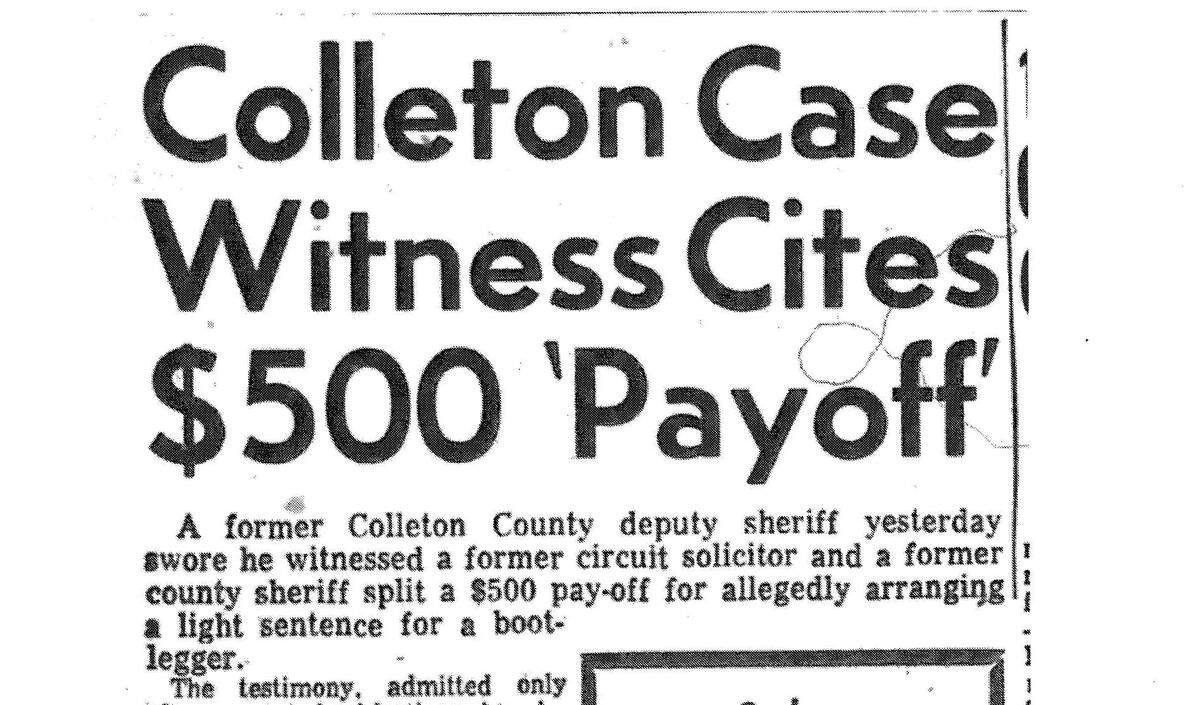
Herndon testified he witnessed the Colleton County sheriff share payoff money with Murdaugh in a courthouse hallway.
The money came from an arrested bootlegger. The deputy said he had been instructed by the sheriff to tell the bootlegger it would cost $500 to get him a light sentence.
The deputy said he received the money in the judge’s chambers while court was in session.
“I walked out of the judge’s chambers into the hall,” the deputy testified. “(The sheriff) came by and I gave him $400. I had been told to keep $100 for myself.
“About that time, Mr. Murdaugh came up and (the sheriff) peeled off two $100 bills and gave them to him and remarked, ‘I wish I could get one like that every day.’
“The following day, (the sheriff) told me that Murdaugh had raised hell about him paying the money in my presence.”
A different bootlegger testified he approached the sheriff after two of his still workers had been arrested and faced trial in state court.
“I told him I was afraid one of the boys would tell all he knowed if he got a stiff sentence. He told me if I could get $200 — that was $100 for him and $100 for Mr. Murdaugh — that he (the sheriff) would see what he could do to get … a light probation.”
Another bootlegger testified the sheriff told him he could get a case “squashed” for $550.
But a circuit judge took the stand to refute allegations that Murdaugh worked out light fines or sentences for bootleggers who were paying officials. He testified that all his sentences and fines during the court session in question were typical.
‘I’LL TAKE CARE OF THEM’
Officials of the 14th Judicial Circuit found yet another way to flaunt the law.
At one point, according to testimony, the head of the Colleton County grand jury started leaning on the sheriff and Murdaugh to do something about the illicit booze industry.
They responded with “friendly raids” to dupe the public and the grand jury.
The deputy who turned state’s evidence testified that the friendly raids were Murdaugh’s idea.
He testified that Murdaugh told him “to go back to the sheriff and tell him to get out and make some raids if only ‘friendly raids’ even if he (Murdaugh) and (the sheriff) had to pay the fines.”
He quoted Murdaugh as saying: “For God’s sake make the raids even if you have to warn them in advance, catch them and set up fines. I’ll take care of them.”
A Colleton County bootlegger testified that the sheriff arranged a “friendly raid” on his still, and a pint of whiskey was seized. He said he and the sheriff then drank about half of the pint and the sheriff took the rest away as “evidence.”
In another incident, a still that was partially owned by the deputy who turned state’s evidence was raided. A photographer was taken along and photos were released to the media.
“The News and Courier ran a picture of me on May 28, 1954, showing me wrecking my own still,” he told the court.
In another instance, students were taken from the Cottageville High School vocational agriculture class to observe a friendly raid in action.
MURDAUGH ON THE STAND
Murdaugh took the stand on a fiery 10th day of the two-week trial.
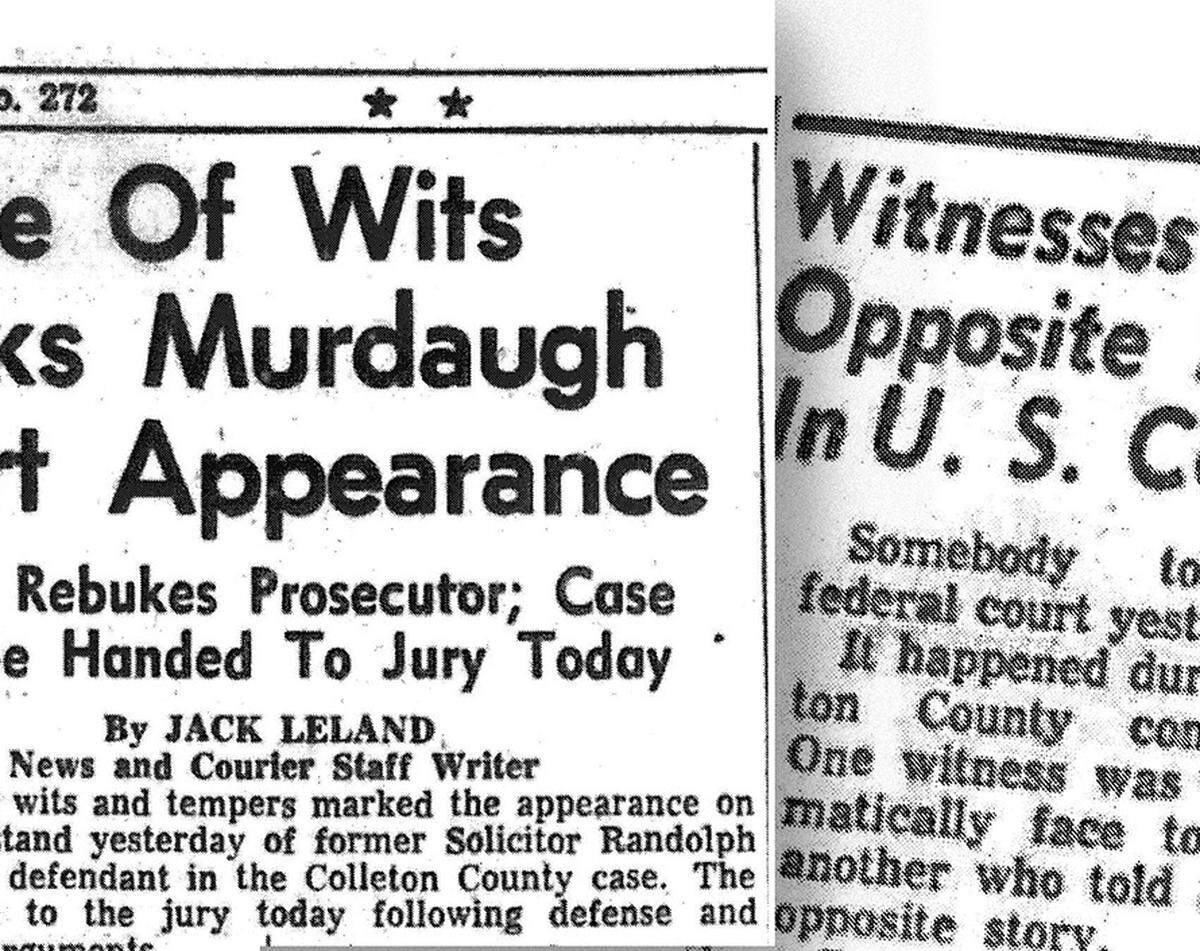
He “denied flatly ever being associated in a whiskey conspiracy,” the News and Courier of Charleston reported under the front-page headline: “Battle Of Wits Marks Murdaugh Court Appearance.”
Reporter Jack Leland described a “tense verbal skirmish” between Murdaugh and assistant district attorney Irvine Furman C. Belser Jr. of Columbia. It was so ill-tempered the judge told them he’d get them boxing gloves to work it out the next week.
Judge Hoffman joined the rage when Belser mentioned Murdaugh’s “income tax matters.”
Defense attorney Henry H. Edens Sr. objected, and Judge Hoffman tore into Belser:
“You know that is inadmissible as evidence. I’ll fine you for contempt of court if you continue. I’m not going to let a man be convicted in this court because of innuendo. … These civil cases must not be used to infer anything. You can either follow my orders, or you can get out of this courtroom.”
However, the prosecution gained admission from a Murdaugh character witness that the solicitor had previous troubles, although the testimony took place after the jury was excused.
“Have you heard about the Hampton County Bar Association efforts to disbar Murdaugh for lying and stealing from clients?” U.S. District Attorney Morrisette asked a prominent Estill grain elevator owner.
“I didn’t know what the grounds were,” he replied. “I did hear, about six years ago, that the county bar association tried to bring charges against Mr. Murdaugh but they never succeeded.”
Earlier, the foreman of the Colleton County grand jury testified that the former sheriff’s deputy who was a key government witness told him in the courthouse that he’d been lying throughout the trial.
After consultation in the judge’s chambers, that was stricken from the record.
Murdaugh denied being involved with light sentences for bootleggers, and a state judge testified that Murdaugh made no requests in the matter.
Murdaugh was questioned about two payments he made to the sheriff.
He said a check for $1,950 was repayment for “investigations carried out for me in a civil case.”
He said a check for $998.32 was to repay the sheriff for money he spent to take care of the families of men injured in accidents, which he said was the custom in his area.
Murdaugh attacked the testimony of Edith Freeman, a star prosecution witness whose husband was a convicted bootlegger.
He said she was enraged because she wanted a case brought against a federal agent who shot her husband in a confrontation after his still near Walterboro was raided.
Murdaugh said he told her to swear out a warrant against the agent, which she did.
He said he refused to prosecute the case because it involved a hassle between Colleton County officers and federal officers.
Murdaugh also addressed the $13,000 cash missing from the Freeman house following the raid.
He said he contacted federal officials in Columbia about it.
The News and Courier reported he “was told the Freemans were ‘about the biggest bootleggers ever to come out of Georgia.’ He said also that they denied any federal agent took the money and ‘claimed the county officers got it.’ ”
Murdaugh was also asked why he would not bring state charges against an accused Hampton County bootlegger, although he represented him as a private attorney on those charges in federal court, earning his law firm $1,733.
Murdaugh responded that the man had never been indicted by a local grand jury.
That man was the bootlegger who testified that Murdaugh once advised him to move his whiskey still to Colleton County where he could operate freely — the charge in Murdaugh’s indictment.
He had been “identified as a long-time fishing and hunting friend of Murdaugh’s until recent political differences,” the newspaper said.
Murdaugh’s secretary testified she had always known the man as a bootlegger.
Asked what he knew the man as, Murdaugh said, “A farmer.”
Murdaugh testified they’d hunted together “but we’re not in the same social class at all. I’ve never visited him at his home nor he in mine. I recall planning a suit against him once for wife beating.”
David Lauderdale may be reached at LauderdaleColumn@gmail.com.
Tomorrow: Judge blasts Buster Murdaugh as “grossly unethical.”
This story was originally published May 18, 2022 at 10:23 AM.