
Here are 5 things we learned that shaped our understanding of NC’s Highway 12
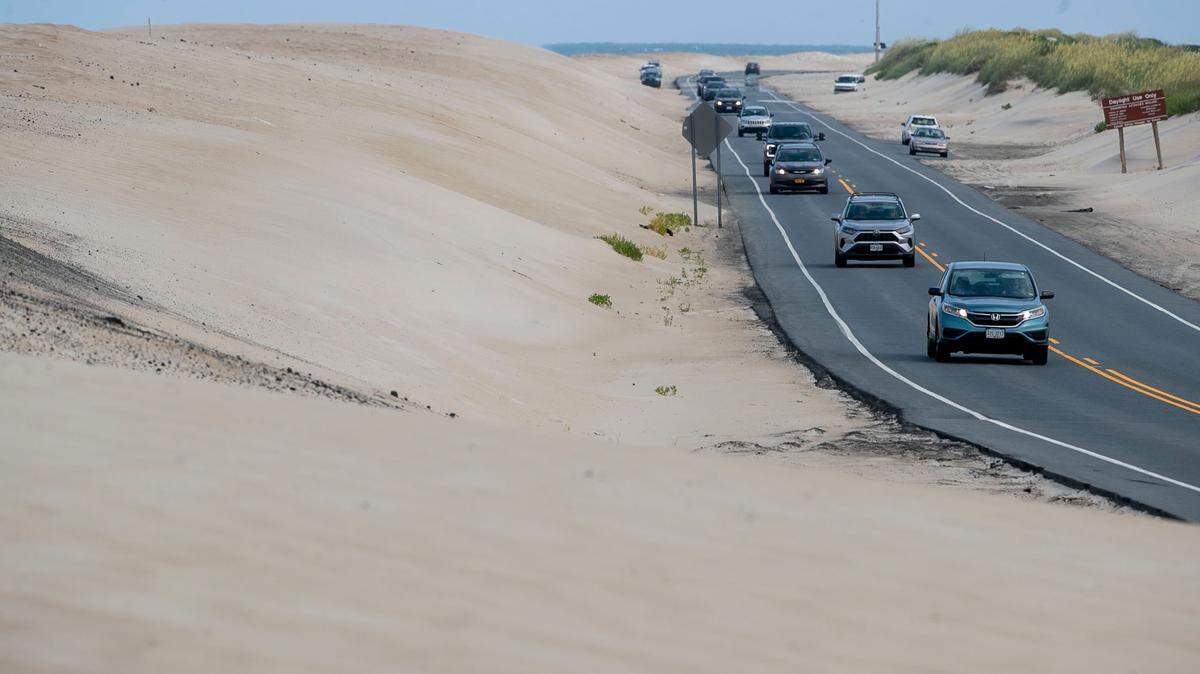
The four-hour drive to the Outer Banks doesn’t feel like a long trip from the Triangle.
It’s close enough that you can leave first thing in the morning and dip your toes in the Atlantic by lunchtime, made possible by a network of roads that have sprung up over the last 75 years or so, including Highway 12. News & Observer photojournalist Robert Willett and I set out to chronicle that road, a leading indicator of climate change in North Carolina.
That meant looking at the choices people are making on the Outer Banks right now, when the road is already seeing frequent flooding. Jan Dawson, who owns the Cape Hatteras Motel in the northeast corner of Buxton with her husband, Dave, explained that she cautions anyone who considers moving to the area after a summer vacation to think through that decision.
She asks them what they would do if they couldn’t get to their pharmacy or if they had considered the possibility of being flown out on a helicopter during a medical emergency. Dawson’s questions drove home the reality of living on a barrier island with one road in and out.
“People who were born on this island, people that lived here permanently far longer than me, you have to be of sturdy stock, you have to be flexible and you have to realize that (when) you have a beautiful day ... it’s not like that every day,” Dawson said.
Here are five things we learned along the way:
1. The sea is rising, the land is sinking
The sea level is rising around the world because of climate change.
But in North Carolina, the Outer Banks is experiencing more sea level rise than the Wilmington area because the land is actually sinking.
This effect has long been observed by coastal scientists in the state. The N.C. Climate Science Report, released last year, found that the northern part of North Carolina’s coastline is sinking at a rate of about 4 inches per century while the southern part of the coastline is being lifted at about an inch a century.
Subsidence is the main factor in Duck experiencing about an additional inch of sea level rise per decade than Wilmington, the Science Report concluded.
2. People learn to adapt
People who live on the Outer Banks know the sea level is rising, and they know the risks that come along with it. They’ve also learned to adapt to those risks in ways large and small.
It’s common, for instance, for pregnant women to stay with friends or at a hotel in Nags Head if a storm is approaching as their due date draws near.
Neil Tolson is another Hatteras Villager who has adapted. Every fall, once the tourism season starts to die down, people drive their cars and trucks to a shed outside of Tolson’s home. There, he rubs the undersides with a homemade linseed oil mixture that gives the metal frame a dull black coating that will protect it against the elements.
“They do it at the dealerships and stuff, but that stuff they put on there doesn’t last down here,” Tolson said. “The water, the elements, the wind, the salt — the salt is what it is.”
Tolson said the linseed oil mixture will keep the elements at bay, but isn’t a total cure for the salty air and water.
“Nothing’s going to stop it here,” he said. “It’s just you’ve got to do something or else it’s going to rot away.”
3. Money flows in from other states
Highway 12 is a massive driver of tourism money on the Outer Banks. On any summer weekend, license plates from any number of states can be found in the parking lots of motels and restaurants from Corolla to Ocracoke.
From 2010 to 2019, visitors to Dare County contributed nearly half a billion dollars in state taxes, according to a report prepared for Visit North Carolina. Hyde County, namely Ocracoke, contributed $16.26 million to state coffers over that period.
Dare County residents argue that this tax revenue is a strong reason for continuing to invest in Highway 12 and protect the road against rising seas.
Ernie Foster, who was raised in Hatteras Village and spent much of his life there, said, “Dare County’s tourism income is almost all found money — 80 to 85 percent of our visitors are from out of state, as contrasted with the beaches of the rest of the state.”
4. Parts of the road are now inlets
Local officials and the N.C. Department of Transportation are devoting significant time and study to what they call “hot spots,” seven flood-prone parts of Highway 12 ranging from Oregon Inlet to the northern end of Ocracoke Island.
These areas aren’t just flood-prone, according to research from Reide Corbett, executive director of East Carolina University’s Coastal Studies Institute. They also tend to be at points of the Outer Banks that are most likely to be broken during storms and turned into inlets.
During recent storms, inlets already have formed in some of those hot spots — like Isabel Inlet just east of Hatteras Village, or New Inlet on Pea Island.
“What we’re looking at is a product of a lot of evolution of these islands through time and the solutions aren’t going to be simple because of the underlying geology and what we actually have in the way of sand in these areas,” Corbett told a local government group studying the hot spots last month.
5. People recognized rising sea levels 60 years ago
Dealing with climate change isn’t new on the Outer Banks. Erosion has always been a reality along the string of barrier islands, and residents have searched for answers to the problem for a long time. They just didn’t call it “climate change.”
In 1964, David Stick, then the chairman of the Dare County Board of Realtors, told the local erosion control board how rising seas would make life more difficult on the Outer Banks. Stick’s neighbors were trying to slow erosion by experimenting with groins, jetties and bulkheads in front of their own properties. Some were burying Christmas trees along the beach in the hopes of capturing sand and building up dunes over time.
“We are now in a period of gradually rising temperatures, with the result that the ice cap is slowly melting and the oceans of the world are rising,” Stick said, according to his archives housed at the Outer Banks History Center.
Reporting for this story was supported by a Southeastern U.S. Ocean and Climate reporting grant from the Institute for Journalism & Natural Resources. This story was also produced with financial support from 1Earth Fund, in partnership with Journalism Funding Partners, as part of an independent journalism fellowship program. The N&O maintains full editorial control of the work.
This story was originally published August 13, 2021 at 5:00 AM with the headline "Here are 5 things we learned that shaped our understanding of NC’s Highway 12."