
Can district attorneys show police body cam video under NC law? Maybe, attorneys say.
Minutes after announcing that deputies were justified when they shot and killed Andrew Brown Jr. outside his Elizabeth City home last month, District Attorney Andrew Womble played several minutes of body cam video from the scene.
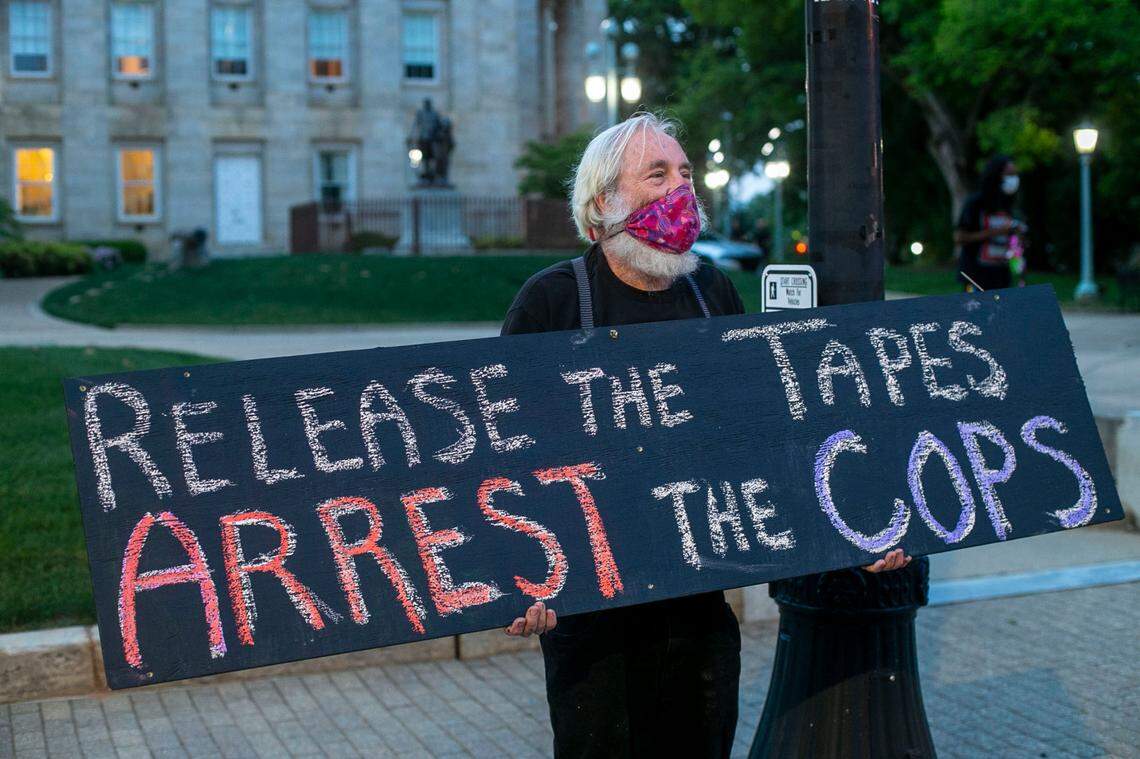
Since Brown’s killing nearly a month ago, his family, protesters, the media and even the Pasquotank County Sheriff’s Office have all pushed for the release of that footage. Those efforts have failed because a state judge has refused to order law enforcement to turn it over — a requirement of state law.
Womble on Tuesday asserted he didn’t need a judge’s order to show the videos because the rules that apply to law enforcement don’t apply to him.
He may be right.
Under a state law passed in 2016, law enforcement can’t release recordings from body and dash cams on their own. They need to petition a court, attend a hearing and secure a judge’s order.
When the Pasquotank Sheriff’s Office did just that last month, state Superior Court Judge Jeff Foster denied the request. He said he’d revisit the issue after Womble decided whether to charge three deputies who opened fire shortly after they arrived at Brown’s home to serve arrest and search warrants related to a drug investigation.
When Womble announced his decision Tuesday, he played four video clips, each less than a minute long, starting with the moments just before deputies rolled up to Brown’s house.
Womble’s screening of that video during a press conference raised fresh questions about North Carolina’s body cam law, a controversial measure state lawmakers are reexamining in the wake of Brown’s shooting.
The district attorney said he spoke with a judge prior to screening the video, but did not get an order to disclose or release it.
“I brought it today for the purposes of accountability and transparency,” said Womble, who refused to replay the video or provide copies to members of the media during the press conference.
Interpretations of NC law
John Rubin, a professor of public law and government at the UNC School of Government, said Womble’s interpretation is reasonable, based on his reading of the law.
Under the statute, the rules laying out the process of going to court for the video apply to “custodial law enforcement agencies.” But these agencies still have to turn over footage to district attorneys for a few specific reasons, including reviewing for potential criminal charges.
“There’s nothing in there that prohibits the DA from then screening it or disclosing it from there,” Rubin said.
Rubin acknowledges this does highlight “some of the tensions in the law.”
One of the issues with the statute’s language, said media lawyer Amanda Martin, is that it neither explicitly allows or prohibits release of video by district attorneys once it’s in their possession.
And there’s another problem, she said: there’s no penalty for violations.
“So even if it was improper for the DA to release it, it doesn’t appear there are any consequences from the statute,” said Martin, who frequently represents media organizations such as The News & Observer in public records cases.
Womble told reporters Tuesday that they would need a judge’s order to obtain the video files.
On Monday, Foster filed a written ruling denying the media’s petition to release the videos, formalizing a similar, oral order he issued several weeks ago in court. Media organizations may ask the courts again to release that footage.
In the meantime, Martin said, Womble’s interpretation of the body cam law means it might be time for the media — and the public — to redirect their demands for footage.
“If it’s up to him, from now on, we should be asking the DAs,” Martin said.
This story was originally published May 18, 2021 at 7:05 PM with the headline "Can district attorneys show police body cam video under NC law? Maybe, attorneys say.."