
Beaufort County's forgotten black athletes: Athletic records for county's three black high schools lost to time
Russell Dortch, the quarterback at Robert Smalls High School in 1959, was trapped and certain to be tackled.
With nowhere to go, he rolled to his left and found an answer to his prayers in teammate Sam Smith speeding down the field. The result was a touchdown and a 12-6 win, keeping Robert Smalls High School unbeaten through three games.
It was, as The Beaufort Gazette reported, a "spectacular" play for the all-black high school in Beaufort.
That year, the football powerhouse team made a lot of similar plays, culminating in an undefeated season and a newfound reputation as the pride of their local community. Players including Dortch, running backs Sonny Boy Jackson and Johnnie Drayton, and powerful linemen including Robert Jenkins grew into big men on campus and around town.
But information about the celebrated team is surprisingly hard to find. Very little documentation exists about any of the school's teams, star athletes or standout performances.
The same is true for Beaufort County's other two all-black high schools that existed before forced integration, M.C. Riley High School in Bluffton and St. Helena High School on the small sea island of the same name.
The Beaufort County Board of Education adopted a desegregation plan in 1969 that took effect in the 1970-71 school year, signaling the end for the three schools. In the decades since, the schools' official athletic records have been scattered, misplaced and ultimately lost to time.
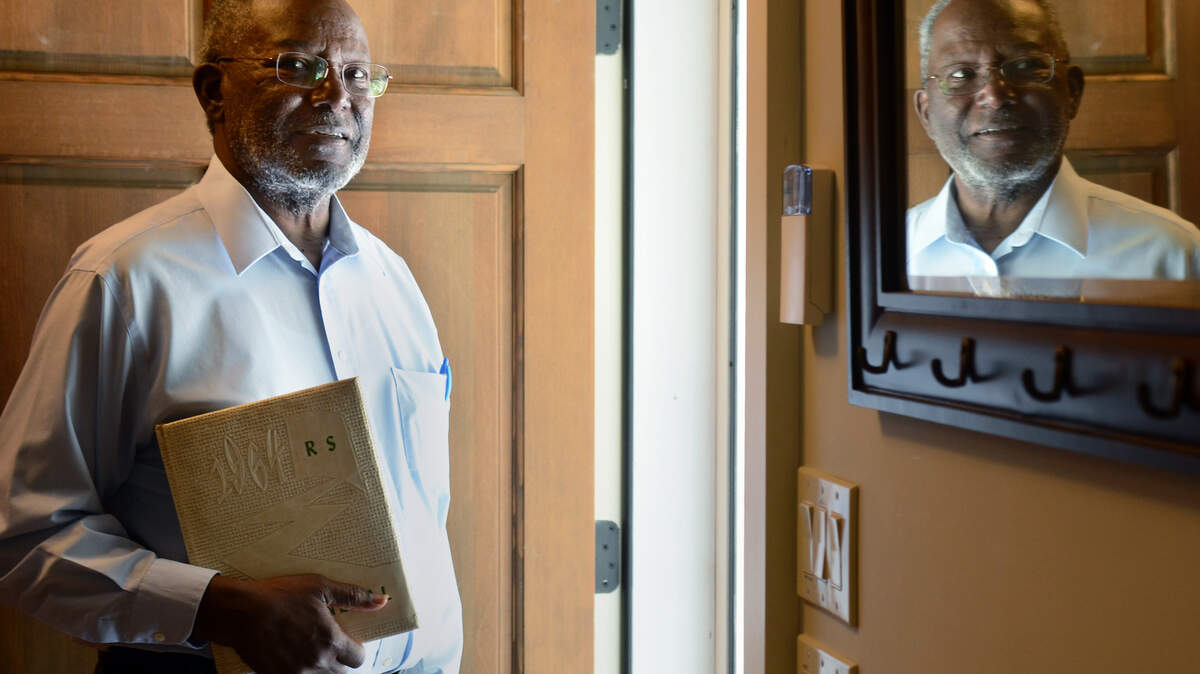
Only a handful of newspaper clippings, some dusty yearbooks that alumni have hung onto and increasingly fuzzy memories tell the stories.
Soon, the tales of these bigger-than-life athletes and historic teams -- including the 1959 Robert Smalls football team and the 1962 M.C. Riley High School's state champion basketball team -- will likely just vanish.
"That's a whole lot of history that (is going) down the tubes," said David Brown, a member of Robert Smalls High's class of 1965.
ALMOST CHAMPIONS
The missing records aren't limited to scores and stats.
No one can say for sure why the 1959 Generals didn't play in the playoffs after finishing an undefeated season.
As far as several former Robert Smalls students remember, the school's administration was unable to pay certain fees that season, making the team ineligible.
Still, the season was one that made the community proud.
That team hadn't been expected to do much, according to a short article in The Beaufort Gazette that labeled the team as a "Cinderella." But led by the backfield trio of Dorch, Jackson and Drayton, the team coached by Arnold Mitchell hit its stride and never looked back.
"That year, we had a group of players (who) had (previously) played together," said Robert Jenkins, a retired SLED agent who now works as a transportation officer for the Beaufort County Coroner's Office. "In '59, that was my junior year, we had all had quite a bit of experience. The senior class that year, most of the kids that year probably started in their sophomore or freshman year."
That experience, and Mitchell's coaching, paid dividends.
"After we played the first couple games and they went real well, it just seemed to get better as time went on," Jenkins said.
In early October, the Generals routed Sol Johnson High in Savannah. The next week, Drayton ran for a 4th-quarter, game-winning 72-yard touchdown to beat heavily favored Beach High School in Savannah.
Jackson and Drayton, who had exceptional speed, according to Jenkins, and Dortch, a future helicopter pilot in the Vietnam War, were nearly unstoppable. In November, the team shut out Holly Hill 19-0 for its ninth straight win.
But that's where the record ends. Now, all that's left to verify that team's accomplishments are short newspaper reports submitted by the school and tucked away in a section titled "News of Particular Interest to the Colored Community."
THE MARCH OF TIME
Part of the reason for the missing records is the passage of time. Nearly half a century has gone by.
There are other factors, too.
None of the three schools still stands.
M.C. Riley High has been replaced by Oscar Frazier Park and the M.C. Riley Sports Complex.
The Robert Smalls High site is now home to Beaufort municipal government buildings. Just a commemorative plaque that stands in front of the outdoor basketball court in Bluffton and a historical marker indicating the former presence of a school.
And all that is left of St. Helena High is the old gym.
Additionally, no one remembers who kept official athletic records. The South Carolina High School League governs the state's public school athletic programs and has listings of state champions and more going back nearly a century.
But they did not oversee the black schools, though both Ted Whitaker, a former coach at M.C. Riley, and Jonathan "Doc" Beasley, a former St. Helena High coach, say there was an association that did at one time.
"Only thing you can get now is from black people (who kept their own) records," said Robert Smalls alumnus William "Preacher" Smith, class of 1955. "But most of them are dead now."
There does not appear to be an official record, for instance, of M.C. Riley's state championship-winning basketball team in 1962. That team traveled to South Carolina State University and defeated Booker T. Washington High from Columbia, according to former students and administrators.
Jan Hogan, a record-keeper and de-facto historian for the SCHSL, said the organization does not have any records from the formerly segregated, all-black schools.
Jim Foster, spokesman for the Beaufort County School District, said any surviving athletic records from those schools would most likely be with Beaufort High and Hilton Head High. In 1970, forced integration meant students from both Robert Smalls and St. Helena were funneled into Beaufort High. M.C. Riley students were shifted to McCracken High in Bluffton before Hilton Head High opened in 1983.
Athletic directors at both schools said they could find no such documentation of past sporting successes.
Only occasional mentions of St. Helena and M.C. Riley's games were included in the local newspaper, The Beaufort Gazette. Even reports for the much larger Robert Smalls High were few and far between.
 Football team photo from the 1964 Robert Smalls High School yearbook.
"We just weren't included in that aspect of newspaper reporting," said Fred Washington Jr., a former basketball and football star at Robert Smalls High.
The problem is hardly limited to Beaufort County. In 1999, a reporter from California researched a national record football winning streak at the old Sims High School in Union, a town in South Carolina's Upstate. The streak is not officially recognized in either South Carolina nor nationally because of insufficient evidence in the form of documentation.
Dave Pickren has been researching the state's high school football history for nearly 20 years. His site, scfootballhistory.com, details former champions and year-by-year records but lacks information on black schools. He has trouble tracking down results and information even for the formerly all-white schools.
"Information from prior to about '65 is just about non-existent," Pickren said. "It's almost legendary in places."
Alumni for the three Beaufort County schools say it's a tragic end for a trio of schools that were the centers of their communities.
"You don't have any numbers (even though) you need to continue to just pass it on," said Herbert Glaze, a former Robert Smalls student who has spent the past four decades as a coach and teacher at Beaufort High. "Those who were involved and those who knew so much have gone on."
 Football team photo from the 1964 Robert Smalls High School yearbook.
A SENSE OF COMMUNITY
It wasn't just in 1959 that the Generals made the community proud.
For years to come, their football games were the week's social highlight for the black community.
On Friday nights in 1962, for example, fans from both Robert Smalls High and nearby rival St. Helena High would pile into cars and head to the games at a Lady's Island football stadium the two teams shared.
Once drivers hit the Beaufort Bridge, the stadium lights were visible -- a beacon of the fun to come, said Glaze.
"I see the lights," passengers would sing out, echoing the lyrics of singer Claudine Clark's 1962 hit song.
 Football action photos from the 1964 Robert Smalls High School yearbook.
Football games were indeed a sort of party for the schools, especially at Robert Smalls High, which boasted a long-standing football tradition.
The school had barely opened when it fielded its first team in 1938. There's a photo of that squad, dressed in uniform, standing at the entrance to the school,19 players strong.
By 1962, the Generals were known throughout the state as a disciplined and strong football presence, according to former St. Helena High coach Doc Beasley.
Fans would show up to support the local 11, singing songs and chanting. At half time, the marching band played the hit songs of the day. It was even more exciting when the rival schools brought their own bands, Glaze said.
"All the teams that we played had good bands," Glaze said.
Traditional high school rites of passage, including homecoming, bonfires and parades, were part of the community fabric.
That 1959 Robert Smalls football team's performance was a high water mark for the athletes who came afterward, including former Robert Smalls player
David Brown, who was inspired by watching the older students play, and Fred Washington Jr., who would eventually serve as chairman of the Beaufort County School District's board.
"You just had to admire them," Washington said of the student-athletes who came before him. "They carried themselves so well."
Pride in sports was present at both St. Helena and M.C. Riley, too.
Former M.C. Riley basketball and football coach Ted Whitaker said basketball was so important in some of the Bluffton neighborhoods that he could easily field a team from just one or two streets in the town. The kids were always playing, he said, sharpening their skills.
Games at all three schools were well-attended.
"Oh, fantastic support from the principal, the teachers, even the parents," said Constance Gardner, a former star girls basketball player for the Generals. "The gym was always packed."
Her husband, Roland Gardner, a former all-state basketball player at St. Helena High, said the tradition of school pride ran deep on the other side of the bridge as well, especially when it came to playing Robert Smalls High.
Shops would close early for the football rivalry, and the school sometimes held basketball games in the daytime so most of the student body could attend.
 Photo of the Robert Smalls High School basketball team senior players from the school's 1964 school yearbook, "The General."
CLINGING TO MEMORIES
Records may not exist today.
But memories still do.
Every three years, the proud men and women of the Robert Smalls Association, an organization formed to keep the school's memory alive, gather for crab legs, grilled chicken -- and a giant helping of remembering.
The group most recently met in July to re-tell their stories about miracle comebacks and stirring victories. Donned in green and white commemorative shirts (their school colors that are still alive today in Beaufort High's uniforms) they laughed about old classes and teachers while passing around yearbooks and old photo albums.
Washington shared the story about "the tree" that stood outside the stadium of the all-white Beaufort High School back in the '50s and '60s.
While he never climbed it, his teammates routinely did so they could catch a glimpse of their white counterparts in action.
"I can remember once, I went and I looked through the fence," Washington said with a smile. "I never climbed the tree, because boy if I'd fallen ..."
The chance to test themselves against the white teams never happened, even though it was something players wanted.
"All the time, we used to talk about it," said George "Essie Boy" Hamilton, a star quarterback at Robert Smalls High who graduated in 1958.
Players at M.C. Riley could also be heard boasting about the possibility of facing off against Bluffton High School on the basketball court.
According to their coach, Whitaker, his players weren't bashful about how such a matchup would end.
"'I'd bet we'd beat the crap out of Bluffton,'" Whitaker recalls his players saying.
While members of the association are trying to keep the stories alive, they know they are aging. It's uncertain just how many more gatherings they will have.
It worries members such as Hamilton, who says he often considers the possibility that a chapter of history may soon be lost.
"I'm afraid of that," Hamilton said, looking around at his former classmates. "I can see that day. All of us, we're old men."
Related content:
- Column; 'Invisible' class was told to never say 'can't' , Oct. 2, 2014
- The Robert Smalls Association on Facebook
- A proud history: Robert Smalls School classmates gather for reunion , July 13, 2009
- Richardson remembered as stern, inspirational educator , Feb. 27, 2008
This story was originally published August 8, 2015 at 11:00 AM with the headline "Beaufort County's forgotten black athletes: Athletic records for county's three black high schools lost to time."