Thousands remain hungry months into pandemic. Lowcountry pantries are trying to keep up
A Port Royal food pantry has seen double the number of people asking for food since the pandemic began this spring.
A Hilton Head-based food rescue agency says demand is up 30%. Distributing food and supplies each week to 55 nonprofits means overcoming meat shortages, scarcities in essential supplies and a lack of volunteers.
And in Bluffton, a food pantry and soup kitchen is supplying meals for nearly 200 people per week, while struggling to meet the substantial needs of the poor, homeless and elderly during the COVID-19 crisis.
As the COVID-19 crisis has stretched the resources of families across the country, many are coping with food insecurity and hunger. COVID Impact Survey estimates indicate that nationally, lack of regular access to food doubled overall and tripled among households with children in April, following the onset of the pandemic, compared to predicted rates for March. According to Feeding America, one in eight people in South Carolina struggles with hunger during normal times.
Across the Lowcountry, many food pantries, which often also distribute household items and toiletries, worry about managing increased demand along with product shortages, fewer donations and other difficulties.
As executive director of Bluffton Community Soup Kitchen, Constance Martin-Witter has worked to secure this year’s most demanded items — toilet paper, disinfecting wipes, dish detergent and so on — to distribute to those in need.
But, Martin-Witter said, her attempts have hit a snag. The nonprofit has the money — it received grants from two foundations to buy “hot stuff,” as she calls the household items, from commercial partners — but has had trouble reaching store executives who would be able to approve the sale of items in bulk.
Grocery stores and big-box stores such as Walmart are still dealing with shortages of household items 5 1/2 months after the pandemic began, leading some to place limits on purchase quantities.
“We’re not trying to sell the stuff,” Martin-Witter said. “We’re going to pay, but [they’ve] got to give us more than two. They always say they have to bump it up to heaven.”
Still, the soup kitchen and food pantry has found some success with local Dollar Trees, which have sold them items in bulk.
“We’re still alive and well,” Martin-Witter said. “We’re not going to give in.”
Lili Coleman, executive director of Hilton Head-based food rescue agency Second Helpings, which distributes food to 55 pantries through Beaufort, Jasper and Hampton counties, said the pantries serviced by the nonprofit are seeing a 30% increase in demand as a result of the pandemic.
But this means that the agency also needs 30% more food to give to the 19,000 people who are served by the pantries each week. Although Second Helping has replenished its inventory to pre-pandemic numbers after being short the first few months, meat remains in short supply due to COVID-19 outbreaks at food processing plants and a scarcity mentality among some members of the public, Coleman said.
“At the beginning of the pandemic, everyone was buying up food, so there was less food to rescue,” Coleman said. “The grocery stores were trying to keep up with that demand. Even now, there’s less soap.”
Second Helpings is trying to get grants to buy more food, Coleman said.
Greatest needs
In rural Jasper and Hampton counties, those in need face further obstacles. For starters, the counties lack the wealth of Beaufort County and have fewer nonprofit organizations to support those in need. And residents live further away from each other, making food deliveries more difficult and costly for pantries.
“They don’t have the support that we have out here,” Coleman said.
Brenda Singleton is pastor of Healing Waters Mission and Wellness Center in Hardeeville. She and her husband, Jeff, operate Healing Water’s food pantry out of their home. They said they need a refrigerated food truck to drive into rural pockets of Jasper County and deliver food to elderly folks and families.
They serve roughly 110 to 150 households per week through mobile distribution, in addition to the 39 to 43 households who come to the pantry each week, Jeff Singleton said. But a refrigerated food truck would allow them to serve more.
“We serve the white population, Hispanic population, Black population,” Brenda Singleton said. “We bring good food. I don’t believe in giving people a whole lot of sweets.”
The pair are now working to build a walk-in cooler to store food, but they need volunteers to help install air conditioning.
Nonprofits in Beaufort County, meanwhile, are seeing similar or higher numbers of clients and are constantly restocking the shelves.
Lori Opozda, director of nonprofit Help of Beaufort in Port Royal, said the pantry has been feeding double the number of people the past month as it did the first few months of the pandemic. At least 125 families come in each week for food, she said.
Opozda suspects one reason is unemployment benefits have been cut while people are still unable to find full-time jobs. The absence of regular church meals for many clients places additional pressure on the pantry to stock up.
“I just went grocery shopping,” Opozda said. “I spent $200 on Sunday, blew through it yesterday. As fast as it is coming in, it’s going out the door.”
Opozda said most food and monetary donations come in at the beginning of the week, and the amounts can vary from week to week. By Wednesday of each week, the shelves are almost empty.
On St. Helena Island, the Franciscan Center has given out more than 3,000 bags of food since the pandemic started and are seeing triple the number of clients.
The pantry is open twice a week, Tuesdays and Thursdays, from noon to 2 p.m. Sister Canice Adams, who oversees the program, said if the pantry were open all day long, people would come all day long.
“You just never have enough of food, because the people just keep coming,” Adams said.
And although Adams and the volunteers ensure no one leaves hungry, St. Helena Island residents are facing some problems the food pantry cannot fix.
“There’s some very sick people out here,” Adams said. “They don’t know they’re sick. We have really had to stress with them, ‘You need to get tested” for COVID-19.”
She said many Americans forget about the poor because they are used to having everything. But that is not the experience for many on the remote island, she said.
“I don’t think I ever heard anyone [at the pantry] complain,” Adams said. “They’ll say, ‘God gave me another day, I’m up, everybody has pain, and I am blessed.’ They really put us to shame.”
A pantry in action
On a hot Monday afternoon, dozens of families looking for food parked at Campbell AME Church on Boundary Street in Bluffton and waited under palm trees for their numbers to be called. Across the gravel lot, Bluffton Community Soup Kitchen volunteers in face shields operated an assembly line — first stop, take some hand sanitizer, next stop, pick a yogurt.
The food is “rescued” from grocery stores by Second Helpings and driven in a refrigerated truck to the church the morning of each distribution.
Dell Pringle, site manager for the soup kitchen and food pantry, said that at the beginning of the pandemic, volunteers would provide food for 200 to 250 clients per week through their two pantry days and one hot meal day. The numbers have dropped a bit, but are still above the pre-pandemic average of 100 to 150.
Most of the clients during the pandemic have been Latino, Pringle said. Latinos in Beaufort County have been disproportionately hurt by the coronavirus, accounting for at least 21.1% of reported COVID-19 cases but only 11.1% of the total population. The organization is working on getting Spanish-speaking volunteers to assist clients who do not speak English, Pringle said.
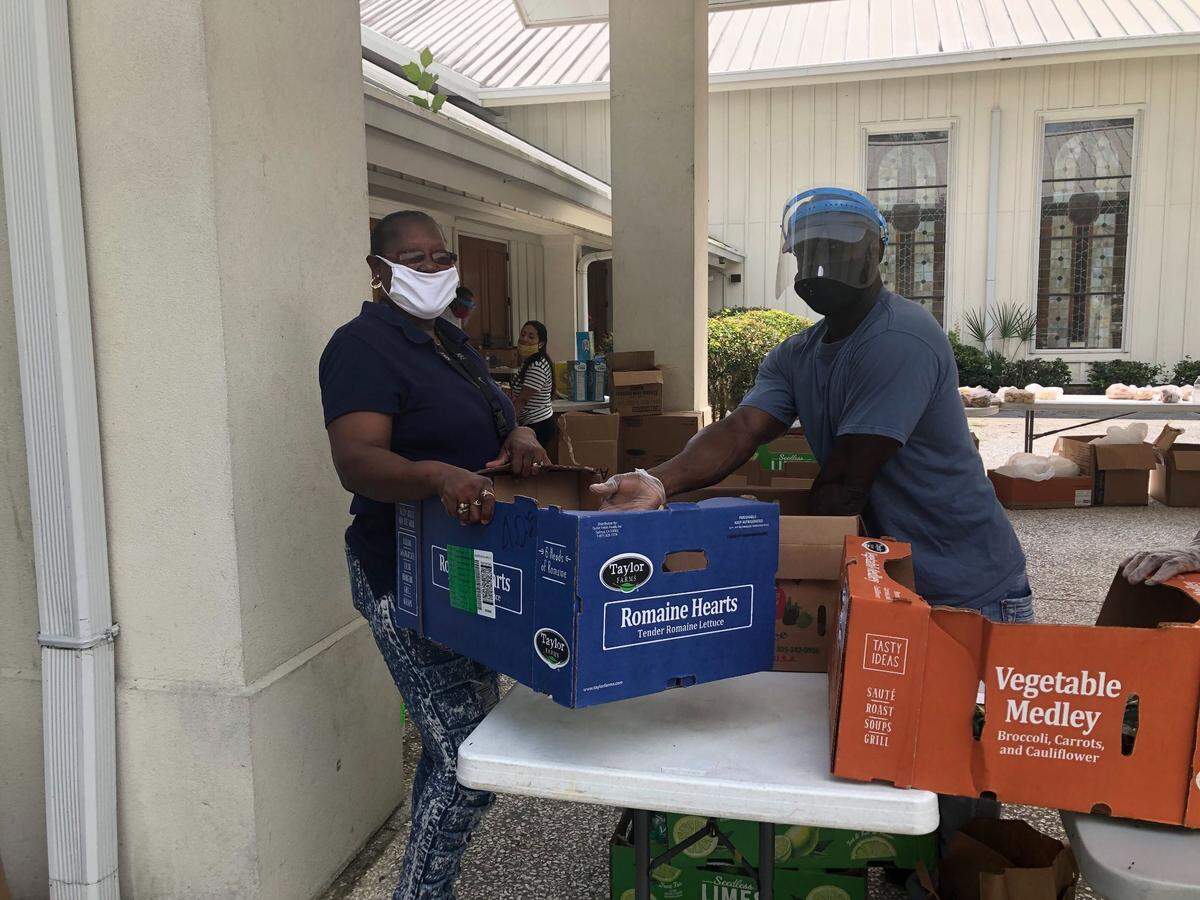
One client, Patricia Garner, arrived with a box ready to fill with food to give to the elderly. She said she started coming during the pandemic to get food for those who could not come themselves.
“It’s blessed that they’re able to help people that are less fortunate, and I’m grateful for that,” Garner said.
At the end of the day, as volunteers wiped and collapsed tables, a truck drove into the parking lot to pick up leftover food and distribute it to pantries in Jasper and Hampton counties so that none of it would go to waste.
This story was originally published September 7, 2020 at 5:40 AM.