Beaufort Co. voters say no to sales tax, government change in lopsided election
Two major proposals — a 1% local option sales tax initiative and a recommendation to change the county’s form of government — failed by large margins at the Beaufort County ballot box Tuesday.
Both referendums were put on the ballot by Beaufort County Council earlier this year, but neither gained much public support in the months leading up to the election.
The council proposed the two after grappling with how to handle disagreements with, and harassment allegations against, its county auditor — and after local municipal leaders lobbied for a new countywide sales tax.
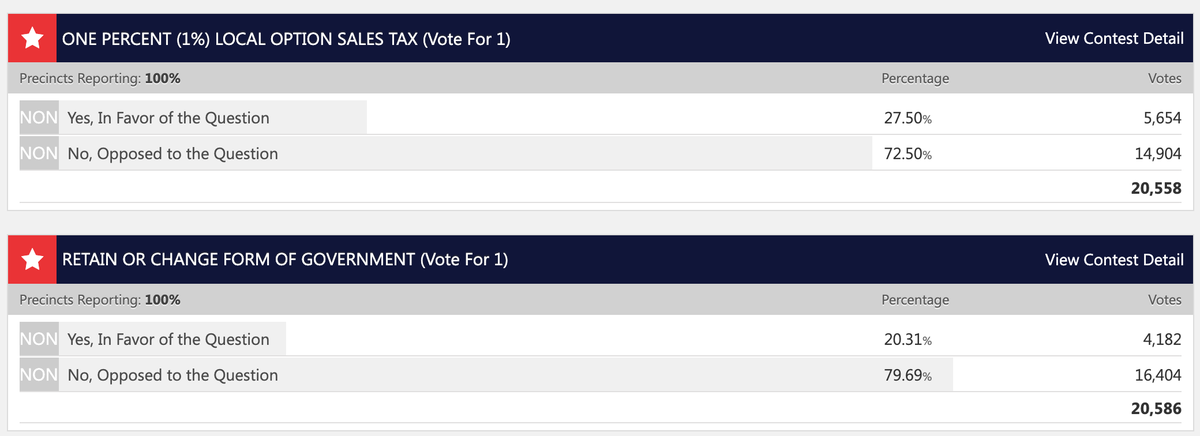
The first ballot question, whether to issue a 1% sales tax countywide, failed in a wipeout — 72.50% of voters opposed, according to unofficial results posted on the South Carolina Election Commission’s website Tuesday evening.
The second proposal, whether to change the county’s form of government and allow the auditor and treasurer to be appointed, not elected, also failed in spectacular fashion — with 79.69% of voters against, the website shows.
As many expected, voter turnout across the county was low this year. A total of 20,753 votes were cast, representing 14.20% of the county’s 146,144 registered voters.
Because it was an off-year election — meaning South Carolina had no national or state elections — many residents criticized the county for pushing forward with both proposals with only a small percentage of voters participating in the decisions.
Due to the tax referendum’s failure, Beaufort County’s 7% tax rate will likely return to 6% by the end of the year. The county expects to stop collecting its 1% transportation tax by Thanksgiving, county spokesperson Chris Ophardt told a reporter this week.
The second referendum’s loss means that Beaufort County will remain a council-administrator form of government. This means that the county’s auditor and treasurer will continue to be chosen by voters rather than hired by the county administrator.
SALES TAX
Because a majority of voters voted against the sales tax, it will not be imposed in Beaufort County. However, according to state law, the county is allowed to call for another referendum as early as next year.
Had the sales tax passed, it would’ve had no end date. To rescind the tax, voters would have had to petition the county to hold another referendum.
In the months leading to the election, many criticized the sales tax proposal and local governments’ decision to hire a marketing firm to promote it. They also pointed out that the ballot question was misleading when it said money from the tax “may” be used to offset property taxes and pay for government operations. State law requires the money to be distributed that way.
Supporters of the tax said it would shift some county homeowners’ property tax burden to tourists and visitors. Local governments said the money would also help fund municipal operations and projects, including roads and parks.
Opponents, however, argued that it was a regressive tax proposal that favored high-income property owners and landlords over renters and low-income residents. Others said that the county and municipalities shouldn’t raise taxes without having a dedicated use for the money — like the 2018 Penny Sales Tax Referendum.
The website SayNoInNovember.com, created by the Beaufort County GOP, asked residents to vote against both the sales tax and the change in the form of government questions.
CHANGE OF GOVERNMENT

Because the second ballot question also failed, Beaufort County’s auditor and treasurer will remain elected positions. The positions are currently held by Auditor Jim Beckert and Treasurer Maria Walls.
As treasurer, Walls serves as the county’s chief banker and investment officer and is responsible for collecting and dispersing all property tax revenues.
Those revenues are calculated by Beckert in his role as auditor.
Both Beckert and Walls were first elected to their positions in 2014 and re-elected in 2018. Their terms expire in 2022.
Beckert and the county have been at odds over the past two years on several issues, including delayed tax bills and a legal battle over a sheriff’s service fee. Walls and the county’s former CFO also filed lawsuits against Beckert, accusing him of harassment.
The referendum, which would have given Beaufort County Council the power to decide whether to appoint the two positions, appeared to be the council’s way to get rid of Beckert. If voters approved the change, council would simply have needed to pass an ordinance to appoint the two positions.
Opponents of the ballot question said it would have taken away the public’s right to choose who serves in those positions.
Of the state’s 46 counties, 34, including Beaufort County, operate under the council-administrator form of government, which gives a professional administrator responsibility for the county’s day-to-day operations. The administrator is hired by and reports to the county’s elected council.
Had the referendum question been approved by voters, Beaufort County would have joined only two counties, York and Greenwood, operating under the council-manager form of government.
Council-manager is similar to council-administrator in that the administrator or manager oversees county operations and reports to the elected council.
The only real difference: In the council-manager government, the auditor and treasurer may be appointed by council rather than elected.
This story was originally published November 2, 2021 at 10:14 PM.