
Tim Scott’s tricky 2024 decision: To confront Trump in a race for president or not
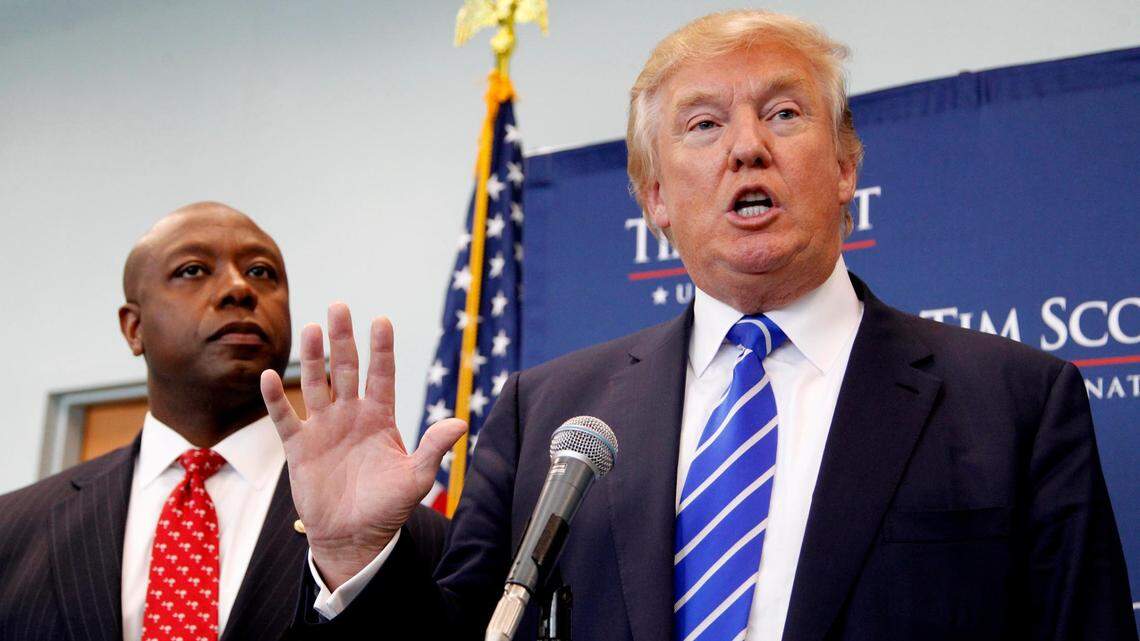
In normal times it would make perfect sense for Tim Scott to launch a campaign for president this year.
Having just handily secured his second full — and if you take him at his word — final six-year term in the Senate, he has a free shot without much to lose. An easy reelection kept him flush with cash. At 57 years of age, he’s an obvious vessel for a new generation of politicians who look positioned to turn the page on geriatric U.S. leadership. Not to mention there’d be the indelible image of the only Black Republican senator striving to become the first Black Republican president.
But politics hasn’t been normal since Donald Trump descended from an escalator in Trump Tower and detonated his White House endeavor seven and a half years ago.
And the twice-impeached, once defeated former president chose Scott’s home turf of South Carolina as a re-launching pad for his third campaign this weekend.
While Trump was flanked and feted at the statehouse by Gov. Henry McMaster and a slice of the state’s eight-member GOP congressional delegation led by Sen. Lindsey Graham, Scott was among those who wasn’t in attendance. Instead, he was at his own event in Washington on Saturday — his absence a telling indicator of the heavy decision that lies before him in the coming months.
Scott is confronting whether to challenge a former president who last summer he described as the most powerful force in all of politics. Or to opt for the safer route: Maintain his place in Trump’s good graces, maximize his chances of being selected as a running mate or top Cabinet official and biding his time for 2028.
“My theory has always been: Do your job where you are, and if the people want more, they’ll ask for it,” Scott told Fox News’ Dana Perino amid his book tour last August.
Some signals are being sent, but they’re being constrained by the dangerous politics of crossing Trump – particularly in a southern state he’s dominated and attempting to lock down early again.
“I think [Scott] should run, I think he will run. I don’t think it precludes him at all,” said one South Carolina Republican congressional member, speaking only on background in a nod to the precarious politics. “It’s just going to be weird because the first person to announce against Trump is going to get their head taken off.”
But this member was privately emphatic, “The country needs Sen. Scott to run and the country needs Sen. Scott to lead. I think he would be a wonderful president. But if I say that, I lose my seat in Congress.”
Rep. Nancy Mace, the Lowcountry congresswoman who got into Trump’s crosshairs for her critiques of his actions on Jan. 6, said Scott’s opportunities were limitless, wants to see an open, diverse Republican primary for president and dismissed the notion that Trump’s ascension was guaranteed.
When a Republican intermediary not affiliated with the Trump campaign reached out to gauge her interest in attending Trump’s Saturday event, Mace declined.
“I don’t think it precludes anybody from running in 2024. Personally I would like to see a bench of Republicans in a primary. That is something that is worthwhile,” she told McClatchy. “Our nominee in ‘24, whomever it is, Tim or anybody else, it needs to be somebody who’s going to be positive. who will unify, who will bring people together.”
Even Rep. Ralph Norman, the hardline conservative Freedom Caucus member, has pumped the brakes on climbing aboard the Trump train, declining an invite to partake in Saturday’s campaign event.
“It’s a little too early. We don’t know, out of deference to South Carolinians, you’ve got Tim Scott, you’ve got Nikki Haley, you’ve got a lot of others, Ron DeSantis ... It’s just too early right now,” he said in an interview, welcoming competition and citing age as a potential issue for the 76-year-old Trump. “I do think age is a factor. Look what age has done to Biden.”
.JPG "Congress (2).JPG")
Scott’s big money list building
Over the past two years, Scott has spent $5.7 million on identifying new donors nationwide, according to a review of his Federal Election Commission reports.
Described as “prospecting and marketing,” the nearly monthly stipends to Targeted Victory, a top GOP digital marketing company, represent a hunger to acquire new contributors through a combination of Facebook advertising, text messaging and email list rentals.
“It’s big relative to what we’ve seen in the past,” noted Republican digital strategist Eric Wilson of Scott’s outlays, “but we should have been doing a lot more in the past.”
“It’s something someone running for president should be doing, it’s something someone running for dogcatcher should be doing,” Wilson added, arguing that GOP candidates as a whole have lagged in online fundraising compared to their Democratic counterparts.
A flawed Democratic opponent in 2022 allowed Scott to preserve most of the largesse his aggressive fundraising has accumulated. He still had $22 million in reserves through November. It’s a wellspring of cash from a GOP donor class that adores his odds-defying life story of overcoming poverty with a single mom.
Considering his pledge to serve only two terms in the U.S. Senate, Scott is sitting on a whole lot of money never to run for anything again.
“You look at his bank account and you can tell he’s not going to be out to pasture,” said Norman. “He’s going to run for something, whether it’s now or whether it’s four years from now or six years from now, who knows.”
Scott also spent much of the last year checking boxes of the things prior national candidates-in-waiting have done. He published a memoir of his life’s “redemption” story, touched down in the early voting states of Iowa — where one attendee yelled, “Tim Scott for president!” — and New Hampshire, deployed the resources of his political action committee to candidates and transferred his most trusted aide — Jennifer DeCasper — out of her role as his chief of staff and into his outside political operation. A pro-Scott super PAC called the Opportunity Matters Fund, stands ready to deploy its $14 million left in the tank post-November.
An aide to Mitch McConnell said the Republican leader and many of his Senate colleagues would enthusiastically embrace a Scott candidacy.
While South Carolina Republicans say they’ve heard little from him about his next steps, Scott has outwardly teased the idea of a presidential campaign.
During his election night party remarks in November, Scott noted that his grandfather voted for the first person of color to be reelected president in 2012.
“I wished he had lived long enough — long enough — to see perhaps, another man of color elected president of the United States,” he said to a crescendo of cheers with an inflection that mirrored a preacher in the pulpit. “But this time, let it be a Republican. Not just a Democrat. So just know, all things are possible – in America.”
Risks of a run
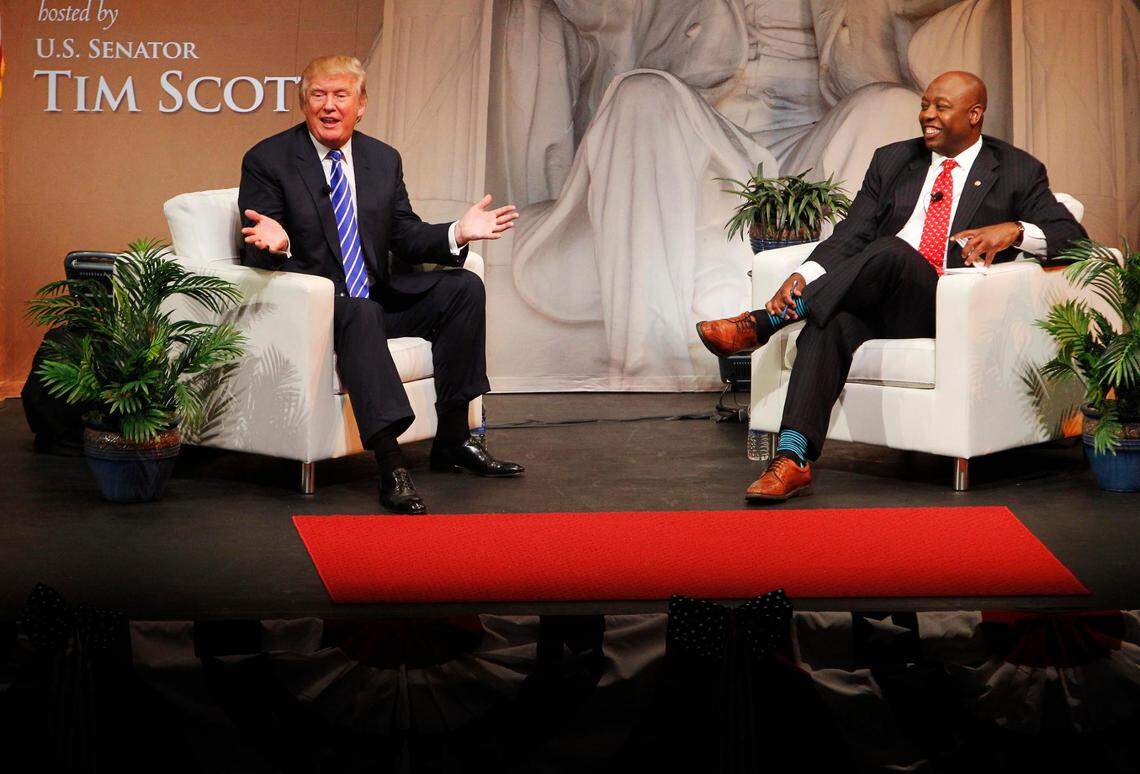
During a fundraiser last year for Scott, in the wealthy Washington suburb of McLean, Va., one host conveyed to confidantes that while he wants Scott to run for president, he sees the more likely outcome for South Carolina’s junior senator as being one of the top three finalists for vice president in 2024, regardless of who the ultimate nominee is.
Sometimes enhancing one’s chances at being chosen for No. 2 means running for No. 1.
But a Scott presidential campaign would likely set up awkward clashes on multiple fronts that risk tarring his optimistic, nice-guy image.
Haley, who appointed Scott to the Senate seat he now holds, looks almost guaranteed to announce her own campaign in the coming weeks.
“Personality wise, I think I would perceive Haley as more aggressive. Scott has been more of a quiet voice over the years. He’s had some effectiveness, but he has not been as much as front and center as Haley,” said Chip Felkel, a GOP consultant in the state.
With Graham as Trump’s top ally and Senate whisperer, Scott would also find himself without the support of his own home state colleague.
And then there’s Trump himself and the question of how aggressive of a contrast Scott would embark on.
“At this point, no Republican has attacked Trump directly and I don’t know if and when that will change,” said Matthew Continetti, an author of a book on the history of the right and senior fellow at the American Enterprise Institute.
“Never before in the history of the South Carolina primary has a presidential candidate received this much support this early in the day,” said Rep. Russell Fry at Trump’s event on Saturday, a subtle reminder to potential opponents.
The anonymous Republican congressman said he hoped to God that Trump would not attack a Scott candidacy.
“Tim Scott is incapable of saying something mean about somebody,” he said, still requesting anonymity. “I have a feeling that he will lose a lot of people from South Carolina if he does anything adverse to Sen. Scott. He’s the only person that people feel that way about.”
Observers say Scott would likely lean into his future-focused vision, highlighting his hard-scrabble biography and pitching tax incentives for underserved areas and expanding educational choice through charter schools.
Given the spike in violent crime in major cities across the country, his bipartisan gambit towards an overhaul of policing and criminal justice laws could irk the Republican base.
Scott holds some staunchly conservative views that are outside the mainstream, like adhering to the Bible’s message of strict abstinence before marriage. “Not to do so is a sin,” he’s said.
Scott is single himself, and the country hasn’t elected a bachelor to the White House since James Buchanan, who served just prior to the Civil War.
“I don’t think that really matters anymore,” said Glenn McCall, the Republican national committeeman. “He’ll have his mother by his side so I think that’ll be fine.”
There’s always the option of running for governor in 2026 or bide his time until Trump’s hold on the party fully evaporates, perhaps by 2028. Though waiting and missing a moment can be just as heavy a risk.
“I wish he would stay in the Senate forever,” said Rep. Joe Wilson, who has endorsed Trump. “We have a history of doing that in South Carolina. And people have changed their mind, good people.”
Correction: An earlier version of this story misreported that a bachelor has never been elected president. James Buchanan was single when he was elected in 1857,
This story was originally published January 26, 2023 at 1:19 PM with the headline "Tim Scott’s tricky 2024 decision: To confront Trump in a race for president or not."
