
Richland County will lose legislative seat after SC House passes new redistricting map
Richland County will lose a representative in the State House after lawmakers voted Thursday to adopt a new map that merges two of the county’s 12 House districts.
The plan, which has been criticized for favoring Republicans and incumbent politicians at the expense of voters, passed 96-14. It requires a final vote Monday and must then be adopted by the Senate, but those steps are considered perfunctory.
The House map, released early last month and amended in committee, is projected to give Republicans a supermajority in the House and could significantly reduce the number of competitive districts in the state. The current political makeup of the chamber is 81 Republicans to 43 Democrats.
Due to South Carolina’s explosive growth over the past decade — the state added about 500,000 people, according to the 2020 census — large-scale changes were necessary to ensure all districts had roughly the same number of people.
Among the most significant changes in the new House map is the consolidation of Districts 70 and 80 in lower Richland County, setting up a possible 2022 primary between Democratic Reps. Wendy Brawley and Jermaine Johnson.
Brawley, of Hopkins, introduced two amendments that would have modified the proposed map, but her suggestions were tabled.
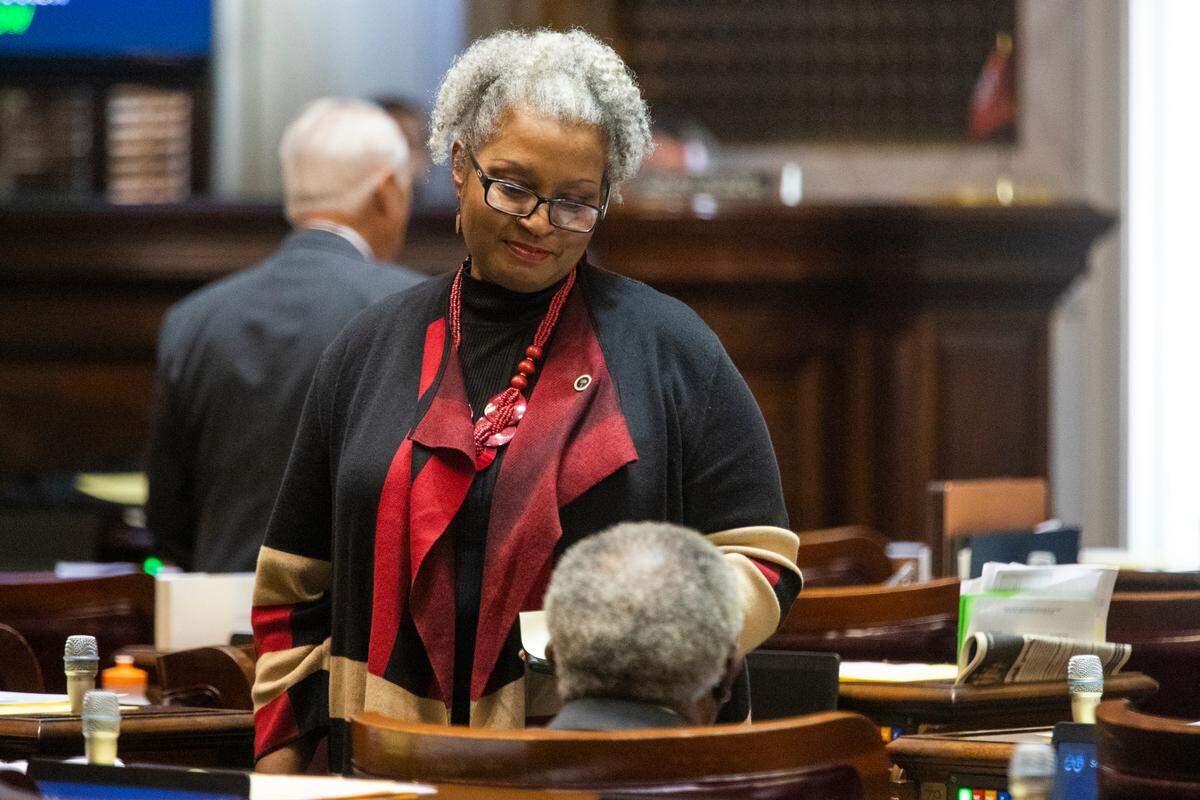
She said she understood and accepted that members of the Republican majority would use their power to draw lines beneficial to themselves. What she didn’t get, Brawley said, was that Republicans would behave as though the process was actually fair and transparent.
“The districts are so gerrymandered not only to protect the incumbents that are here who are Republicans, but also to increase their numbers so significantly that it totally marginalizes the Democratic vote and it totally marginalizes the minority populations of this state,” she said Thursday on the House floor. “I just believe we can and should do better. And I would hope that we’d want to do better.”
State Rep. Jay Jordan, R-Florence, who chaired the House redistricting committee, defended the integrity of the panel’s process, saying it had gone to great lengths to ensure everything was done transparently.
“Incumbent locations were considered,” he said. “But lines were not contorted in order to protect incumbent legislators. I can say that very, very clearly.”
While the once-a-decade redistricting process is nearly always fraught with conflict and accusations of partisan bias, critics say the House map is particularly egregious — a sign the map may be challenged in court.
The state’s underlying demographics make creating a truly unbiased map impossible, but the new House map is significantly more gerrymandered than even the existing imperfect map, an impartial analysis indicates.
Only nine of 124 districts are competitive, or about half as many as the current House map, according to Dave’s Redistricting app, a popular map drawing and analysis tool.
“The extremely low number of competitive districts — even at a generous ±5% standard — points toward making voters nearly obsolete in general elections for the SC House of Representatives,” the nonpartisan League of Women Voters of South Carolina wrote in its assessment of the proposal.
The House map splits roughly the same number of counties as the current one, but nearly three times as many precincts, which can create voter confusion. It has 32 majority-minority districts — two more than the current map — but actually scores lower on minority representation, according to Dave’s Redistricting.
Under the proposal, Charleston, Horry and York — three of the fastest growing counties in the state — would add seats from areas where population has increased more modestly or not at all since 2010. Richland County, on the other hand, is due to lose a seat after the merger of the two lower Richland districts.
District 66, which moved from Orangeburg to York County to accommodate the area’s population growth, will absorb the portion of state Rep. Raye Felder’s current district west of Interstate 77, including Tega Cay, but not crossing over Lake Wylie.
“We’ve had tremendous growth in northern York County and northern Lancaster County. I mean, the census numbers just blew up,” Felder, R-York, said. “So in looking at that amount of tremendous growth, there was really no other way but to add a new district up there.”
Felder’s District 26 will now run east of I-77 to the Lancaster County line, and together the districts will comprise all of York County north of the Catawba River.
“York County is very similar all over, but especially north of the Catawba River,” she said. “We are geographically incredibly similar, and also in our lifestyle and our quality of life because we are next door to Charlotte.”
The new York County seat is open, with no incumbent living in the district.
Felder said she was thankful the committee had taken her input about maintaining districts within county lines, using natural barriers — like a river or an interstate — to divide districts and keeping communities of interest together
“Try not to split cities, try not to split townships. I think all of that builds to better government, where it’s possible to do,” she said.
New House map pits incumbents against each other
Ten incumbents — four Republicans and six Democrats — are drawn into districts with one another, setting up potential primaries next year, and at least two districts are left without an incumbent after their representative was shifted into a neighboring district.
State Rep. Sandy McGarry, R-Lancaster, one of the lawmakers who has been drawn into an incumbent’s district, said Wednesday she did not plan to run against Rep. Richie Yow, R-Chesterfield, her political mentor.
Brawley, however, intends to run again, she said.
Johnson, her potential primary opponent, said he’d yet to make a decision about his political future and wanted to sit down with Brawley and talk it out before doing so.
Regardless of his decision, Johnson said he had immense respect for his colleague and would not allow a potential election get between them.
“We’re not going to allow this to divide us. We’re not going to allow this to divide our community,” he said. “If it comes down to a point to where we have to decide what we’re going to do, we’re both going to sit down, we’re both going to discuss this and we’re both going to figure out a way forward.”
Other House lawmakers who have been drawn into the same district are Reps. Vic Dabney, R-Kershaw, and Brandon Newton, R-Lancaster, in District 45; Reps. Jerry Govan, D-Orangeburg, and Russell Ott, D-Calhoun, in District 93; and Reps. Cezar McKnight, D-Williamsburg, and Roger Kirby, D-Florence, in District 101.
Of the incumbents who are “double bunked” in the new map, all but Newton, McKnight and Yow voted against the proposal or did not vote.
Democrats’ power further diminished
McKnight, whose district now extends beyond Williamsburg into Florence and Berkeley counties, said he wasn’t surprised about its geographic expansion.
“There’s an old saying, especially if you listen to hip hop: Men lie, women lie, numbers don’t lie,” he said, riffing on the words of rapper Jay-Z. “And we’ve had a severe population bleed in my part of the state, so I was expecting having to expand District 101 out a great deal into Clarendon and other places to make up the population.”
While McKnight said he wished he and Kirby hadn’t been drawn into the same district, he understood it was “just what happens when your areas don’t grow.”
He spoke highly of the Republican-led House redistricting process, despite the fact that it would likely result in Democrats losing more power in the years to come.
“There are winners and there are losers, and that’s just the way that our democracy was set up,” McKnight said. “Right now I don’t see anything on its face that makes me say this was an unfair process.”
If Republicans eventually gain a supermajority in the House, which models predict will happen under the new map, Democrats would be unable to use parliamentary measures to hold up controversial bills, as they have in the past.
“That’s just a reflection that elections have consequences,” McKnight said. “I think, as a party, we Democrats have to do a better job of messaging so we can find more voters that identify with us. It’s our time in the wilderness. We’ll eventually come out if we’re smart.”
Johnson lamented that it could be decades before Democrats regain any semblance of power in the State House, but said at least residents upset with the state’s direction will know which party to blame.
Will Hilton Head continue to be split?
Two of the nine Republicans who did not vote on the bill represent portions of Hilton Head Island.
State Rep. Weston Newton, R-Beaufort, missed the vote while recovering from a recent choking incident that put him in the hospital and Rep. Jeff Bradley, R-Beaufort, abstained because he vehemently opposes the way his district has been drawn.
At issue is the splitting of Hilton Head into two House districts, with Bradley representing the entire island with the exception of half of a single voting precinct that falls in Newton’s district.
Even though the split is historical, Bradley said he’s been catching hell from constituents who blame him for carving up the island.
“It’s important that people understand I didn’t set this up. It wasn’t me,” he said, adding that he prefers the district to be drawn as sensibly as possible.
Bradley proposed an amendment to the House map Thursday that would make the island whole in his district, but it was tabled at the request of House Judiciary Chairman Chris Murphy, R-Dorchester, because it would affect Newton’s district.
Bradley said afterward that he hadn’t been able to get in touch with Newton about his proposal, but that he hoped his amendment could be attached to the redistricting bill in the Senate, if he’s able to get Newton’s blessing.
Newton, who sits on the House redistricting panel, responded to criticism of the Hilton Head split during a committee hearing earlier this month, saying that the portion of Hilton Head that stretches into his district, an area known as Jenkins Island, is actually outside the municipal boundaries of Hilton Head and has “dramatically different” interests than the rest of the island.
“It has been made clear that that area does not believe that they are part of Hilton Head, in fact they have resisted the municipal boundary annexation,” he said.
While the unusual split of Hilton Head may not be a new feature of District 123, its extension into parts of Jasper County is novel. Bradley’s district, which currently encompasses only Hilton Head and Dafuskie islands, will extend along the Savannah River and up to Hardeeville following the redraw.
This story was originally published December 2, 2021 at 12:22 PM with the headline "Richland County will lose legislative seat after SC House passes new redistricting map."