
SC’s federal lawmakers request earmarks in spending plans. Here’s what the money’s for
Nearly $400 million in federal spending could come back to South Carolina through direct requests and spending authorizations from the state’s congressional delegation.
The requests come as Congress has brought back direct spending requests, referred to as earmarks, for the first time in about a decade as it puts together appropriations bills for the upcoming federal fiscal year.
The U.S. Senate currently is working on various appropriations bills that could include money for public projects in South Carolina.
U.S. Sen. Lindsey Graham, R-Seneca, who is the ranking Republican on the Senate Budget Committee, has requested nearly $44.5 million including money to acquire land to build Interstate 73 to connect Interstate 95 to Myrtle Beach; building a new access road to Charleston International Airport; creating a road network to ease congestion along Whiskey Road in Aiken; a wastewater collection and treatment system in Dorchester County; eliminating vacant and dilapidated properties in Sumter, and continued planning on the Saluda Grade Rail Trail in the Upstate.
Graham also has requested more than $230 million for various military construction projects at bases around the Palmetto State in the Military Construction and Commerce appropriation bills, including $122.6 million at the Marine Corps Air Station in Beaufort to construct an aircraft maintenance hangar to support the F-35 training squadron.
He also has requested more than $1 million for police departments in the state, including $709,000 for the Columbia Police Department’s body worn and in-car camera program in the Commerce, Justice and Science appropriations.
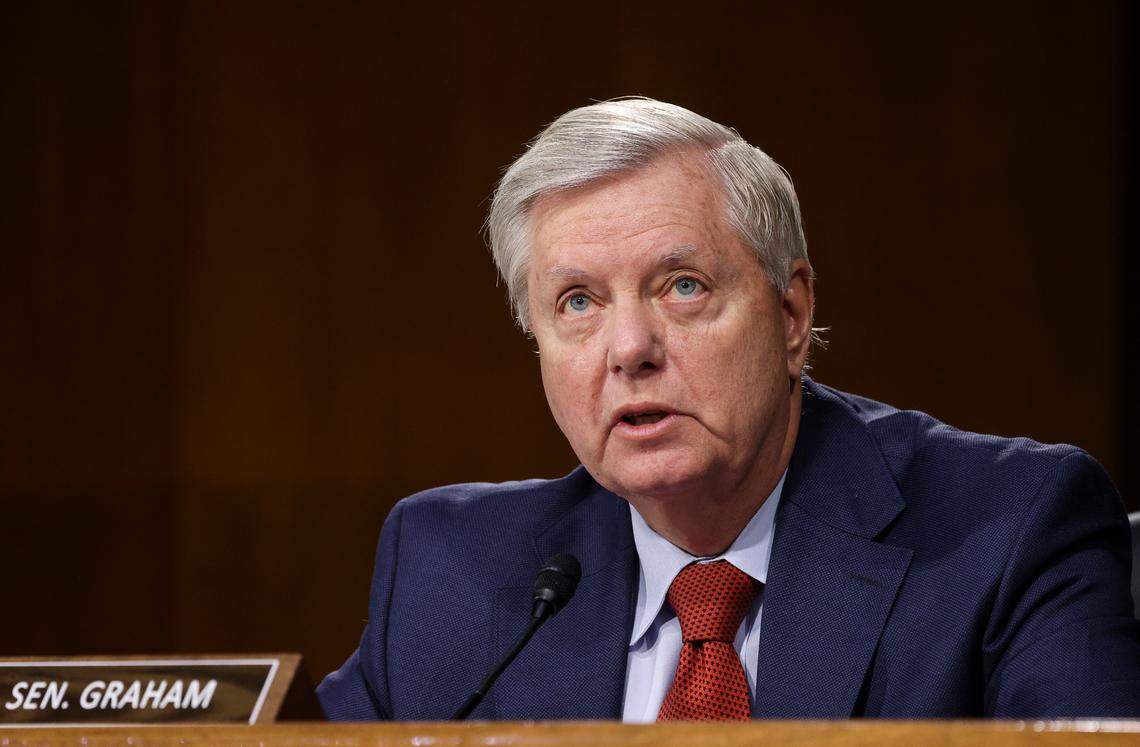
The state’s senior senator also requested $18 million to provide water to the U.S. Highway 176 corridor in Orangeburg County and Berkeley County in the Camp Hall area, as well as $1.5 million for Charleston for a inland flood risk study and $1 million for hydrology study in Horry County to mitigate future flooding around the Waccamaw River.
“I believe it is important that elected officials have a say in how taxpayer money is spent on infrastructure and not rely on bureaucrats in Washington to protect South Carolina’s interests,” Graham said in a statement. “The funding requests for member-directed spending items are public record. Every person will be able to judge for themselves if these are worthwhile requests.”
House members, through their Appropriations Committee, also were able to make requests for earmarks community projects.
U.S. Rep. Jim Clyburn, D-Columbia put in $48.2 million worth of requests, including the same funding request for Orangeburg-Berkeley Reach, as well as a $4.3 million earmark for Allen University to restore and expand the Waverly-Good Samaritan Hospital building and $4.3 million for Benedict College to provide a learning hub to provide direct services to underserved students.
“I have never been against earmarks,” Clyburn said. “I’ve always been for them, and even when we didn’t have them, I didn’t miss an opportunity every year to tell them that we’re crazy for not doing it.”
He says the projects he proposes are investments constituents say are needed for their areas, giving an example of a previous water system earmark at Lake Marion.
“Guess what, the Volvo plant is there because of that water system,” Clyburn said.
He said he wants earmarks included annually and thinks it was a mistake to do away with them.
“I’m glad we came to our senses in bringing them back,” Clyburn said.
Earmarks stopped in January 2011 because they had been criticized as being politically motivated, potentially wasteful spending and inequitable. The ban came during the Obama administration and after the Tea Party waive gave Republicans control of the US House.
The appropriations process takes place after the House passed the INVEST in America Act five-year authorization for federal infrastructure spending, including billions out of the highway trust fund.
The legislation, which passed the Democratically controlled House with only two Republican votes, authorizes spending for $53 million for specific South Carolina projects.
Clyburn helped ensure authorizations for up to $20 million for projects in his district, including the widening of the US 21/178 Bypass from US 301 to US 178 in Orangeburg, improvements to the Manning Avenue Bridge in Sumter; construction of a bicycle and pedestrian lanes in Columbia; rehabilitation and renovation of Santee Wateree Regional Transit Authority’s administration, and maintenance facilities, improvements along Old State Road in Calhoun County.
SC’s infrastructure needs called ‘dire’
House Transportation Committee member U.S. Rep. Nancy Mace, R-Daniel Island, put three authorization requests into the bill, but only $20 million for an I-26/I-526 interchange project in North Charleston was included in the final House bill.
Requests to authorize funding for a Hilton Head Airport expansion and an intersection improvement at the US 52 and US 176 were ultimately kept out of the bill.
“South Carolina’s infrastructure needs are dire and mounting, which is the reason why I requested to be a member of the House Transportation and Infrastructure committee,” Mace said.
Bill writers also included a $13 million request to help widen Belvedere Clearwater Road in Aiken submitted by U.S. Rep. Joe Wilson, R-Springdale.
However, both Wilson and Mace voted against the bill.

“I am grateful that the funding I requested for the SC-126 Belvedere Clearwater Road Widening was included in the House Surface Transportation Bill, but unfortunately the bill as a whole is nothing more than a partisan spending spree full of wasteful Green New Deal-inspired handouts, increased irresponsible spending leading to more debt and higher inflation, and increased federal overreach,” Wilson said.
Money in the House transportation bill, which needs approval from the Senate and the president’s signature, authorizes money be spent for projects and other initiatives.
Projects funded through the surface transportation authorization bill will get money directly from the Highway Trust Fund and do not require a separate or subsequent appropriation bill, according to the House Transportation committee instructional booklet for members making requests.
Other Republican members of the state’s congressional delegation did not request projects be included in the House transportation bill and have not requested funding for community projects in the House appropriations bills.
“I drew a line in the sand promptly upon my swearing in that I would not support frivolous spending or earmarks, given the past instances of misuse, fraud and waste. I won’t vote to add to the deficit and I won’t vote to raise taxes,” Mace said.
“Furthermore, given the economic issues we face today, now more than ever, we need to think long and hard about how the government spends tax dollars. In the middle of the pandemic the government literally shut businesses down, yet continued to spend big, just like always. It’s do as I say, not say as I do up here.”
This story was originally published July 22, 2021 at 5:30 AM with the headline "SC’s federal lawmakers request earmarks in spending plans. Here’s what the money’s for."
