Beaufort County tables vote on ‘problematic’ new public records policy
Update: One week after the publication of this story, Beaufort County Council tabled the final vote on the proposed policy Monday night and voted to review it in executive committee.
Beaufort County is considering a new policy that could restrict the public’s right to access government records.
The uniform Freedom of Information Act policy approved by the county’s executive committee last week seeks to “balance Beaufort County’s commitment to transparency and openness” while protecting confidential information, the policy states.
Officials applauded the move to create a policy. They wanted a roadmap for how to respond consistently to requests for public records from reporters, lawyers, business owners and everyday citizens trying to find information about such things as taxes, real estate and trash and recycling programs.
But the county government has struggled with transparency in recent years — and the new policy approved by committee includes several problematic hurdles for citizens who want to know what their government and elected officials are doing, legal experts say.
Beaufort County has been criticized in the past for its interpretations of state law and handling of public records. The county currently faces a lawsuit claiming that its use “of excessive fees and costs is a willful violation” of the Freedom of Information Act “designed to chill the public’s right to access to government records.”
The County Council’s top elected leader was forced to resign the chairmanship last year after he refused to allow the public access to his calls and emails. And the council’s vice chair has publicly advocated for the county to “control” data provided to the public.
The new nine-page policy, which the council is expected to consider at its next meeting, details how to file a Freedom of Information Act request, which documents are not considered public and how much money the county plans to charge for records.
Among the rules laid out in the policy are some stipulations that give legal experts pause.
“The devil is always in the details,” said Taylor Smith, an attorney who litigates Freedom of Information Act cases.
▪ Under the new policy, the resignation letters, resumes and performance reviews of government employees will be redacted, video and audio recordings are withheld from public view, and the county may require some citizens to sign an affidavit with two witnesses and a notary before records are released.
Bill Rogers, executive director of the S.C. Press Association, said he thinks the county has “missed the point” of the Freedom of Information Act by planning to redact documents such as disciplinary issues. The policy, he said, creates a barrier between the public and their elected officials.
“It certainly is overkill,” he said. “Just release the documents. It should be simple. You file a request, you get your document. This is elevating it to another level.”
▪ The policy allows the county to close public records request after 90 days of inactivity — which is not mentioned in state law. Smith called this “problematic.”
▪ It also does not include the line in state law that allows governments to provide records for free if the documents benefit the public. However, it does give the county administrator and records department the ability to waive fees if the records cost less than $50.
Although setting a uniform public records policy is a “good first effort” at engendering transparency in local government, it could send mixed messages about how the state law is supposed to be enforced, Smith said.
“It is often true that the unequal enforcement of any law is what creates less trust,” he said.
Smith said the policy will “will live and die” based on how the county chooses to enforce it.
The policy
The County Council introduced its new Freedom of Information Act policy at last week’s executive committee meeting.
It is intended to “provide the public and County’s employees with clear requirements and practices that will permit the County to operate in an open and public manner,” the resolution states.
After little public discussion, the committee unanimously approved the policy. It’s likely to go before the full County Council for approval at its next meeting on Feb. 22.
The lengthy policy outlines step by step how citizens can file for public records, includes a cost breakdown for requests and describes exactly what the county doesn’t consider a public record.
Council Chair Joe Passiment said Friday that the goal of the policy is to make sure the county handles public records in conformance with state law.
“We’re clearing things up,” he said. “We’re setting our goals for the coming year, and we want to make sure we’re doing everything correctly.”
The policy was reviewed by the county’s legal department before last week’s meeting, he said, and it could be amended before it gets to council for final approval.
“We want to make sure we do everything right,” he said. “That’s why we had [the legal department] start the process. If there are any concerns, we can address them now.”
What is a public record?
According to the policy, the following are not considered public records:
▪ Income tax returns
▪ Medical records
▪ Hospital medical staff reports
▪ Scholastic records
▪ Adoption records
▪ Records related to registration and circulation of library materials to the extent they identify library patrons
▪ Information relating to security plans
▪ The identity or information tending to reveal the identity of any individual who in good faith makes a complaint or otherwise discloses information which alleges a violation or potential violation of law or regulation to a state regulatory agency
▪ The use of any personal information from a state agency for commercial solicitation
▪ Other records which by law are required to be closed to the public.

The policy also states:
▪ That government employees’ personnel files are considered public record, but says the county will redact drivers licenses, information about spouses and children, personal phone numbers, personal email addresses, resumes, health insurance, benefit packages, employee reviews and resignation letters. This information, the policy says, is redacted to protect employees’ privacy.
Smith, the public-records attorney, said the policy’s statement that government employees’ resumes and resignation letters can be withheld from the public’s view is “just asinine.”
A person has a right to privacy in their own home and certain aspects of their life, Smith said, but government employees have “absolutely no expectation of privacy” when performing their public duties.
“To say that a resume or a resignation letter, which is only provided in a professional context, should be redacted because it’s an unreasonable invasion of personal privacy simply ignores what personal privacy is,” he said.
▪ That video and audio recorded within any building owned or occupied by Beaufort County will not be released because of “security purposes.”
▪ That the county may require citizens to sign a Commercial Solicitation Affidavit if they request “extensive” tax records, housing records or records “pertaining to a large number of citizens in the county.”
The affidavit, attached to the policy, requires the requester to swear the documents requested will not be used for commercial solicitation. It requires a notary and two witness signatures.
Smith said asking citizens to swear under oath that they will not use records for commercial solicitation “represents yet another hurdle to accessing information at minimum cost or delay, which the state open record laws require.”
It’s not the government’s job, he said, to “police” whether a person intends to sell the records under penalty of perjury. It’s up to the requester to know the law.
“This is a potential sea change that is troubling,” he said.
And, he said, the policy’s requirement that record requests can be closed after 90 days of inactivity creates a burden on citizens that’s “more extreme” than what state law requires.
The cost of public information
S.C. law states governments may charge fees for searching, retrieving, redacting and copying records, but it is not mandatory. There is also a provision in the law allowing governments to provide records for free when the information is “primarily benefiting the general public.”
According to the S.C. Press Association guidebook, “News reports based on public documents almost always benefit the public.”
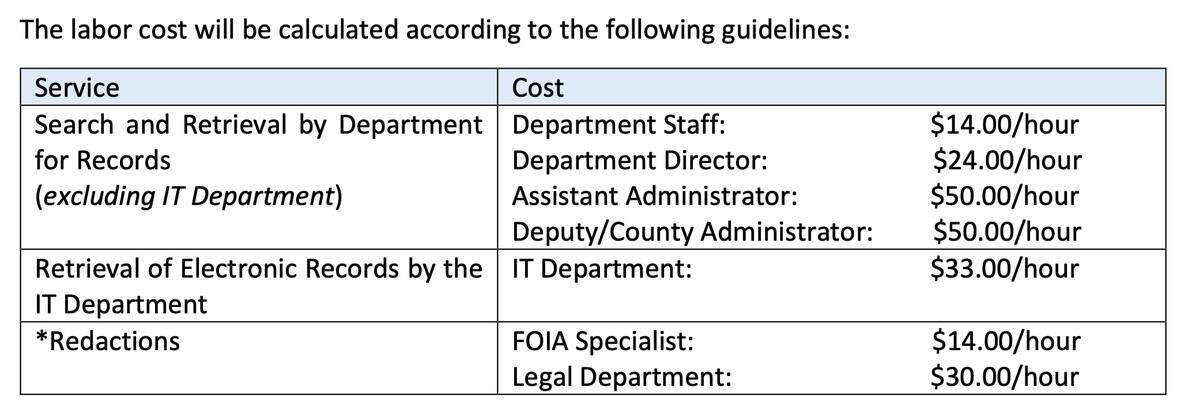
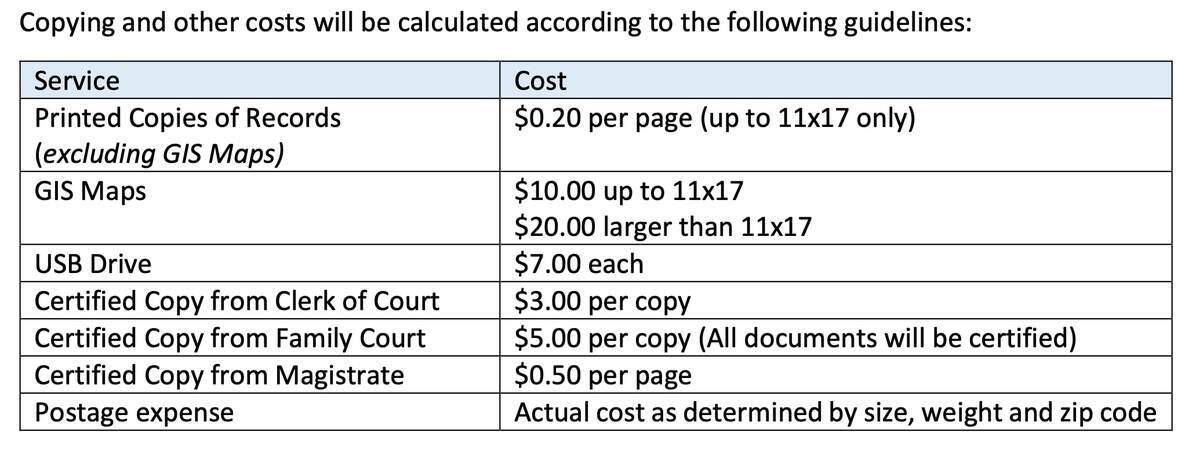
The county’s policy breaks down the price of record requests by labor, copying and other costs.
Costs range from $14 an hour to $50 an hour for county staff to search, retrieve and redact the documents. The cost range is based on the hourly wage of the employee.
S.C. law states that the hourly rate to obtain records “shall not exceed the prorated hourly salary of the lowest paid employee who, in the reasonable discretion of the custodian of the records, has the necessary skill and training to perform the request.”
This provision is quoted in the county’s policy.
This story was originally published February 15, 2021 at 9:00 AM.