Former SC official who lived and voted in NC won’t be charged with crime, solicitor says
A nearly year-long criminal investigation has found that Gerald “Jerry” Stewart, former Beaufort County Council vice chairman, did not violate state law when he lived and voted in another state during his term on council, according to a Oct. 27 letter obtained by The Island Packet and Beaufort Gazette.
Although the S.C. Law Enforcement Division’s investigation confirmed that Stewart “vacated” his seat and was “unqualified” to serve on Beaufort County Council when he moved his permanent address to North Carolina, SLED and 14th Circuit Solicitor Duffie Stone determined that S.C. law allowed Stewart to continue serving as a “de facto” member of council until a successor was elected or appointed.
A special election to replace Stewart never occurred because he didn’t publicly divulge his residency change until his last meeting on council. However, a July 2018 email obtained by the newspapers sent from Council member Stu Rodman to Stewart and current Vice Chair Paul Sommerville shows that at least some council members were aware that Stewart was traveling back and forth to North Carolina during his term.
Both Rodman and Sommerville have denied knowing that Stewart was a resident of North Carolina during part of his term on council.
As council vice chairman and head of two important county committees, Stewart held significant voting power during a contentious period on county council.
Two of the biggest issues in the county during Stewart’s last six months on council were the search for a county administrator to replace Gary Kubic and the subsequent fallout related to a $24,000 consulting contract given to former interim administrator Josh Gruber in July 2018.
Council members were divided on both issues. One faction — a group of five members that included Rodman, Sommerville and Stewart — supported Gruber for the administrator’s job. A group of six seemed to oppose his appointment from the beginning.
Stewart did not immediately return a call for comment Monday.
SLED began the investigation last November, a month after the newspapers reported that Stewart, who served three terms on county council — from 2007 through 2018 — voted on important county issues, and in a South Carolina primary, despite residing in North Carolina.
The newspapers also reported that Stewart was registered to vote in both states and had Beaufort County Council payments addressed to his N.C. home.
Former Beaufort County Council member Rick Caporale, who asked Stone’s office to investigate Stewart after the stories published, called the decision not to charge Stewart “a huge miscarriage of justice.”
He said he plans to ask the legislative delegation to consider changing a “terrible loophole” in state law that allows an elected official to continue serving while residing outside of the state he or she represents.
“I’d say it’s a black hole,” he said. “It’s bigger than a loophole, and the legislature should jump on it right away. As far as I’m concerned, he voted illegally on council.”
The letter from Stone, addressed to SLED investigator Capt. Ryan Neill, states that, according to S.C. law, “once Mr. Stewart moved outside of his district and/or county, he would no longer be qualified to sit on County Council. His seat would be vacated.”
The newspapers reported that, while serving as vice chairman of Beaufort County Council, Stewart officially registered to vote in North Carolina in September 2018.
However, Stone’s letter, which cites state law and several Attorney General’s opinions, says, “an elected official who becomes unqualified due to a change in residency may continue to perform the duties of a previously held office as a de facto officer until such time as a successor is elected or appointed to fill the unexpired term.”
“There is abundant legal authority that Mr. Stewart retained the right to act as a de facto councilmember with voting rights until such time as a successor was appointed to fill the remaining months of his term,” the letter said. “Accordingly, there is no evidence that Mr. Stewart committed any crime.”
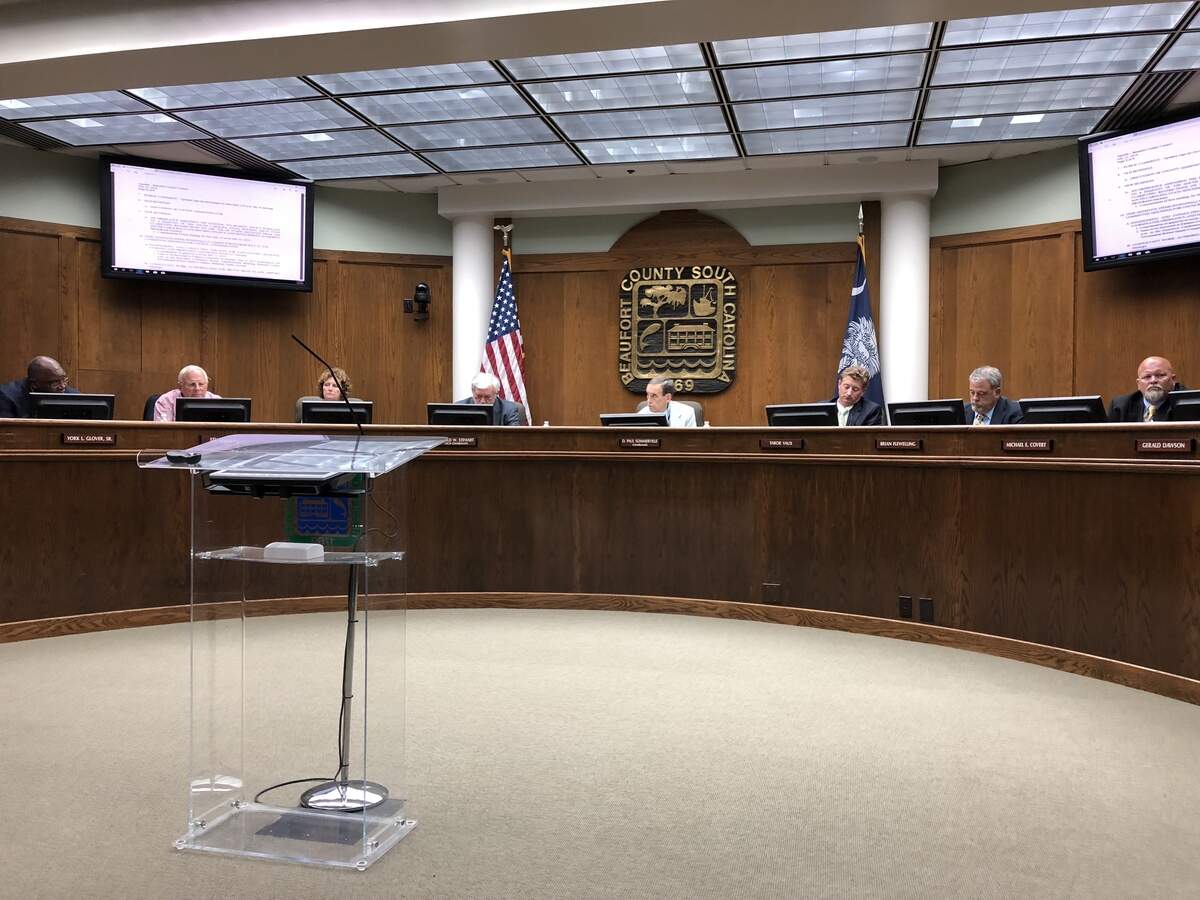
Because Stewart did not publicly address his residency change until Dec. 10, 2018 — his last council meeting — an election was not held to replace him.
The SLED investigation found that Stewart rented a home in Bluffton from January 2018 through October 2018. The report states that Stewart physically moved from the rented house on Oct. 31, 2018.
Mare Baracco, a Port Royal resident who also called on Stone’s office to investigate the issue, said Stewart “should have informed County Council and his constituents he had moved and registered to vote in another state, which would have triggered a special election.”
Instead, Baracco said, “Stewart chose to continue collecting Council pay and expenses, vote on important issues, and chair a powerful committee, all while being a registered voter in North Carolina.”
She called it “outrageous conduct.”
The newspapers reported that copies of Beaufort County pay stubs showed that, in July 2018, Stewart changed his address to his N.C. home, and received council payments there, while voting on Beaufort County issues.
The letter from Stone confirmed that Stewart “notified county personnel of his address change,” but did not clarify who was aware that he was living in North Carolina.
The letter from Stone did not address the newspapers’ report that Stewart voted in the Nov. 6, 2018, election as a N.C. voter despite serving on Beaufort County Council.