Fact-checking the claims made in the Herbkersman-Covert Republican primary campaign
The race between Bluffton Republicans Bill Herbkersman and Mike Covert for S.C. House of Representatives District 118 has been contentious, full of disrespect, rancor and jabs at the other’s fitness for the office.
Both candidates have made claims against each other in ads published in The Island Packet and Beaufort Gazette.
Herbkersman compiled a table comparing his positions and background with Covert’s. Covert’s attacks mainly have come through government critic Skip Hoagland, working in conjunction with the Covert campaign.
With the June 9 Republican primary two days away, the newspapers fact-checked some of the statements the two candidates have made. Here’s what we found:
Fact check: Herbkersman’s claims about Covert
.jpg "download (1).jpg")
Claim: Covert was elected vice chairman for five days before being removed by fellow council members.
Fact check: The questionable word here is “removed.” In January 2019, Beaufort County Council members Brian Flewelling and Mike Covert were elected as chairman and vice chairman on a 5-3 vote, with three council members absent. The vote was invalid, however, because council rules state that it takes six votes to be elected, not a majority. Five days later, the complete council voted, and both Flewelling and Covert were defeated.
Claim: Covert made a contribution to an “Anti-Second Amendment organization.”
Fact check: Herbkersman is citing an answer Covert gave on his S.C. Carry Inc. candidate questionnaire. On that document, Covert responded “Yes” to the question, “Have you ever contributed to any gun-control organization?”
There are 13 gun-related questions on the document. On the other 12, Covert is unequivocal that he favors open carry without permit, is against gun registration, would allow guns to be carried on school grounds, churches and medical facilities, and is a member of the NRA.
When asked by the newspaper about his answer to the contribution question, Covert said he misread the question and should have answered “No.” He said he has never contributed to an organization that is against the Second Amendment.
Claim: Covert has “regularly been receiving salary, stipend and holiday pay” he should not have received.
Fact check: Herbkersman is citing a May 24 article by The Island Packet that shows Beaufort County Council members approved cost-of-living increases for county employees four times over the past eight years. Because the raises were applied to council salaries, five of the 11 council members made more money in salary and stipends than county ordinance allows. The ordinance has not been amended since 2011. Covert was not elected to council until 2017.
Claim: Covert “has disseminated a photograph of the president that appears to be photoshopped.”
Fact check: On May 21, Covert sponsored a YouTube advertisement entitled “Mike Covert: Pro-Trump Conservative.” The video depicts a photo of President Donald Trump next to a photo of Covert. The advertisement does not imply that it was a photo of the two men together.
Claim: “Covert was Vice Chairman of Finance for Beaufort County Council when a lack of funds affected response for emergency situations.”
Fact check: In mid-April, Beaufort County emergency officials shelved a long-planned project to install its first tornado sirens due to budget constraints attributed to the coronavirus pandemic. The decision to postpone the $520,000 project came just after the deadly tornadoes in neighboring Hampton County. Covert was not the finance vice chair, and the finance committee did not have a say over the project’s postponement.
Fact check: Herbkersman’s claims about himself
Claim: Herbkersman talks of his accomplishments and says he 1) “ensured that local roads were on state high priority list, 2) “improved” green space, parks and water access, and 3) said his “political influence has resulted in better roads.”
Fact check: The claims are not specific enough to fact check.
Fact check: Covert campaign’s claims about Herbkersman
Claim: Covert, in a brief 10-second YouTube ad, says Herbkersman “attacks” Trump.
Fact check: Covert does not cite any support for this claim. Herbkersman hosted Trump in 2016 at a Sun City event, and Herbkersman shared at the event that he and his wife donated to the Trump campaign. Herbkersman’s website claims Trump has endorsed him, although it offers no support for the claim.
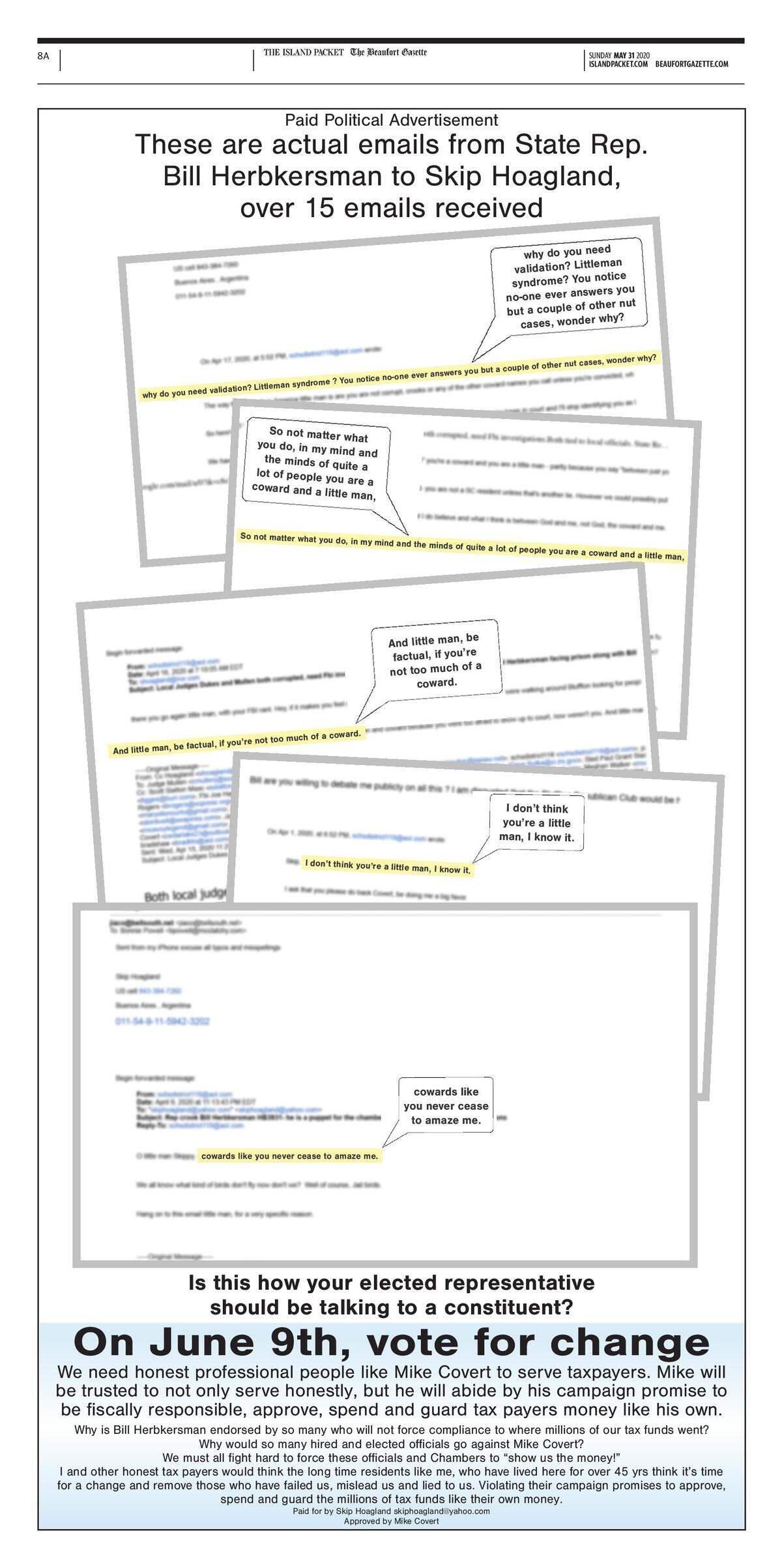
Claim: Covert’s newspaper ads were paid for by longtime chamber of commerce and government critic Skip Hoagland. They attack Herbkersman’s fitness for office by showcasing email responses to Hoagland that speak to him in derogatory terms, calling him things like “little man” and “coward.”
Although Covert did not pay for the ads, they were approved by his campaign before publication and ask taxpayers to vote for Covert.
Fact check: The emails come from Herbkersman’s email address, and he has not disputed sending them.
The ads, however, black out Hoagland’s portion of the emails showing the context in which they were sent. In those sections, Hoagland makes claims of corruption against a variety of people not involved in the election. He also personally attacks Herbkersman and his religious beliefs.
The Island Packet and Beaufort Gazette newspapers chose not to publish these emails.
Hoagland, for years, has sent long, antagonistic missives to a broad list of recipients, accusing dozens of people of corruption and assorted crimes. Those accused in the emails rarely respond, but in this case, Herbkersman did so.
BEHIND THE STORY
MOREHow we did this story
The Island Packet and Beaufort Gazette newspapers researched the facts in political advertisements published leading up to the June 9 Republican primary for state House of Representatives District 118, a two-person race.
S.C. Rep. Bill Herbkersman paid for and approved his ads attacking challenger Mike Covert, a Beaufort County Council member. Herbkersman’s ad on June 3 contrasted him and his opponent. Covert did not run a similar ad, but his campaign benefited from ads written and funded by government critic Skip Hoagland. Covert approved the ads, which ran in the newspapers on May 24 and May 31.
All ads were treated as representatives of candidates’ respective campaigns and examined for truthfulness and accuracy.