‘Mess of epic proportions’: Beaufort Co. expects major revenue drop due to coronavirus
Beaufort County’s local governments, anticipating major losses in revenue due to the coronavirus pandemic, are adjusting budget drafts for the upcoming fiscal year to avoid a deficit.
County Administrator Ashley Jacobs said she expects revenue to decline between 10% and 20%, although the county has not completed projections beyond the general fund, which is about 60% of the total budget.
Earlier this week, County Chief Financial Officer Alicia Holland provided financial documents projecting the county’s total revenue at $194 million for fiscal year 2021 compared to $335.6 million in fiscal year 2020 — a 42% decline.
Before The Island Packet reported the numbers, the newspaper asked Holland to clarify that revenue was projected to decline by 42% in 2021. In an email, Holland confirmed that “for now, that is our picture of revenue,” though she said it was a preliminary number.
After the story published Wednesday, Holland said the two figures actually could not be compared because the data for 2021 was still incomplete and did not include revenue from the 2018 penny sales tax, grants from the Federal Aviation Administration and transfers from other funds.
According to projections, Beaufort County is expecting to bring in $126.6 million to its general fund in 2021. That’s down only about 6% from the $135 million that was budgeted in the general fund this fiscal year.
In its total budget, Administrator Jacobs said, the county is expecting up to a 20% drop in revenue.
The city of Beaufort has not announced its projected revenue losses for 2021, but officials said Tuesday they anticipate the city will lose about $2.1 million from its $22 million budget in the current fiscal year due to the virus.
Hilton Head and Bluffton officials say they have not been able to calculate all of the losses from businesses closing, and because governments have delayed deadlines for business licenses, hospitality taxes and other fees, they won’t know the extent of the loss until just before the start of the new budget year.
Unlike Congress, which can run a deficit, local governments must balance their budgets, which means either cutting spending or raising taxes. Across the country, towns and counties acknowledge the coming year will be tough.
San Antonio Mayor Ron Nirenberg told the Washington Post that nationwide, cities “are looking at some degree of austerity.” He predicted his city would face as much as a $100 million shortfall. “This is a reckoning for us.”
To shore up the budget, Nirenberg said, the Texas city may have to look at “streets and sidewalks, parks, libraries, culture programming, social services” and other areas for potential cuts.
Beaufort County may have to cut new jobs and equipment and reduce some operations, Jacobs said, but layoffs are a last resort.
“This is a mess of epic proportions,” she said. “It’s unprecedented.”
While revenue projections are almost guaranteed to change over time, the county is anticipating that the coronavirus pandemic could last 18 to 24 months, according to predictions Jacobs said she received from the Centers for Disease Control and Prevention and S.C. Department of Environmental Health and Control.
A prolonged pandemic where taxpayers are confined to their homes will severely reduce revenue generated from business license fees, permits and taxes on tourism.
“It depends on what happens over the next few months,” Jacobs said. “I do anticipate that we’ll have to come back in January with a budget amendment. During this time, I would be very surprised if we had people buying new houses, and we think people will be slow to pay taxes.”
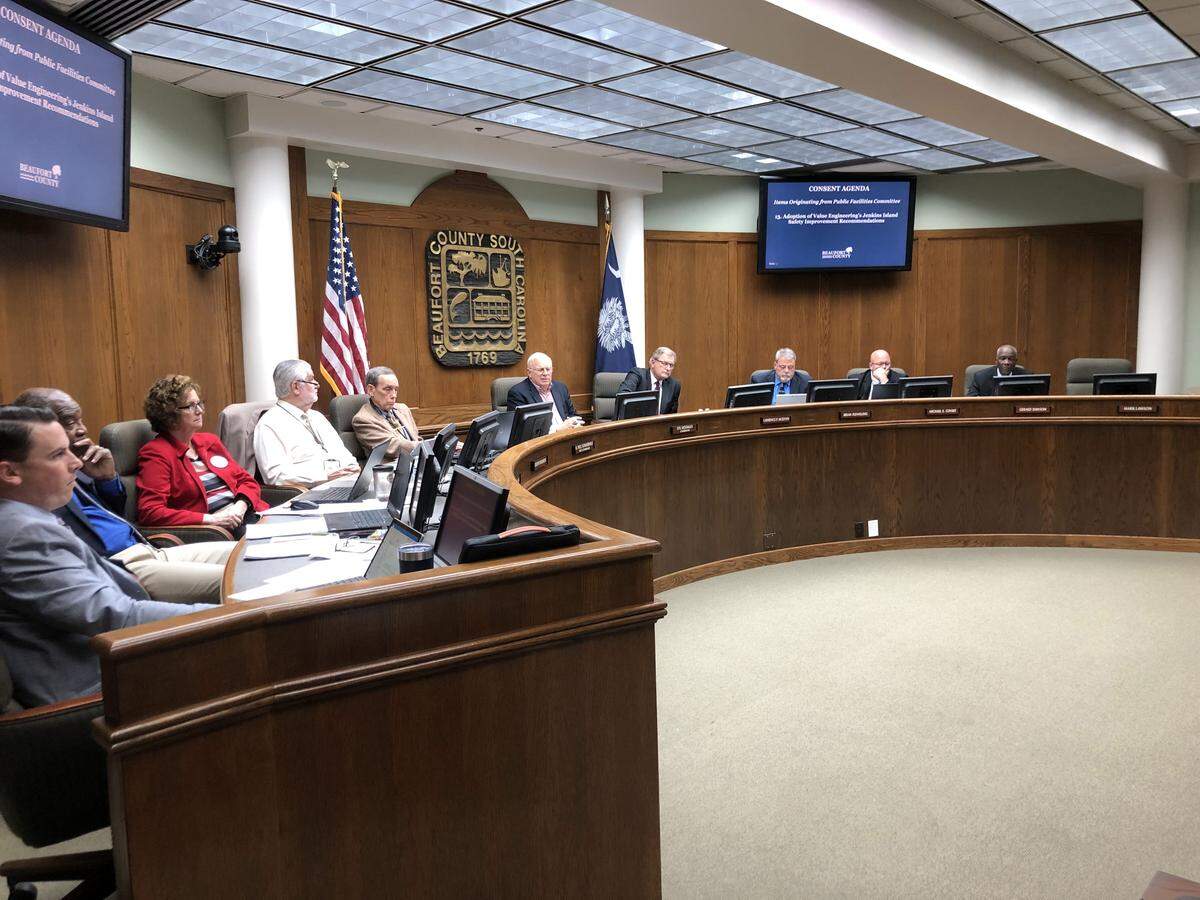
It’s still early in the budget process for fiscal year 2021, and the full financial repercussions of the virus remain to be seen because most local governments have extended deadlines for taxes and fees.
“I’ve asked my department heads to see where they can make cuts,” she said. “My primary goal will be to keep everyone employed. We’re really trying to avoid layoffs.”
Jacobs said she hopes to finish her recommendations for the budget by the beginning of May for council approval.
Until recently, Beaufort County did not have an itemized budget book with a list of expenditures and revenue — something Jacobs was worried about when she took the job last year.
The new budget workbook she started this year allows county officials to compare spending and revenue to previous fiscal years.
A loss in revenue
In 2018, Beaufort County received $240 million in revenues and $215 million in 2019. According to the initial numbers provided by Holland, the county appeared to have budgeted for $335 million this year. However, that number is front-loaded with revenue that the county hasn’t received yet like revenue from the “penny sales” tax.
Next year, however, the county projects significant losses from revenue streams across the board due to expected results of the coronavirus pandemic such as citizens who are laid off, home foreclosures and business closures:
▪ No growth in revenue from real property taxes
▪ A 20 percent reduction in personal property taxes
▪ A 25 percent reduction in permits and licenses
▪ A 15 percent reduction from local governments
▪ A 50 percent reduction in accommodations and hospitality tax revenue
▪ A 30 percent reduction in service fees
Despite losing all of this revenue, the county is expecting to lose only about 6% from the general fund because about 70% of its revenue comes from real property taxes — which the county expects to remain flat with no losses.
The county is also expecting to lose about $3 million from the Town of Hilton Head Island for services from the Beaufort County Sheriff’s Office. In November, Hilton Head Mayor John McCann said he would refuse to pay the $3 million for extra services.
Though the mayor has proposed a trade, telling the county the town is willing to take on current county responsibilities for parks, roads and the Island Recreation Center, Administrator Jacobs said the county has not determined how it will recoup the $3 million in lost revenue.
Municipal governments
In Bluffton, Town Manager Marc Orlando said he plans to propose a “lean budget” to town council next month due to projected losses “in several of our revenue streams.”
“The town is still assessing the pandemic’s local economic impact and its domino effect on the town’s forthcoming budget, which begins in July,” said Chris Forster, Bluffton’s director of finance and administration. “At this point, the town has a flat projection for property tax, since the pandemic does not affect this year’s property assessments. However, the town is projecting a decrease in revenues from business licenses, building permits, accommodation taxes and hospitality taxes.”
Orlando said he will propose his recommended cuts to council next month.
Hilton Head Island Town Council has not changed its biannual budget, but last week the council deferred a set of budget amendments to April 21 after council members were advised they could not discuss non-emergency topics at an emergency meeting.
Town finance director John Troyer said Monday that the town has not been able to calculate all of its coronavirus-related losses. The town has deferred payment of all taxes until June 20, which means business license taxes, hospitality taxes, hospitality fees and local accommodations taxes won’t be fully paid until just before the start of the new fiscal year on July 1.
Once the tax deadline passes, Troyer said the town should be able to calculate how much coronavirus hurt its budget.
The budget process itself is still going ahead as planned, Troyer said. Town Manager Steve Riley will present a draft of the second year of the biannual budget around May 5.
City of Beaufort officials anticipate revenue from the city’s general fund, parks and tourism fund and state accommodations to reduce by about $2.1 million this fiscal year, according to a 2020 budget analysis.
To prevent further losses this year, City Manager Bill Prokop said he is implementing:
▪ A hiring freeze on all open positions, with a few exceptions
▪ A request that each department review and cut operating costs
▪ A hold on all capital projects except stormwater
▪ Suspension of all overnight travel and training except for police and fire academy training
Countywide budget cuts
Cuts will first be applied to new requests from various departments.

Several departments have requested money from the county to pay for new positions, vehicles, equipment and operating costs:
▪ New position requests: $1.8 million
▪ New vehicle and equipment requests: $2.4 million
▪ New operating requests: $4.5 million
These requests include $598,322 for the 14th Circuit Public Defenders Office, $720,775 for Emergency Medical Services equipment and $992,294 for solid waste and recycling operating costs.
Administrator Jacobs said it’s unlikely the county will be able to grant most of the requests — except for those related to public safety like EMS services.
“There are so many unknowns,” she said. “We don’t know how long businesses will be closed or even if we’ll be shut down further. It’s totally uncertain. I’m just trying to be very conservative.”
Jacobs said the county could manage cutting about 20% of the budget. If officials have to cut 30% or more, then they’ll have to start laying off employees, she said.
Once Jacobs meets with department leaders and staff, she will present her recommendations to the county’s finance committee. Council members will then have final say on the budget in June.
Reporters Stephen Fastenau and Katherine Kokal contributed to this story.
This story was originally published April 15, 2020 at 12:04 PM.