‘Unacceptable’: Beaufort Co. Council emails reveal secret plan for dealing with chairman
Beaufort County council members met in closed session and have been communicating through email to decide what to do about embattled council chairman Stu Rodman after an attempt to remove him from his leadership position failed, emails obtained through the Freedom of Information Act show.
The closed-door meeting and email conversations, which included talk of a possible censure of Rodman, as well as a plan for three council members to discuss grievances with the chairman, appear to have violated South Carolina’s open meetings laws.
S.C. law 30-4-70 states that elected leaders may not use electronic communications, such as email, to circumvent a public meeting and may go into closed session only by citing one of four exceptions — none of which apply to “a discussion of individuals involved in county council.”
Emails obtained by The Island Packet and Beaufort Gazette detail the private conversations among all county council members and Administrator Ashley Jacobs and show council members’ hopes to resolve problems with the chairman and restore the public’s trust in council.
The problems noted in the emails include Rodman’s private conversations with staff without knowledge of the county administrator, unilateral decisions in adding and removing agenda items and, in one case, “harassing and demeaning the Administrator on the telephone and before staff.”
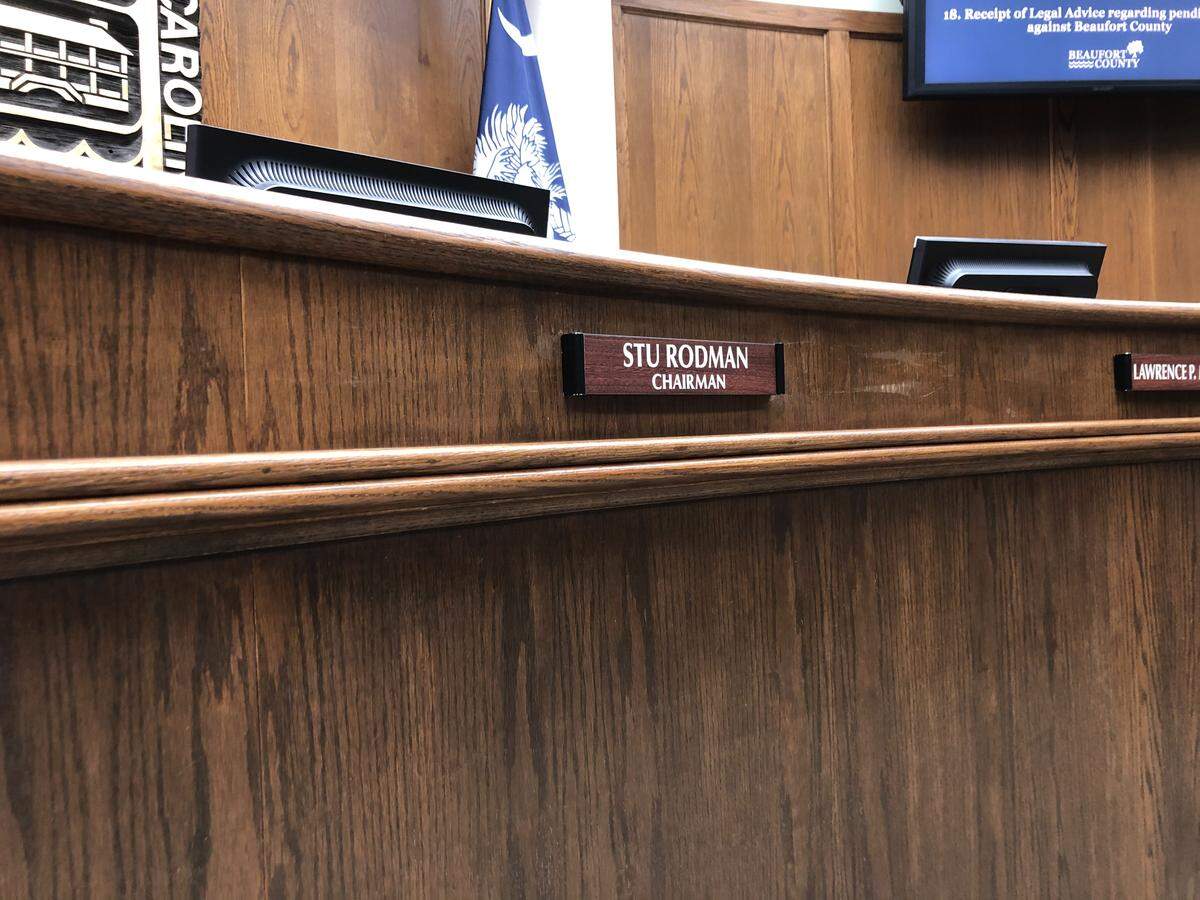
After almost two weeks of private conversations about the chairman — including a discussion in executive session that even some council members agreed was illegal — council members say they have done nothing to address the concerns. Emails, however, appear to show that a plan was put in place.
S.C. media law attorney Jay Bender said council members cannot meet in executive session to discuss themselves. In addition, he said communicating by email could be considered an official meeting. The public is supposed to be notified in advance when council members meet, and the council must cite the specific, legitimate exception to the open meetings provisions of S.C. 30-4-70 before it shuts the public out.
“There must be something in the water in Beaufort,” Bender said. “This council seems intent on violating the law at every opportunity.”
S.C. Press Association Executive Director Bill Rogers said the emails set a “terrible precedent for openness in government.”
The emails
On Feb. 10, Beaufort County Council members tried to use parliamentary procedure to oust Rodman as chairman, but the plan failed on a 5-5 vote.
That night, council went into closed session “for a discussion of individuals involved in county council.” Council members say no action occurred during that meeting; however, their emails show members discussed a plan, and indicate decisions on how to move forward may have been made.
Bender, the media attorney, noted that “nothing in the state code would justify a meeting closed to the public so council can discuss each other.”
On Feb. 11, the morning after the meeting, council member Joe Passiment emailed all fellow council members except Rodman, asking them to share their grievances about the chairman to “restore our credibility with the public we were elected to represent and restore our council leadership.”
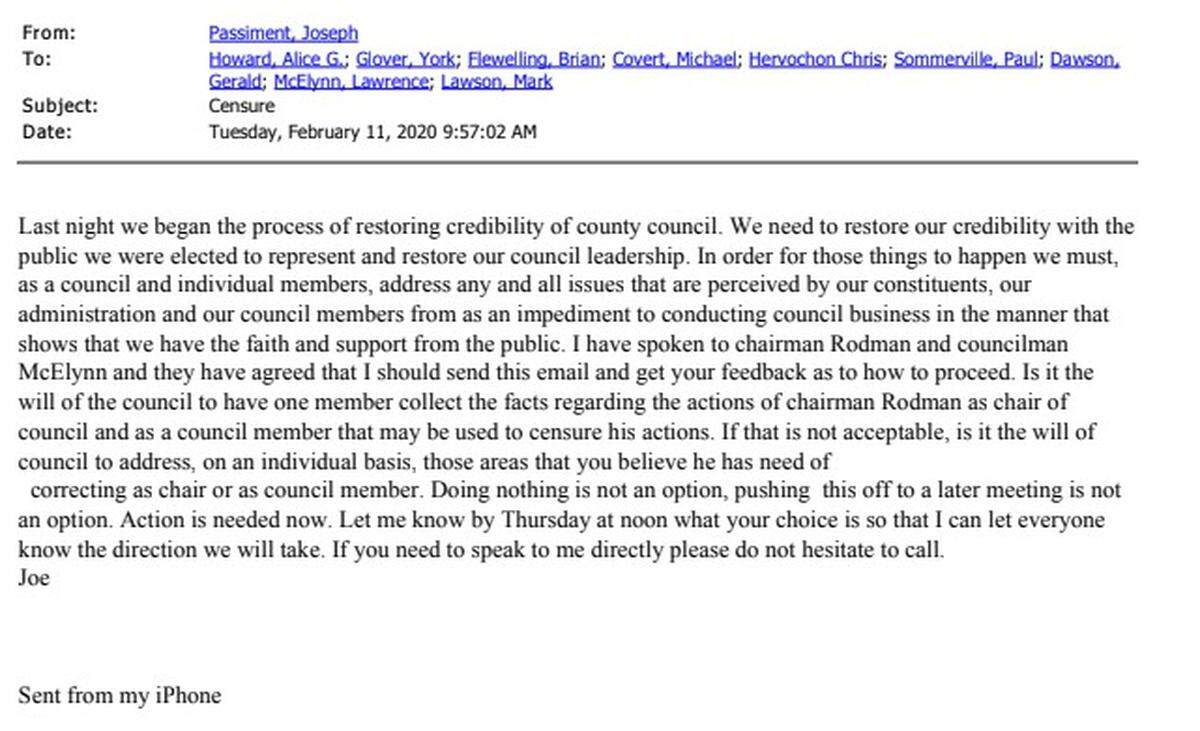
In the email, Passiment asks if it is “the will of council to have one member collect the facts regarding the actions of chairman Rodman ... that may be used to censure his actions.”
“Doing nothing is not an option, pushing this off to a later meeting is not an option,” Passiment wrote. “Action is needed now. Let me know by Thursday at noon what your choice is so that I can let everyone know the direction we will take.”
Bender said Passiment’s email was an example of a council member using electronic communication to solicit an action and, therefore, an illegal meeting of council without public notice.
Seven hours after Passiment’s email suggesting a deadline for response, council member Brian Flewelling replied to all: “This chain is illegal, a violation of ‘sunshine laws.’ Please abandon it. It is completely unacceptable to conduct business in this manner.”
The next night, Feb. 12, council member York Glover emailed council member Larry McElynn, copying all other council members and Jacobs, with a summary of his takeaways from the executive session and a list of his concerns about Rodman being chairman.
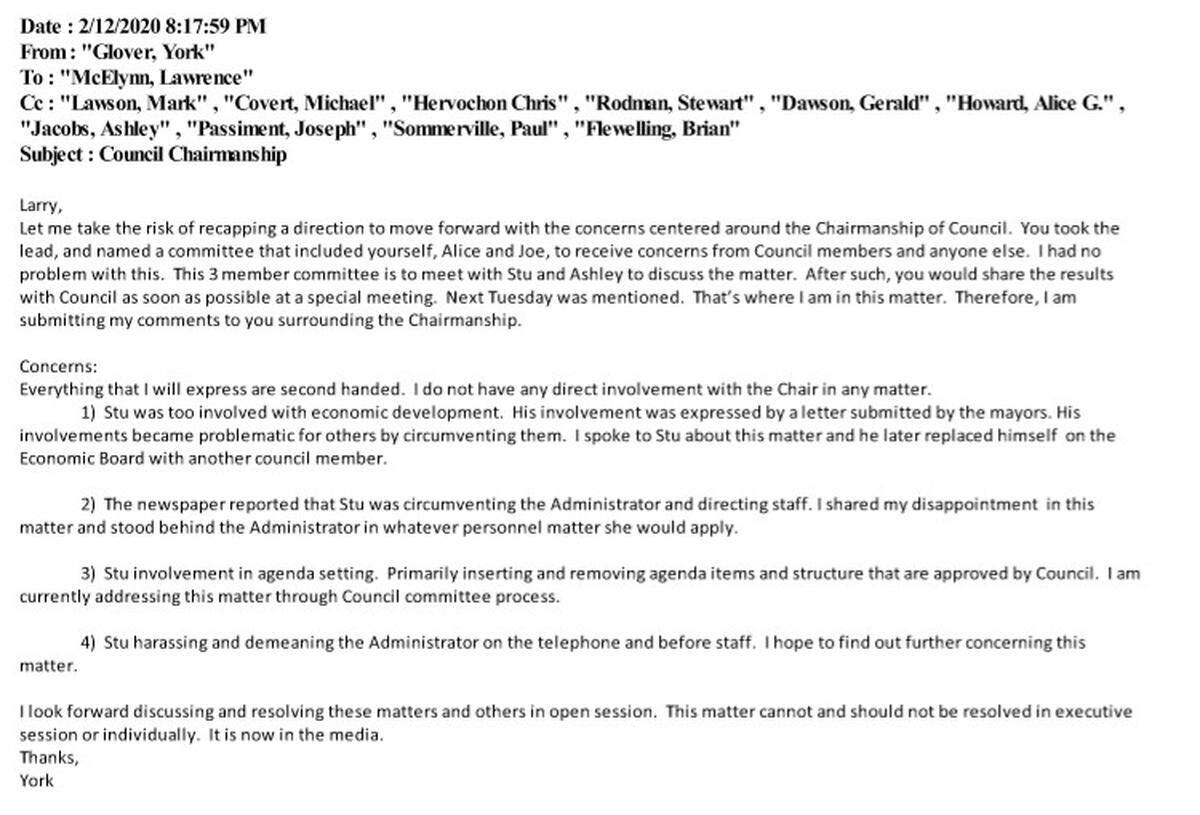
Recapping the executive session, Glover wrote to McElynn: “You took the lead, and named a committee that included yourself, Alice and Joe, to receive concerns from Council members and anyone else ... This 3 member committee is to meet with Stu and Ashley to discuss the matter. After such, you would share the results with Council as soon as possible at a special meeting.”
Glover listed four reasons he was concerned about Rodman as chairman, but warned that everything he described was second hand, not his own observations:
- Rodman’s involvement in the Beaufort County Economic Development Commission.
- A Feb. 2 article in The Island Packet and Beaufort Gazette that detailed the chairman privately discussing plans for the Jenkins Island road safety project with a county employee and stressing the conversation be kept between “the two of us.” Glover had previously emailed Rodman that he was “disturbed” by the article.
- The chairman “inserting and removing agenda items and structure that are approved by Council.”
- The chairman “harassing and demeaning the Administrator on the telephone and before staff.”
Another email from that week appears to confirm Glover’s assessment of the executive session that three people would be appointed to meet with Rodman and Jacobs, the administrator, to discuss issues on council.
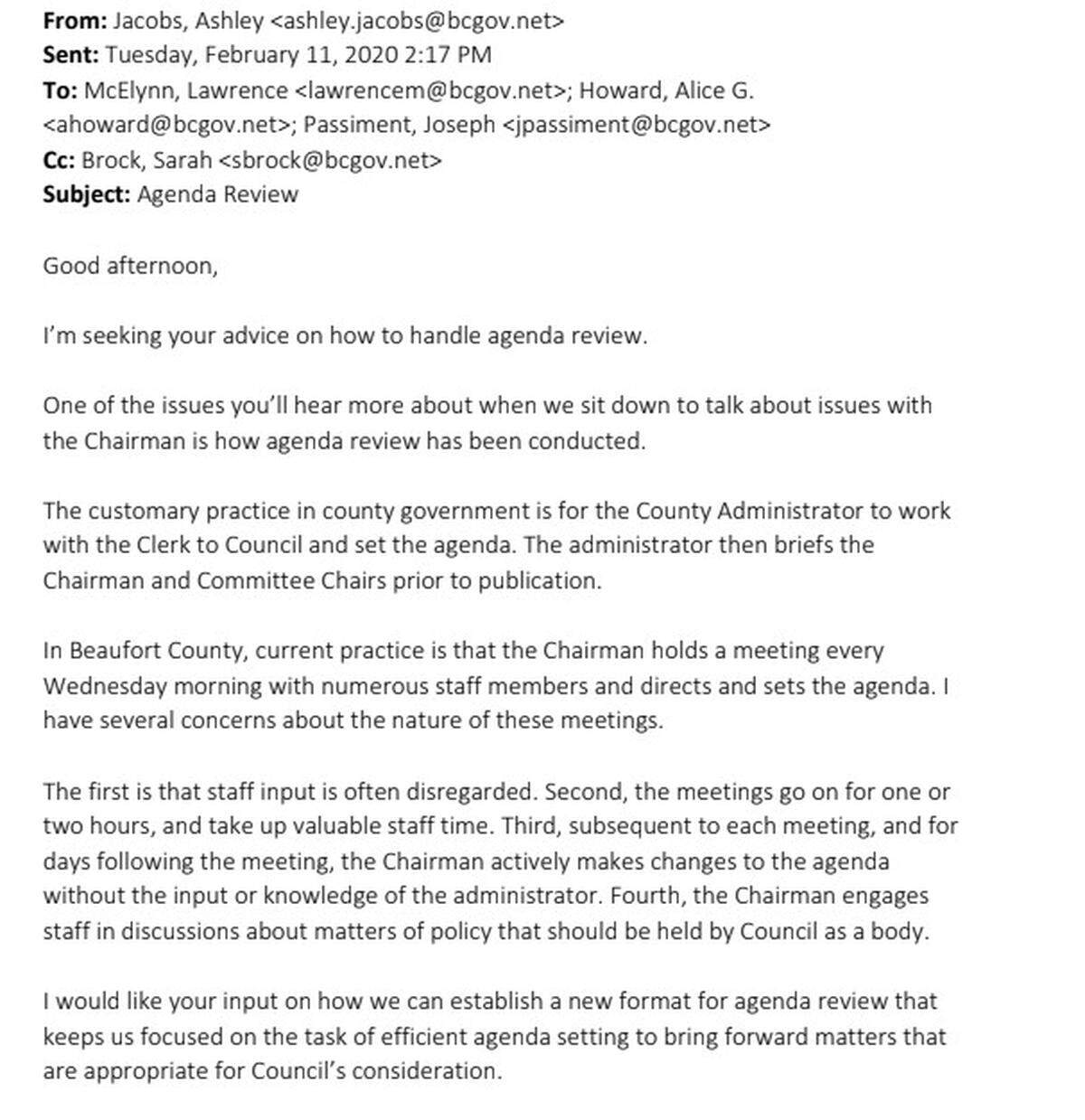
Jacobs, in an email to council members McElynn, Alice Howard and Passiment — the same three people Glover’s email references as being part of a “committee” — said “one of the issues you’ll hear more about when we sit down to talk about issues with the Chairman is how agenda review has been conducted.”
Jacobs wrote that the chairman directs staff members while setting the agenda, actively makes changes to the agenda without her knowledge and “engages staff in discussions about matters of policy that should be held by Council as a body.”
In the email, Jacobs calls for a new format for the agenda-setting process.
On Wednesday, Passiment told a reporter that no committee was created, that the idea was merely “discussed.”
Passiment said council members have not met with Rodman or Jacobs to discuss issues with the chairman.
The next council meeting was scheduled for today, but on Wednesday, Rodman canceled it.
This story was originally published February 24, 2020 at 4:30 AM.