‘Ridiculous.’ Beaufort Co. Council OKs controversial Bluffton riverfront development
The years-long Pepper Hall plantation saga between owner Robert Graves and Beaufort County came to an end Monday night, as county council voted to approve a development agreement to allow Graves to develop his Okatie River-front property in Bluffton.
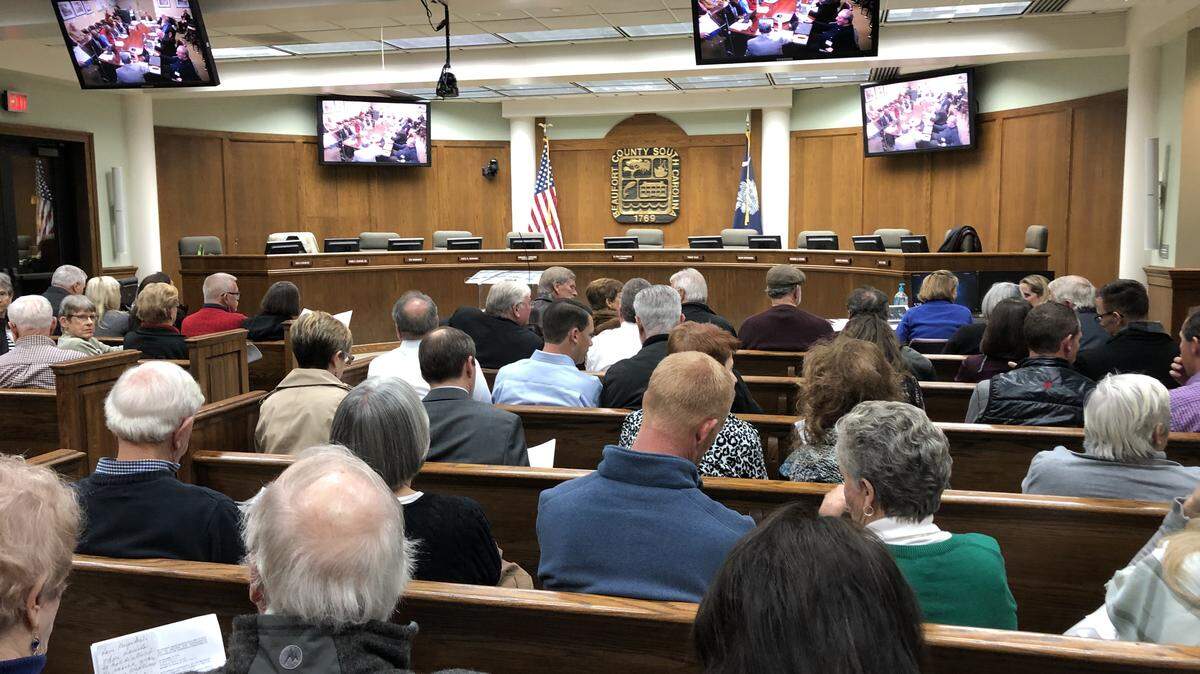
Council narrowly approved the agreement, which had undergone several changes since its unveiling in October, before a packed house. Nevertheless, nearly 30 people — including several members of Graves’ extended family — provided public comment over a span of three hours, mostly in opposition to the agreement.
Barry Johnson, Robert Graves’ lawyer, declined to comment on the decision, saying he still considered the issue a pending matter.
Most of the public’s voiced concerns centered around what it perceived to be hasty approval of an unfinished agreement.
Councilman Brian Flewelling, who chairs the county’s Natural Resources Committee and voted for the agreement, said many opponents’ concerns were unfounded.
“I have the whole picture,” he said Tuesday. “I know I have the right information. I got 400 to 500 emails, most that showed either they didn’t have that information or they were intentionally misled by others.”
Councilman Mike Covert, who also voted for the agreement, said the county has been dealing with this issue with Graves for long enough.
“This issue has been going on for, what, 12, 15 years?” he said Tuesday. “(Opponents) don’t know how development agreements work. The county hasn’t done enough education on that, and shame on us.”
Both in his remarks after the public comment session ended Monday and in a conversation Tuesday, Covert said he empathized with the family.
“We saw that throughout, there are obviously some family issues,” he said. “I don’t remember anyone without family problems. I’m just sorry for the family that theirs had to be aired out in the public.”
Despite the personal nature of the agreement, Covert said Tuesday he felt his job was to vote with the county’s interests in mind.
“I don’t profess to fix their problems,” he said. “I only look at what’s in front of me and make appropriate decisions.”
The agreement received 5-4 approval. Outgoing Councilman Tabor Vaux recused himself, as he had throughout the proceedings, because a lawyer who works with him at his law firm previously represented the Graves family on the Pepper Hall matter.
Vice Chairman Jerry Stewart, who was one of three members on the subcommittee that helped negotiate the agreement, also recused himself from the entire meeting, his last on council. Stewart, who is retiring from council, cited concerns raised about his eligibility to vote on Beaufort County matters now that he is a legal resident of North Carolina and has been for several months.
The original version of the agreement called for four controversial concessions by the county. As The Island Packet reported in November, those concessions read that:
- The county would allow Graves an exception on the amount of open space his property would require to be developed. Beaufort County would count the 18 acres it purchased from Graves in 2013 toward his open space requirement instead of requiring additional land.
- Beaufort County would swap 2.97 acres of its waterfront land along the Okatie River for 1.5 acres of inland property that Graves currently owns. Graves earlier sold a barn that sits on the property to the county and would regain ownership of it through the swap.
- Graves and the county would split stormwater management costs 50-50 despite the fact that Graves owns a majority of the property on which the management and associated costs would apply.
- Beaufort County would agree to pay $2 million to pave and reroute Graves Road in order to save two oak trees. A sizable portion of the road would sit on Graves’ private property.
After the second county council reading of the agreement — which saw an outpouring of opposition as well — council revised it to remove the open space exception and land swap.
However, the 50-50 stormwater cost split and $2 million provided to pave Graves Road remained intact in the final version of the agreement.
Rikki Parker, a project manager with the Coastal Conservation League, said Monday after the decision that the league was satisfied with the outcome.
“We heard the stormwater concerns but are pleased that the Rural and Critical Lands integrity was preserved,” she said. “We question whether the 50-50 split was equitable but County Council felt it was.”
Councilwoman Alice Howard, who favored postponing the vote so council could get a better understanding of its components, opposed the agreement, largely because of the stormwater item.
“The 50-50 split is just ridiculous,” she said Monday after the vote. “I can’t wrap my head around that.”
Before the vote, Howard explained that staff had presented to her a report and memo that showed that the county should only be on the hook for 3 percent of stormwater management and maintenance costs instead of 50 percent. She also expressed concern over the lack of a cap on how much money the county would provide toward that 50-50 split.
“That’s the unknown,” she said Tuesday. “Nobody knows, ‘how much will it cost us?’ I think that’s the question.”
Her other chief concern, which Councilman York Glover said before voting against the agreement, was that staff was not listened to during the process.
“That was the worst part for me,” Howard said Tuesday. “We should’ve listened to them. It’s never good when you just do what you want when you have qualified staff telling you what’s best.”
Flewelling disagreed Tuesday with Howard’s assessment of staff’s input.
“I don’t believe voters elected me to do what unelected bureaucrats are doing,” he said. “I am one of 11 that makes policy. At the end of the day, it’s my decision to make for the voters. I will never just completely rely on staff to make a policy decision.”
One compromise proposed among members of council was pursuing a purchase of the entire Pepper Hall property, which it previously had the option to do for $12 million as part of the 2013 agreement.
Council did not exercise that option, but members said it could consider using Rural and Critical Lands (RCL) program funds to buy the rest, in a similar manner to how it spent nearly $5 million to buy the Whitehall property in Beaufort, even after pushing the agreement through.
Howard expressed doubt during council discussions about whether RCL had enough money to do that, even after county voters approved an additional $25 million in funding in a November referendum.
However, Flewelling said Tuesday he would consider it, while Covert said he would support such a proposal if the county finds it has the money to buy the land.
“Absolutely,” he said. “Everything is for sale. If Rural and Critical Lands wants to buy it, why won’t you?”
This story was originally published December 11, 2018 at 2:54 PM.