
Mystery of prehistoric killing solved by using preserved bite marks on Arizona fossil
Evidence of a grisly prehistoric moment has been uncovered by scientists studying fossils at Arizona’s Petrified Forest National Park.
A mysterious series of gashes and punctures on a 200-million-year-old armor plate has been classified by experts as bite marks belonging to “a large carnivore.”
Finding bite marks on Late Triassic fossils is rare by all accounts — leading researchers Susan M. Drymala, Kenneth Bader and William G. Parker to conclude they had been handed a unique opportunity.
Seeing the marks as evidence in an ancient whodunit, the team began trying to match the teeth impressions with fossilized teeth also found in the park’s Late Triassic formations.
It’s not clear how many giant reptiles were considered suspects in the case (Drymala started the research in 2012). But the team eventually estimated both a match and a narrative, leading to a study published by Palaios in January.
Researchers hailed the study’s findings as “the first direct evidence” of interaction between top predators and prey within the park’s Late Triassic Chinle Formation. The formation is famous for hosting fossil evidence of “a wide assortment of animals, including early dinosaurs such as Coelophysis,” the National Park Service says.
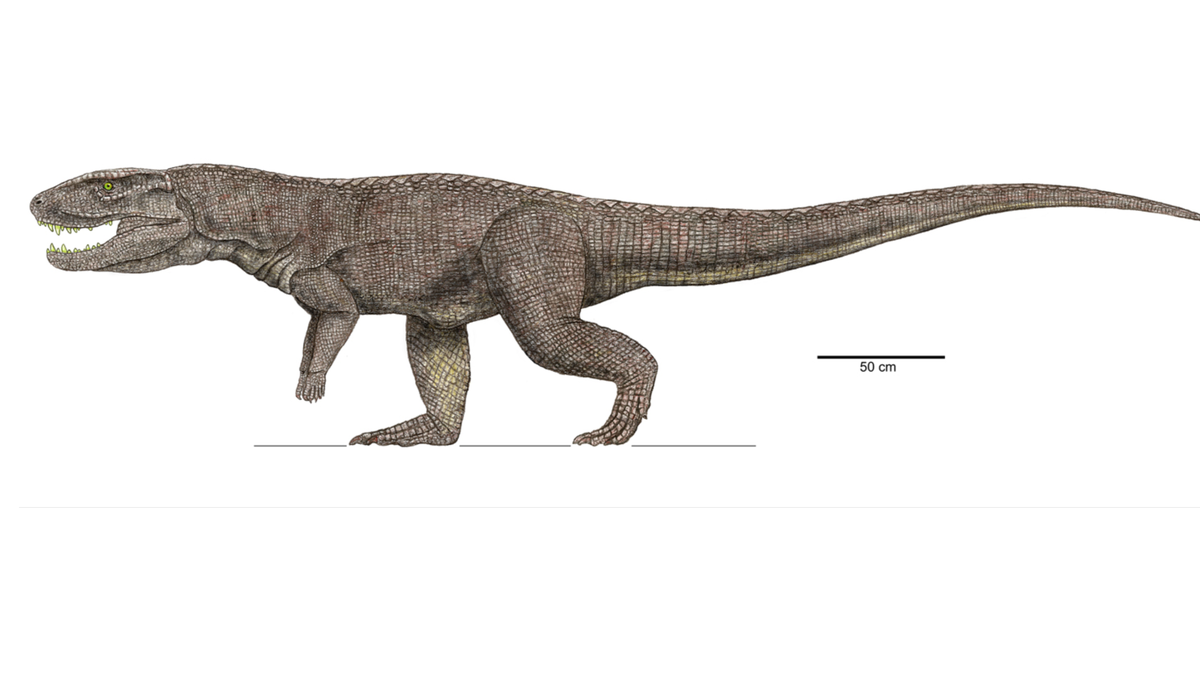
The bites studied by the team were not those of a dinosaur, but the predator was still pretty scary.
They were likely left by a giant reptile which closely resembled a crocodile — if crocodiles were as tall as people, grew to 39 feet in length and had 3-inch-long serrated teeth. (Two kinds of reptiles fitting that general profile roamed the park 200 million years ago — phytosaurs and Postosuchus, the report says.)
“As for the victim, the armor plate was from a Typothorax, a heavily armored reptile also related to the crocodile, but looking more like an 7-foot, 225-pound armadillo, according to a report in Science Daily. Experts believe they were herbivorous and insectivorous.
One thing the report couldn’t determine is whether the Typothorax was killed by the larger predator, or was already dead when the feasting began.
Still, the shape of the teeth marks indicate a scene of frenzied biting.
“The feeding traces ... are dominated by pits, but also include striated scores. It is unlikely that these marks were made through defleshing because the behavior that produces pits does not result in flesh removal,” the study reports.
“These bite marks may instead represent a predator or scavenger’s attempt to remove the osteoderms (armored plating) and gain access to the flesh beneath. The presence of large bony plates provides a major obstacle to active predators and scavengers alike. The bite likely took place either post or perimortem (near the time of death).”
The bite marks support the idea that herbivore reptiles served as meals for larger carnivores in the Late Triassic era, when the planet was recovering from “the largest mass extinction in Earth history,” the researchers wrote.
This story was originally published February 10, 2021 at 11:52 AM with the headline "Mystery of prehistoric killing solved by using preserved bite marks on Arizona fossil."