Raising minimum wage may prevent infant deaths — and every dollar counts, study finds
A new study found that each additional dollar of the minimum wage reduces infant deaths by up to 1.8% each year in major urban U.S. cities.
Syracuse University researchers say higher minimum wages could help lower financial stress, maternal smoking, obesity and teenage pregnancy — factors that have been tied to poor infant survival and birth outcomes — and increase access to pre- and post-natal care.
President Joe Biden signed an executive order this week that calls for increasing the minimum wage of federal workers from $7.25 an hour to $15. House Democrats introduced legislation that would gradually increase the federal minimum wage annually until it reaches $15 in 2025 — then tying it to median wage growth.
The proposals face pushback from many Republicans, lobbying groups and state governments. Twenty-five states have passed “preemption” laws preventing minimum wage increases above the state minimum in cities and counties, according to researchers, who say more than 600 infants could have been saved annually if localities had been allowed to pay workers no less than $9.99 per hour.
More than 1,400 infants could have been saved each year if localities had been allowed to raise the minimum wage to $15 per hour, according to the study published this month in the journal Preventative Medicine.
And “even a modest reduction in infant mortality is economically meaningful,” the researchers said. Just one life saved could add as much as $9.6 million to the U.S. economy.
Experts say the rising use of preemption laws — which block local leaders from passing legislation to address local problems — is an issue that the COVID-19 pandemic brought to the forefront, as state governments have restricted counties or cities from adopting stay-at-home orders or face mask requirements to slow the spread of the coronavirus.
“Keeping the minimum wage low may protect business profits and keep prices lower for consumers,” the researchers said, “but our results suggest that the tradeoff in human lives is steep.”
Opponents to Democrats’ bill seeking to raise the federal minimum wage say the move could strip more than one million people of their jobs because of the impact on businesses — particularly smaller ones, with teens, part-time employees and those with no college education most affected.
A 2019 report from the Congressional Budget Office revealed that about 1.3 million people could become jobless if the minimum wage was raised to $15 an hour. But it would also raise about 1.3 million people out of poverty while increasing wages for an estimated 17 million people who would otherwise be earning less than $15 an hour.
The federal minimum wage has not been increased since 2009, according to researchers, who argue states that block the move on a local level are contributing to infant deaths.
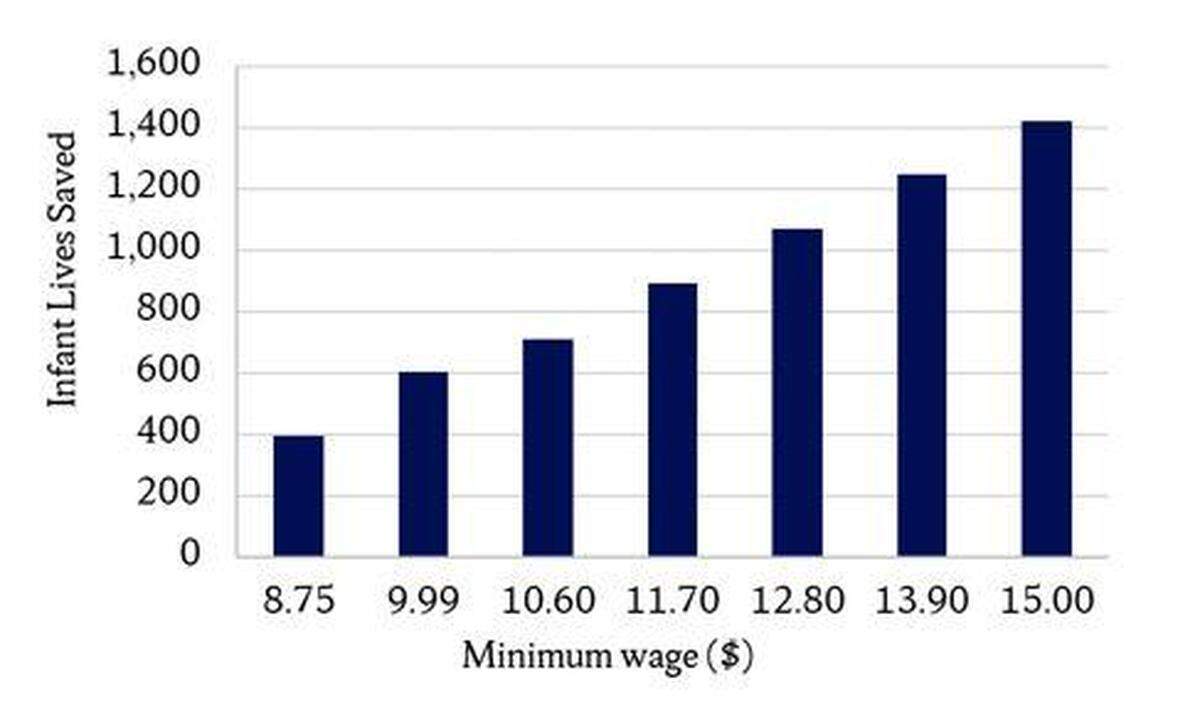
In the nine largest U.S. urban counties with populations exceeding 250,000, the average minimum wage was $7.74, while the average minimum wage was blocked by state laws stood at $9.99 in 2018.
Based on the numbers, the researchers estimated that these counties would have experienced 468 infant deaths instead of the 493 they actually did — a reduction of 25 deaths if preemption laws didn’t stop them from increasing pay.
When considering all 25 states (541 counties) that had preemption laws, up to 605 infant deaths could have been prevented with wage increases to $9.99 an hour alone.
The team used data on infant deaths from national databases between 2001 and 2018, data on minimum wage levels from the U.S. Bureau of Labor Statistics and models they developed that factored in other variables that may affect infant mortality in all 50 states and the District of Columbia.
Why higher minimum wages could improve health, infant survivability
Making more money per hour makes it easier for people and their families to afford medical care and health insurance, as well as increase job satisfaction which may improve overall employee health, according to health economics professors at the University of California, Davis.
More evidence suggests that increasing minimum wages reduces smoking, increases infant birth weight and could make healthy products more affordable such as certain foods and medicines.
But the extra money could also mean more to spend on “health-harming” products such as tobacco, alcohol, junk food and illegal drugs, the researchers’ 2018 health policy brief said.
Minimum wage trends and marginalized communities
The Syracuse University researchers noted they did not investigate if there are “race-specific responses to minimum wage changes” or to state preemption laws, but historical trends point to potential racial disparities in infant mortality, based on the benefits that more money can bring to expecting mothers.
Valerie Wilson, director of the program on race, ethnicity and the economy at the Economic Policy Institute in Washington D.C., told Marketplace in 2019 that “racial wage-gain disparity” can be attributed to lower educational status, higher unemployment and racial discrimination in hiring among Black people.
While increases in minimum wages have helped workers of all races and ethnicities, the cities and states they occur in tend to have lower populations of Black Americans.
“African American workers haven’t benefited as much as they would from a federal minimum wage increase,” Wilson told the outlet, “which would get into those southern states that have about 60% of African American workers, and are much less likely to increase minimum wages.”
Black women also earn less than Black men on average, Marketplace reported, even though they make up a larger portion of the labor workforce — which may play a role in infant survivability.
Two economists with the University of California, Berkeley wrote in The New York Times that a 1966 decision to raise minimum wages reduced the earning gap between white and Black workers by about 20% between 1967 and 1980.
“It is no coincidence that civil rights leaders in 1963 singled out the minimum wage as a critical tool for racial justice, and their demands are just as salient today,” the economists wrote. “The federal minimum wage has not been raised since it went to $7.25 an hour in 2009. And inflation has reduced its value by nearly one-third from its highest real value, in 1968.”
The researchers of the study on infant mortality said that about 2.6 million workers make at or below the federal minimum wage and another 20.6 million make “near minimum wage.”
This story was originally published January 28, 2021 at 1:52 PM with the headline "Raising minimum wage may prevent infant deaths — and every dollar counts, study finds."