
With the Swash, Whirlpool, P&G again try an alternative to dry-cleaning, washing
CHICAGO — The new product pitched to Whirlpool executive Marc Bitzer three years ago wasn't all that new. Whirlpool had tried to sell two previous versions of the device, which was designed to clean clothes that didn't need much cleaning. Both flopped.
So when about 20 designers and technicians came to Bitzer in 2011 to propose yet another iteration, he was prepared to nix it.
"I was lukewarm, very honestly, because I had seen excitement before," recalls Bitzer, who oversees North America, Europe, Africa, and the Middle East for the home appliance giant.
But within two hours, Bitzer was a cheerleader for something called a Swash.
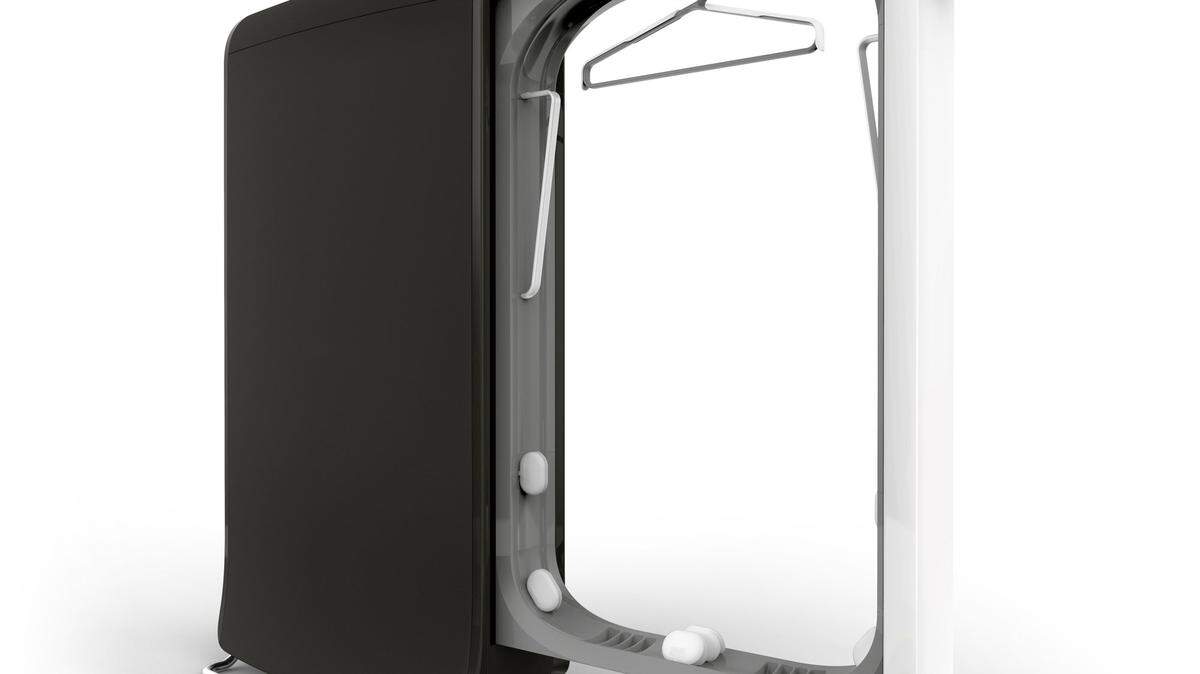
Three months ago, Swashes developed jointly by Whirlpool and P&G started showing up in select Bloomingdale's stores and Delta airport lounges. Salespeople explained how the Swash, a four-foot-high, steel-and-plastic box shaped like a radiator, could in just 10 minutes unrumple a cocktail dress or whisk cigar stench from a sport jacket.
Advertising claimed the Swash would cut dry cleaning bills in half by letting people re-wear dress shirts, sequined dresses, wool sweaters, and other clothes they'd normally wash after one wearing or, in the case of $300 designer jeans, never wash at all.
For the $499 price of a Swash, now available nationwide, consumers could buy a new smartphone or an actual washing machine. As executives from both companies say, the Swash serves a need that many people aren't aware they have, or might decide they don't have. They declined to disclose specific Swash sales numbers.
The product is hardly make-or-break for Whirlpool, with $18.8 billion in revenue last year, or P&G, with $83 billion; each introduces upward of 50 products annually. Still, even if it's a washout, the Swash firmed up a historically symbiotic relationship that had weakened.
Go Unlimited, a joint venture the two quietly formed to bring the Swash to market, is working on additional products. The Swash is a platform for other new ways to care for clothes, Whirlpool and P&G executives say, declining to provide more details.
— — —
The age-old Rust Belt companies, which rose to prominence last century on sturdy brands like Kitchen-Aid, Crest and Amana, have collaborated on-and-off for decades. Old newspaper ads tout the virtues of using P&G's Tide detergent in a Whirlpool washer. Executives regularly ferry between P&G's headquarters in Cincinnati and Whirlpool's in Benton Harbor, Michigan. Whirlpool leans on P&G for consumer insight; P&G relies on Whirlpool's manufacturing chops.
In the late 1990s, the companies had gathered research indicating Americans increasingly were admitting to wearing clothes more than once between cleanings. Michael Grieff, P&G's research-and-development director for new business creation, says that 23 years ago: "Nobody would ever talk about re-wearing their clothes. It was almost like talking dirty."
The companies thought people might buy an appliance that would freshen up worn clothes, but two product failures followed.
The first, introduced in 2001, was a large, wardrobe-like piece of furniture that sold for as much as $1,200 and took half an hour to spruce up a shirt. In 2005, Whirlpool tried its own collapsible garment bag that used distilled water.
"Customers would be walking by it on the floor at a Lowe's or a Sears and they wouldn't know what it was," says Brett Dibkey, a Whirlpool vice president.
When Dibkey assumed responsibility for global new business creation at Whirlpool in 2010, the relationship with P&G had become "hot and cold," partly because of the product flops, he said. He flew to Cincinnati "a little bit hat in hand." A series of meetings between Whirlpool CEO Jeff Fettig and then-P&G CEO Bob McDonald followed.
Soon a group from both companies assembled in a Chicago conference room before the skeptical Bitzer. Although exploiting the re-wear market had become "almost toxic" at Whirlpool, Dibkey says, P&G wanted to take another crack. Grieff, who has spent virtually all of his P&G career in laundry, did most of the talking.
Grieff's points: 91 percent of Americans said they regularly wore clothes more than once between cleanings, up from 76 percent in 2007; 43 percent of men's pants had fabrics suited to re-wear, up from 14 percent in 2008; 70 percent of consumers said they avoided buying clothes requiring excessive care. P&G calculated that there were almost 40 billion re-wear occasions in the U.S. each year.
"That was an opportunity," Bitzer says.
Grieff told Bitzer that P&G had distributed working prototypes to about 200 Cincinnati-area consumers. By then it was clear that most people choose their daily outfit around the time they shower, so a Swash would have work in 10 minutes or less.
The appliance would need to look nice enough that consumers wouldn't mind it in their bedrooms, rather than laundry rooms, Grieff said. And it had to be a simple, one-button device. P&G wanted Whirlpool's help in making the thing both practical and pretty.
An issue from past collaborations nagged: The companies didn't want to waste time haggling over how to split Swash revenue or seeking approvals up and down company hierarchies. Executives wanted the companies to behave as one, with a singular goal: creating something entirely new to both.
They incorporated Go Unlimited, a separate entity owned 51 percent by P&G, 49 percent by Whirlpool, and staffed by a few dozen Whirlpool and P&G employees.
Whirlpool ensconced its Swash team half a mile from its main campus. Engineers, designers, marketers, and salespeople work side by side. A 3-D printer and wood-modeling gear help churn out prototypes.
Go Unlimited leased an office near Indianapolis where Swash teams from Ohio and Michigan regularly meet for a few days at a time.
"I don't believe too much resources help with innovation," Bitzer says. "If they knew the companies were going to put $100 million into a marketing campaign, they would've acted differently."
Consumers using a prototype would hang an item of clothing inside, insert a small cup similar to a Keurig coffee pod filled with a water-based chemical solution, and push a button to start the spritz-and-dry cycle.
A big challenge was getting garments wet uniformly, then drying them quickly. Variables included the viscosity, or thickness, of the solution inside the pod, and the size, number and placement of nozzles dispersing it. There had to be enough liquid to ensure coverage but not so much that leftover would drip into the bottom of the machine. Drying heat had to remove wrinkles and restore fit without shrinkage.
Swash team members consulted with agricultural spraying experts at the University of Leuven in Belgium. They experimented with different liquids and nozzle plans, then fed the results into computers that modeled the system now in the Swash: two nozzles on each inner wall, about three inches from the hanging garment.
The pod solution spreads about 30 times faster than water and contains pH-altering agents that neutralize body odor and other acidic aromas.
The air-recycling system was enginered to retain heat at 140 degrees Fahrenheit (60 degrees Celsius) while connected to a standard 120-volt outlet, a power draw roughly equivalent to a blow dryer.
The efforts were rewarded by the enthusiasm of the testers, some of whom stopped returning calls when it was time to return the prototypes, says Megan Chase, who leads Swash engineering at Whirlpool. "That's when we felt we had something really powerful."
Others are skeptical. Euromonitor analyst Cristina Baus says the device will sell better to hotels than households: "I don't see it becoming the next 'it' thing."
"You can't really get through life without a washing machine, but you can get through life without this," says Lloyd Shefsky, a professor at the Kellogg School of Management and author of the new book "Invent Reinvent Thrive: The Keys to Success for Any Start-up, Entrepreneur or Family Business."
Yet the problem of persuading people to buy things they don't know they need has been solved before, perhaps most spectacularly by Sony with its Walkman. Whirlpool and P&G are relying on online ads, YouTube videos, Facebook, and Twitter to get the Swash message out.
The target buyer is "Sam," a hypothetical, androgynous 30-something with an annual income of $80,000 and spends heavily on clothing. The companies sought their first Sams at three chains: the fashion-conscious at Bloomingdale's, techie first-adopters at Best Buy, and home-improvement enthusiasts at Bed Bath & Beyond.
At Bloomingdale's, merchandise manager Michelle Israel said in August that while the Swash was perfect for her upscale chain, she wasn't sure about getting one herself.
"I live in an apartment in Manhattan, so I'm thinking about it, but space is precious," she said then.
Now she has a Swash.
This story was originally published November 3, 2014 at 10:15 PM with the headline "With the Swash, Whirlpool, P&G again try an alternative to dry-cleaning, washing."