What’s a snood and how fast is a wild turkey? 10 things to know about the star of the season
In the Hilton Head area, residents encounter turkeys more often than once a year on the Thanksgiving table. Most South Carolinians do. Turkeys have been here for hundreds of years, although islanders probably see them less often than those living on the mainland.
In years past, the birds have been more contentious than the debate on whether stuffing goes inside or outside.
In 2014 the Bluffton’s The Crescent community endured car-attacking, aggressive and abnormally colored birds, when domesticated turkeys bred with Eastern Wild Turkeys. The birds saw their reflection in the cars and would attack. Those birds were killed and their meat was given away. Before that, a Sea Pines Plantation resident tried to pen-raise turkeys, which caused trouble when they began roosting on houses, according to South Carolina Department of Natural Resources Big Game Program coordinator Charles Ruth. Since those two scenarios, there haven’t been any other turkey issues in Beaufort County, according to Ruth.
After the species almost went extinct around 1900, they’re in all 46 counties in South Carolina thanks to SCDNR re-stocking programs and habitat improvement. Although, Beaufort County has the second-lowest turkey harvest in the state.
SCDNR estimated about 62 birds were harvested last spring compared to some of the state’s counties that harvest 400-500.
Why the number difference? It’s because of the habitat, Ruth said.
“It’s a small county, much of which is paved over with development,” he said. Even with the development, Hilton Head is a maritime forest, which isn’t the best habitat for turkeys. He explained that westerly, over the waterway, there are more turkeys. “Palmetto Bluff is a good example,” he said. “They’ve got a good strong population there.”
Here are 10 fun facts, according to SCDNR, you can share next time you see a turkey, whether it be next to cranberry sauce or outside your window:
1. Wild turkey can out-sprint a galloping horse
“They’re extraordinarily fast,” Ruth said.
For about 100 yards, they would be able to out-sprint a galloping horse, he said.
2. Wild turkeys can fly, but domesticated ones can’t
Wild and domestic turkeys are genetically the same species, but selective breeding makes them dissimilar.
In the air, wild turkeys can fly and have a top-flight speed of about 55 miles per hour, which is about as fast as a car on a highway.
Selective breeding diminished the domestic turkey’s ability to fly. Instead, they are heavier and broad-breasted with shorter legs.
3. You can tell a Turkey’s sex by their droppings
Male droppings are j-shaped while female droppings are spiral-shaped.
4. A turkey vulture is not a turkey
They’re completely different species. They’re also not a cross between a turkey and a vulture, they’re a type of vulture.
“They’re no more similar than a horse and a cow,” Ruth said.
Turkey vultures are federally protected because they’re migratory birds, according to Ruth. He said wild turkeys aren’t migratory, they stay put.
5. The flap of skin hanging over a turkey’s bill is called a snood
It can change color, size, and shape based on the turkey’s mood and activities, such as when they’re courting.
6. Wild turkeys are omnivores
They eat plants like acorns, nuts, seeds, berries and greens as well as animals like insects, small amphibians and reptiles.
7. They have better daytime vision than you do
Wild turkeys see in color and have eyesight three times better than a human’s.
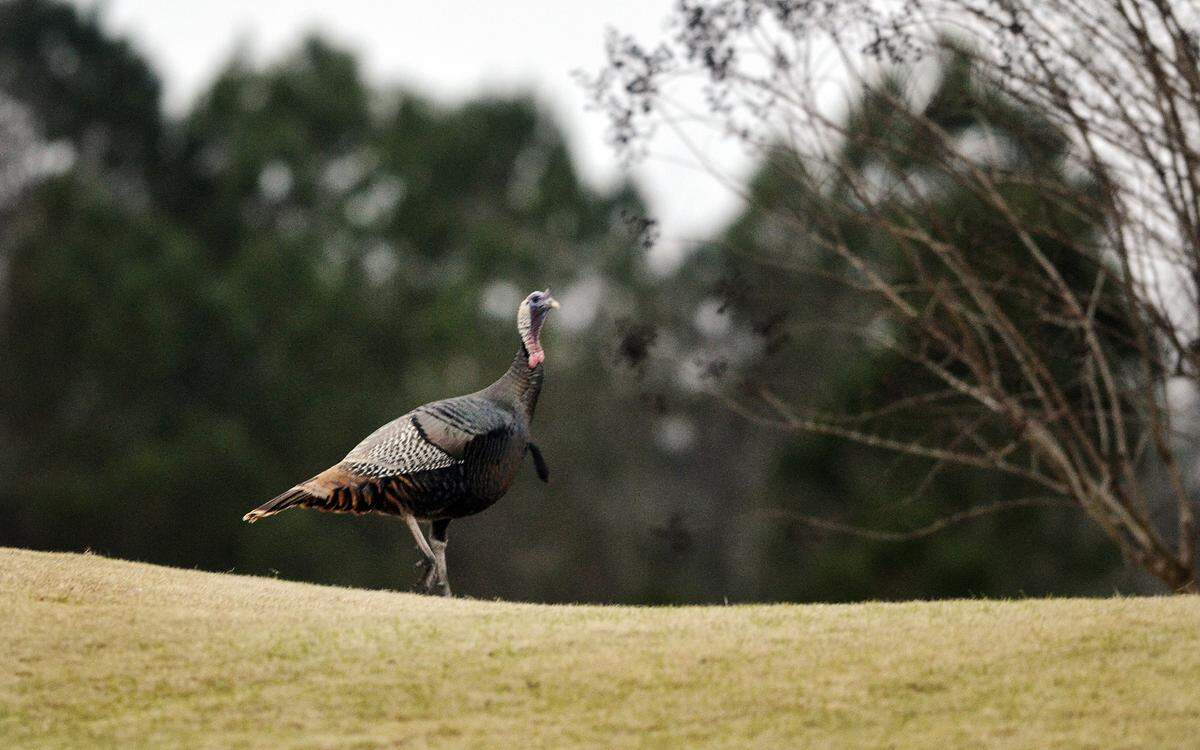
8. They’re not very smart
They have good instincts, but their brain is about the size of a pea or a large single peanut.
9. American Indians domesticated turkeys before Europeans set foot in the United States
Archaeologists have found turkey bones in American Indian burial mounds in Tennessee, Kentucky and other areas in the South. Turkeys were raised in Mexico and Central America for more than 500 years before the Spanish arrived. Archaeologists found Turkey relics in Arizona dating as far back as 25 A.D., and turkey-raising could be one of the oldest forms of organized meat production in the Northern Hemisphere.
“I think there was probably some surprise with the early colonists,” Ruth said. “What they brought with him was already here.”
10. Adult males are called toms, and females are called hens
A “rafter” or “flock” is the name for a group of turkeys. Very young turkeys are called “poults,” young females are “jakes” and young females are “jennies.”