Hilton Head golfer’s shot ended up in an alligator’s mouth. Do you see it?
It’s the time of year on Hilton Head Island when alligator tales come out of the woodwork.
Following a series of articles by The Island Packet and Beaufort Gazette about golfers’ funny encounters with the massive reptiles, Hilton Head resident George Salemi reached out to share a story that would be nearly unbelievable if he didn’t have the photo to prove it.
Salemi was playing golf in Palmetto Hall in March 2016 when his second stroke on the fourth hole took an unexpected right turn toward a lagoon and a sunning alligator.
When the neon yellow ball got closer to the alligator, Salemi watched in awe as it ball rolled up into the alligator’s mouth and rested on the animal’s tongue.
“I couldn’t believe it!” Salemi said.
He drove up and zoomed in on his viewfinder to get a photo of the inconceivable shot.
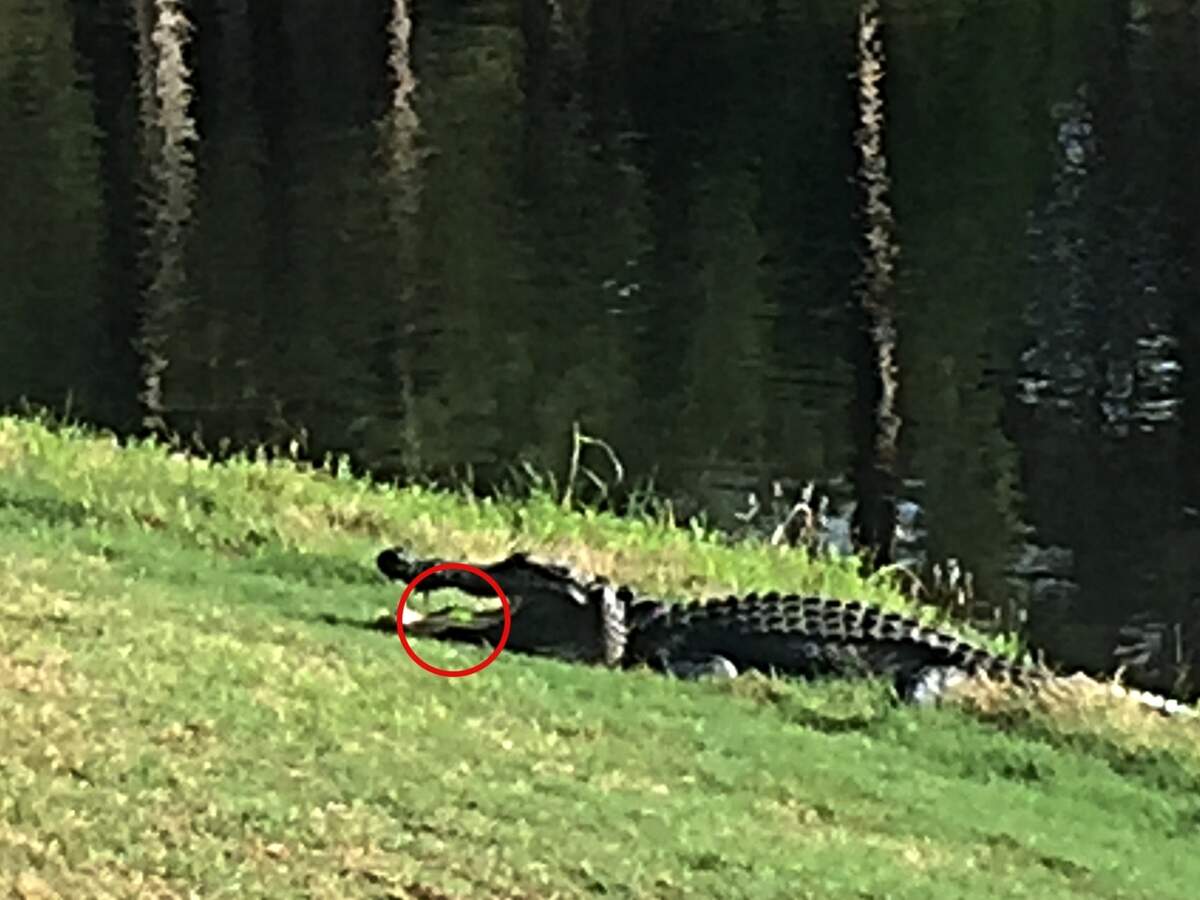
“I wasn’t freaked out. I thought it was great!” he said. “I’m used to alligators. When we lived in Palmetto Hall we had alligators that used to come up to our window.”
Salemi dropped a new golf ball far from the sunning alligator and kept playing. He said he remembers recording 7 strokes on the hole (which is a par 3).
“They wanted me to take another stroke, and I said ‘hell no, I’m not taking a stroke,’” Salemi said. His golfing buddies had argued that losing a ball to an alligator should count as an extra stroke.
When his group left the 4th hole, the alligator still had the ball in its mouth. By the time the next group came by, the alligator had spit it out.
“I thought for sure he’d swallow it,” Salemi said.
Too bad Hilton Head courses don’t have alligator-related ball-drop areas. Salemi probably could have gotten closer to the green.
Hilton Head alligator safety
Spring is mating season for the American Alligator, which means you’re more likely to see males moving among lagoons to meet their mates between late March and early June.
Alligators, native to Hilton Head and the Lowcountry, can grow to 12 feet long. They are often found sunning themselves on the sides of ponds or lagoons. The animals are ectothermic, meaning they rely on external sources of heat to regulate their body temperature.
If you come across one, keep your distance. Approaching or feeding an alligator is one of the worst things you can do — for you and the animal — according to the S.C. Department of Natural Resources.
When alligators associate humans with food, they’re more likely to come toward them and be perceived as threatening. When they’re removed from backyards, properties or lagoons, they’re often euthanized.
Here are some tips for alligator mating season:
- Scan the edges of lagoons for gator activity: Steer clear, no matter the size of the alligator.
- Never, ever feed an alligator: Alligators are more likely to approach people if they’ve been fed before, according to SCDNR.
- Remember that while alligators are mostly freshwater animals, they can survive in salt or brackish water for several hours or even days, according to the National Oceanic and Atmospheric administration.
If you’re approached by an alligator, wildlife expert Corbin Maxey told Business Insider that you should back away without turning your back on the alligator.
If you’re being bitten by an alligator, Maxey said, do not attempt to pry open the animal’s jaws. Instead, attack the animal’s sensitive snout and hit its eyes.
Most importantly, Maxey said, don’t play dead. Ideally, you’d stay out of the animal’s territory in the first place, he said.
What to do when you see an alligator...
- At the beach: If an alligator is swimming in the water or on the beach, tell a lifeguard and stay out of the water. Alligators can survive in salt water for only a couple of days.
- On the golf course: Clear the area and maintain safe distance. Allow the alligator to get to its destination while you warn other golfers. Report the alligator sighting to the clubhouse.
- On a bike path or in a public park: Keep your distance and encourage other riders or park users to do the same. Allow the animal to pass.
- In your backyard: Stay inside and keep track of children and pets. Report the alligator to your property owners’ association or, if necessary, the Beaufort County Sheriff’s Office.
If an alligator does not appear aggressive, you can keep your distance and leave the animal alone in nearly all circumstances.
When an alligator begins to threaten people or pets, it may be time to discuss the gator’s removal with the SCDNR.
SCDNR’s helpline, (800) 922-5431, will connect you with a biologist and help you determine the next steps, according to agency spokesperson David Lucas.
Not all alligators have to be removed and euthanized. Community security guards sometimes relocate small alligators to other lagoons in the same neighborhood.
This story was originally published April 17, 2021 at 4:00 AM.