
A 4-inch predator with parenting skills on the hunt for crickets, cockroaches
One of South Carolina’s little-known features is that it’s the only state with an official state spider.
This distinction is held by the Carolina wolf spider (Hogna carolinensis), a brown and gray hunting spider found throughout southern Canada and most of the U.S., including the Southeast.
There are some 2,200 species of wolf spiders worldwide, and Carolina wolf spiders are the biggest ones in North America, measuring up to three or four inches across. Females are larger than males.
Unlike insects, spiders have eight legs, not six. They also have just two body parts: an abdomen at the rear, and a combined head/middle segment called a cephalothorax.
Spiders lack the antennae typical of insects, but they do have a pair of leg-like appendages called pedipalps at the front of the body. They also have fangs used to inject venom, and their mouthparts are adapted for sucking up the liquified tissues of their prey.
Unlike sedentary web-building species, wolf spiders are agile ground predators. Camouflaged by their drab colors, and using speed and keen eyesight, they spend much of their time chasing down grasshoppers, crickets, cockroaches, and any other prey they can catch.
Wolf spiders are particularly active at night, and their presence may be revealed by the beam of a flashlight when it picks up “eyeshine” from a reflective layer found in four of their eight eyes.
When not hunting, Carolina wolf spiders take refuge in solitary tubular burrows dug as deep as eight inches into the ground.
Aside from their predatory habits and arresting size, our state spider has another distinctive feature: parental care.
After mating, the female lays a hundred or so eggs, protecting them within a large silken sac. Then she attaches the sac to the end of her abdomen and carries it around with her, even while hunting, being careful not to let it drag along the ground.
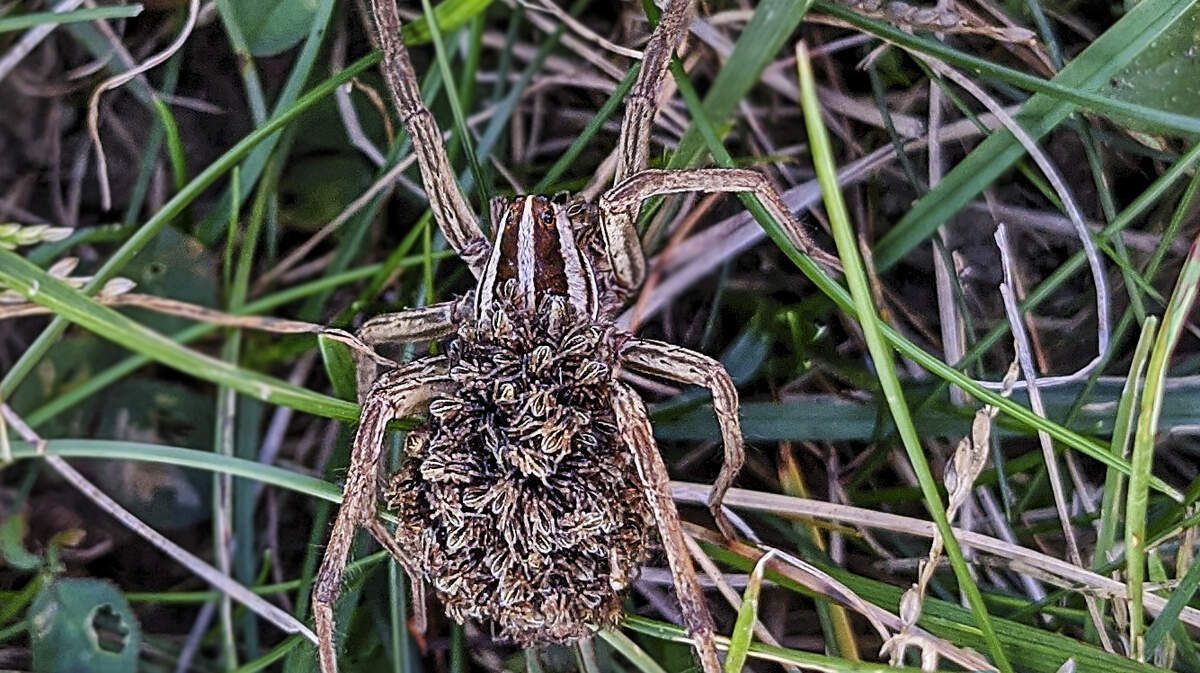
Once the tiny spiderlings emerge, they pile onto her abdomen and hitch a bumpy ride for a few weeks until they’re big enough to hunt on their own.
Recently I found a female Carolina wolf spider loaded with dozens of wriggling offspring — a remarkable sight. With each step the spider took, a few spiderlings tumbled off, but most managed to climb back on via long, connecting strands of silk.
Male wolf spiders often die soon after mating. Their offspring finish growing the following summer. Females may live for a year or two, sometimes seeking shelter indoors once cooler weather arrives.
Carolina wolf spiders play an important ecological role as natural predators of insects. If provoked, they may bite, but they’re usually not aggressive, and their venom isn’t considered dangerous to humans.