
A dragonfly worth studying: How the tiny Amberwing protects his mate from other suitors
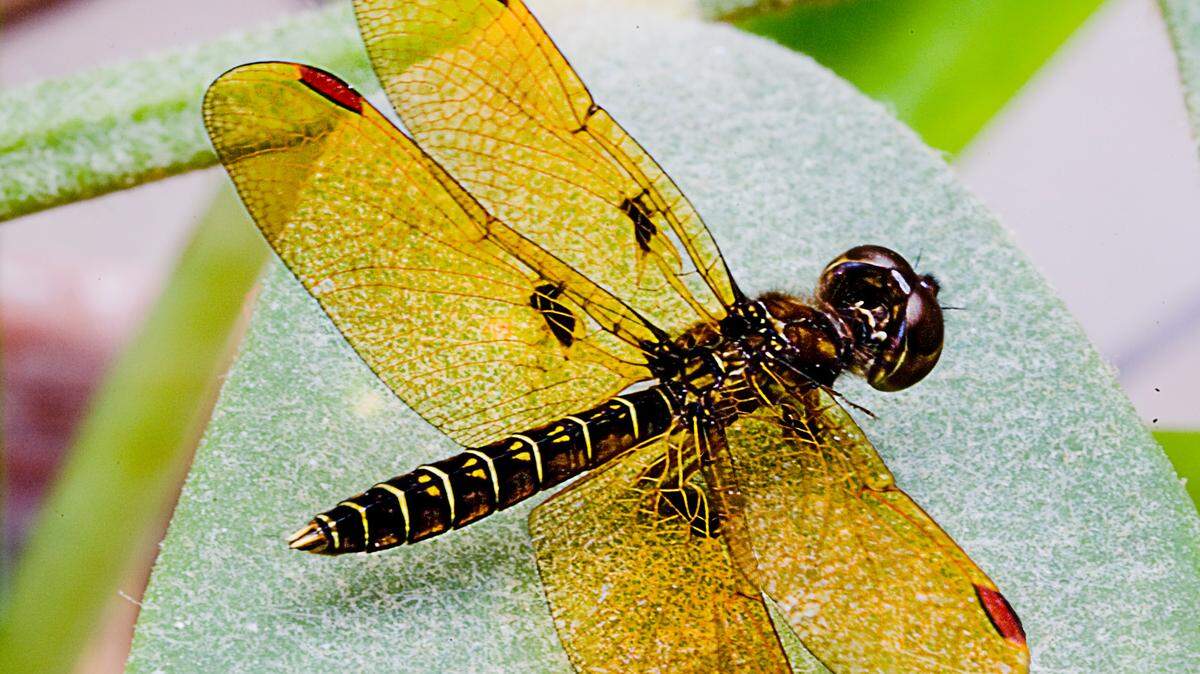
Eastern Amberwings (Perithemis tenera) look rather like brightly colored wasps busying themselves along the muddy edges of lakes and ponds.
While perched, they even act like wasps, fluttering their wings and wriggling their abdomens up and down — behavior thought to deter predators.
Actually, Amberwings are dragonflies — one of some 150 species in South Carolina — and they’re common throughout the summer in the Lowcountry.
True to their name, males have yellowish-orange wings, often with scattered dark dots. Their brownish abdomens are ringed with pale stripes, and their large compound eyes are red. Females have clear wings with brown bands.
As dragonflies go, Amberwings are tiny, with bodies barely an inch long. Despite their small size, males are easy to spot flying over shallow water or resting on low vegetation.
If you watch a male Amberwing closely, you may see that he’s staked out his own small territory along the shoreline. This area contains potential egg-laying sites (floating plant material) attractive to females.
Within his territory, the owner perches, patrols, and chases off intruding males.
If a female shows up, the male “courts” her by hovering over the water with his abdomen raised. Mating typically follows.
In Amberwings this act takes a mere 20 seconds, during which time the male transfers sperm to a specialized storage sac inside the female. Then, usually while guarded by the male, she deposits masses of fertilized eggs onto plant material just above the waterline.
In a few days, the eggs hatch into wingless, aquatic larvae that breathe via gills and capture tiny prey via hinged mouthparts complete with claws.
Some weeks later, once mature, the larvae climb out of the water onto plant stems, shed their “skins,” and emerge as winged dragonflies.
Amberwings have been the subject of much scientific study because of the male’s tendency to hover near the female during egg-laying, protecting her from the advances of other males.
As in many other dragonflies, mate-guarding enhances the male’s “sperm investment” in his mate. If the female were to mate again with a rival, the guarder’s sperm would be displaced toward the rear of her storage sac. Then the second male would end up fertilizing most of her eggs.
Studies have also shown that a male Amberwing can show strong site-fidelity. In other words, he’ll return to defend the same territory day after day — especially if he’s been lucky there with females.