
What’s black, white and red, with yellow-green feet? Check the edge of the marsh
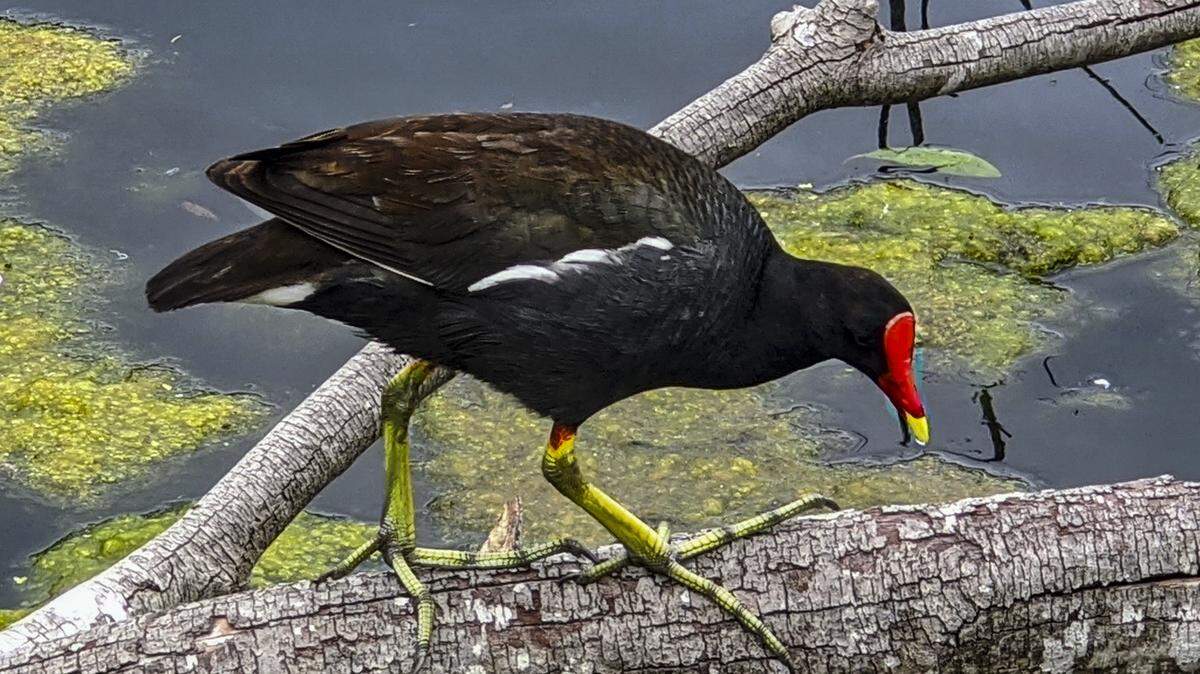
You may hear the unearthly squawking, cackling, whinnying noises of Common Gallinules (Gallinula galeata) even before you see them.
These chicken-like water birds used to be grouped with Common Moorhens (G. chloropus), similar-looking birds with a broader, worldwide distribution. A few years ago, Common Gallinules were reclassified as a separate species.
They breed throughout much of central and southern North America, down to northern South America. In coastal South Carolina they’re present year-round.
Look for Common Gallinules skulking around the edges of lakes and marshes, picking their way across floating vegetation, or floating like ducks in the shallow water. They’re easily recognized by their dark body, white side-stripe, yellow-tipped red bill, and red forehead shield. Their legs and feet are an arresting shade of yellow-green.
Pairs build nests usually on top of thick masses of vegetation near the shore and anchored to emerged plants. Males defend breeding territories and sometimes mate with more than one female. Young, unmated birds may help their parents raise the next brood of offspring.
Common Gallinules feed on a variety of plant material, as well as insects, spiders, snails, earthworms, and other small animals.
In some parts of their range, Common Gallinule populations have decreased due to the loss of natural ponds and marshes.
Elsewhere, though, the creation of lagoons, retention ponds, and other new habitats has led to flourishing populations of this unassuming but strikingly vocal marsh bird.