
Once-endangered Wood Storks may look clumsy on land, but wait until you see this
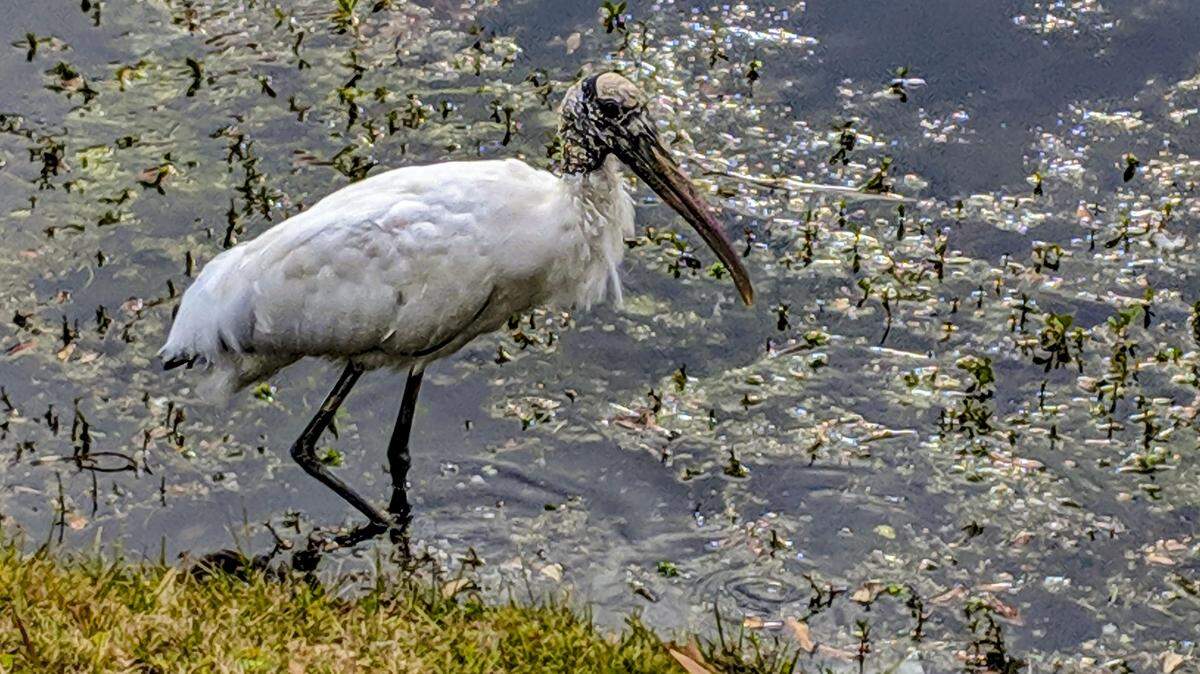
They might not win any avian beauty contests, but Wood Storks (Mycteria americana) do have a certain homely charm.
They’re stocky wading birds standing over 3 feet tall, with 5-foot wingspans. They have a sturdy, decurved beak somewhat like that of an ibis, and a naked, scaly, vulture-like head. Their white body plumage is accented by black flight feathers and a black tail. During the breeding season, their long legs darken and their feet turn pink.
Although ungainly-looking on land, Wood Storks are surprisingly elegant in the air, gliding high on thermals with heads and legs outstretched. Their graceful flight so enchanted John James Audubon, the 19th-century artist and naturalist, that he described their tireless “spiral circlings” as “the most beautiful evolutions that can be well conceived.”
Worldwide, there are 18 other species of storks, including the familiar rooftop-nesting White Stork (Ciconia ciconia), common in Europe and parts of Africa and Asia. This is the bird that’s immortalized in European folklore for its role in presenting babies to new parents.
Although the Wood Stork has no obstetrical associations, it’s notable as the only species of stork that breeds in the United States – specifically in cypress swamps and other wetlands in parts of Florida, Georgia, and South Carolina.
Wood Storks are highly social birds, feeding in flocks and nesting together, sometimes along with herons and egrets. Both parents build a large platform of sticks high in trees above standing water; then they line it with Spanish moss and guano. They take turns incubating and feeding the young.
Wood Storks capture fish, crustaceans, and other small aquatic animals, which they locate by feel, using their beaks. Several birds often wade together in a line through shallow water, one after the other, sweeping their bills back and forth while shuffling their feet to stir up prey. Studies have shown that once a stork locates a potential food item, it can snap its bill shut in 1/40 of a second. A single bird can eat a pound of fish in a day.
Since their offspring stay in the nest for a relatively long period of time (an average of 55 days), Wood Stork parents need abundant food throughout the breeding season, and they’ll abandon their eggs or young if food becomes scarce. For this reason, the depth of standing water underneath stork nests needs to be shallow enough (less than 20 inches) for the birds to wade through it and for prey to be highly concentrated.
On the other hand, very shallow levels of standing water can lead to low prey availability and make it easier for raccoons and other terrestrial predators to access stork nests.
Wood Stork populations are consequently vulnerable to droughts, flooding, logging, land development, and other factors that degrade or destroy their nesting and feeding areas. In fact, after decades of habitat loss, particularly in their historic breeding range in southern Florida, Wood Storks were placed on the U.S. Endangered Species List in 1984.
By then, the first successful Wood Storks nests had been reported in South Carolina (11 nests, in 1981). Parts of our state have since become important breeding and feeding areas for the species. In 2014, the status of Wood Storks was changed from “endangered” to “threatened,” though populations still fluctuate and environmental concerns remain.
Hopefully, with continued conservation efforts, further recovery will be possible for what Audubon called “this very remarkable bird.”
This story was originally published March 20, 2019 at 3:34 PM.