
For this male Lowcountry spider, life is short and the sex is deadly. Females fare better
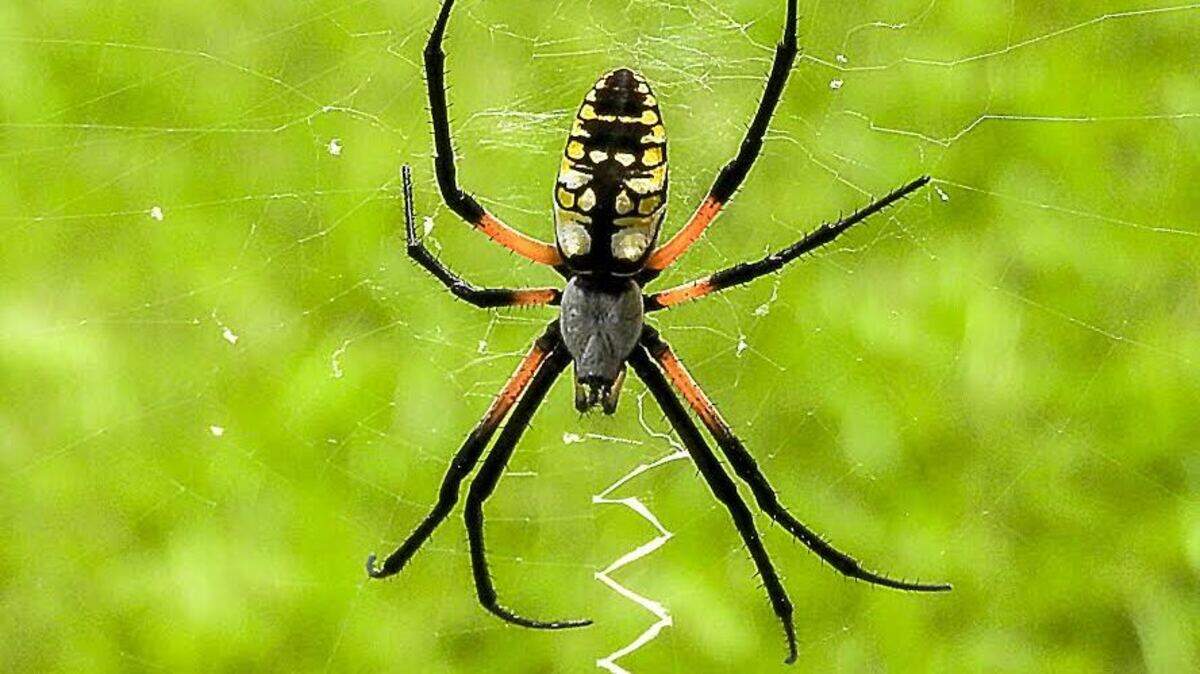
Yellow orb-weavers (Argiope aurantia) are among our most familiar American spiders, common throughout most of the U.S.
You’ve probably seen their large circular webs, perhaps two feet across, stretched across shrubs and tall grasses or draped from the eaves of houses. Equally arresting are the spiders themselves, with their long legs and robust black and yellow bodies an inch or so long. They’re one of more than 40,000 species of spiders worldwide, in the same family as golden silk (or “banana”) spiders, also common in the South.
Both of these big arachnids score high in terms of shock value, but neither bite unless molested, and their venom is relatively harmless to humans.
Like all spiders, yellow orb-weavers have eight legs (insects have six), two main body parts, eight tiny eyes, and a pair of strong jaws.
They produce silk via special glands, called spinnerets, at the tip of the abdomen. Not all spiders spin webs, but among those that do, females are the major web-builders. Spider webs vary greatly in size and shape depending on the species. Those of many orb-weavers have a conspicuous silken zigzag (stabilimentum) running down the center. Originally, biologists assumed its function was to stabilize the web, but now that seems unlikely. Perhaps the zigzag gives some protection from predators, drawing their attention to the web and away from the spider herself.
It may also advertise the web’s presence so that large animals don’t blunder through and damage it.
Still another possibility is that the thick, reflective zigzag helps attract flying insects (food), though some studies seem to suggest just the opposite.
One summer, a yellow orb-weaver built a huge web just outside my daughter’s home near Columbia. The family named her Charlotte after the famous spider in E.B. White’s children’s book “Charlotte’s Web.” For several months, Charlotte was a distinctive, if startling, feature of the front garden. She spent most of her time hanging upside-down in the center of her web, lying in wait for passing insects to become entrapped in the sticky threads. She injected each prey with venom, wrapped it tidily in silk, and set it aside for a future meal. Most food items were small, but once she captured a dragonfly even bigger than herself. Every night Charlotte gobbled up the center of her web, leaving the basic scaffolding intact, and methodically rebuilt it the next morning.
As the weeks went by, she grew increasingly plump. One day she was gone, but next to the remains of her web hung a papery, brown sac about an inch long, filled with perhaps a thousand eggs.
Female yellow orb-weavers typically produce three or four egg sacs in late summer or early fall.
After hatching, the spiderlings overwinter inside their silken home, emerging the following spring.
Reproduction in this species has been a focus of much study by biologists. As is typical of spiders, males are smaller than females of the same species, and in the case of yellow orb-weavers, males are minuscule.
For them, reproduction entails a brief bout of courtship and mating, followed by likely death. Once a male locates a female, he builds a small web of his own nearby. Then he advertises his intentions by plucking a few strands of silk in her web. Once close to the female, the male transfers sperm into her internal storage sacs using each of his two leg-like pedipalps. Then he dies within minutes.
The interesting thing is that the female doesn’t cannibalize the male — he just passes out and his heart stops, seemingly spontaneously. Afterward, though, the female sometimes does make a snack of him.
Although a macabre story by human standards, it’s fascinating from an evolutionary perspective.
And there’s more. Not only does the use of his second pedipalp apparently trigger the male’s death; also, he dies while still attached to the female. His body, in effect, plugs up the female’s reproductive openings — despite vigorous attempts of subsequent suitors to dislodge his corpse and introduce their own sperm contributions.
For a male orb-weaver, life may be short and sex may be deadly.
But death after mating has adaptive benefits: to help provide nutrients for his mate’s egg production and to safeguard his own paternity.
This story was originally published August 21, 2018 at 6:34 AM.