
If you see this noisy Lowcountry bird, keep both hands on your Big Mac
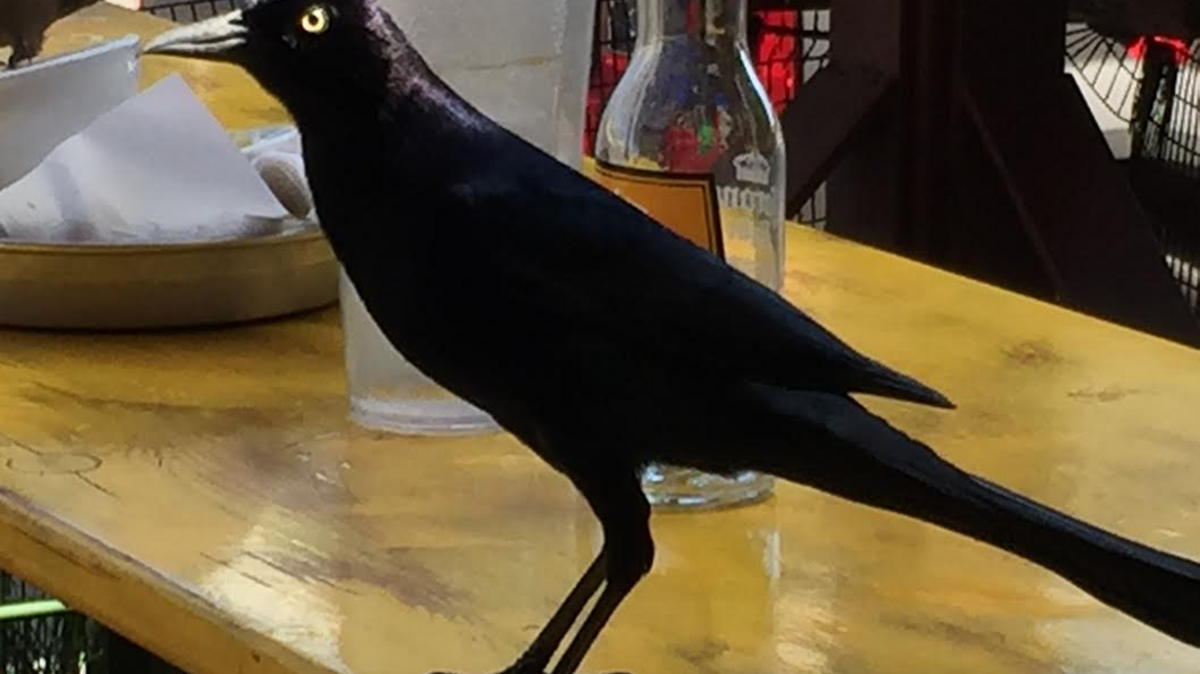
Boat-tailed Grackles are large, noisy birds with forceful personalities.
Males have glossy, iridescent black feathers and long, keel-shaped tails. Females are smaller and brownish, with shorter tails.
Boat-tails are one of three kinds of grackles in the U.S. and were once thought to be the same species as the Great-tailed Grackle, which has an even more outlandish tail. Both are easily distinguished from the widespread Common Grackle, which is smaller overall. Boat-tailed Grackles are common at marshes and beaches along the Atlantic and Gulf coasts, and near inland waters across the Florida peninsula.
They’re omnivorous and opportunistic, feeding on everything from small fish, turtles, snails, mussels, crabs, insects, and frogs to various seeds and fruits. They may steal food from other birds and raid their nests. They’re also at home among people — near fast-food restaurants and dumpsters; in town parks, picnic areas, and parking lots — where they’re adept at dodging pedestrians and traffic. In such habitats they spend much of their time noisily strutting around, scavenging for scraps of food.
I once had to guard my lunch from Boat-tailed Grackles at an outdoor restaurant in Folly Beach, near Charleston. Recently, I was aggressively “buzzed” by a female grackle at the Florida Welcome Center off I-95, when I unknowingly approached her nest. It was one of dozens of grackle nests packed together in a clump of trees lining the busy parking lot. Although Boat-tailed Grackles typically breed near water, they’ve clearly adjusted to hanging out at highway rest stops and other highly populated areas, which provide both food and some protection from rats, snakes, and other predators.
Birds in these aggregations are interactive, spirited, and noisy. Their call — a loud "jeeb-jeeb-jeeb" — is just one of many sounds in a diverse vocal repertoire.
The species is well known for a distinctive mating system called harem polygyny, in which males compete for dominance and mating opportunities via fights and aggressive displays. The resulting dominance hierarchy can be fairly stable over several years. Only the top-ranking male succeeds in defending and monopolizing a nesting colony of females — though studies have shown that other males (usually younger) get lucky sometimes and may pair up with a female when the alpha male isn’t nearby.
The intriguing reproductive behavior of both males and females in Boat-tailed Grackle colonies is still a focus of much ongoing research.
This story was originally published July 3, 2018 at 5:39 AM.