
What to do if you haul in one of these colossal Lowcountry creatures
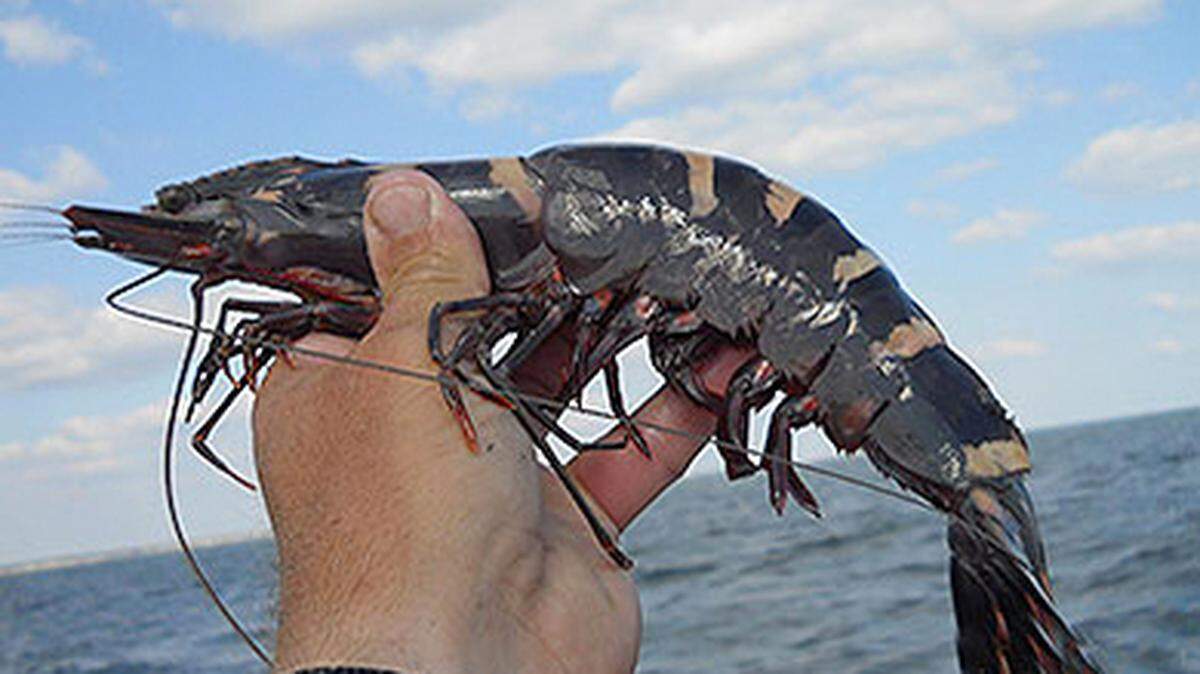
It's dark.
It's striped.
And, for a shrimp, it's downright jumbo.
"You think I can eat that in two bites?" Ridgeland resident Clay Daley asked in a Facebook post. It was a photo of the Asian tiger shrimp Daley caught June 21.
The tiger shrimp is considered invasive to American waters.
After years of the species living here — and in reported numbers that vary from year to year — the South Carolina Department of Natural Resources continues to research the shrimp and its effect on native wildlife.
Five years ago, DNR officials, concerned about how the tiger shrimp might impact the local white shrimp population, began urging residents to report catching the creatures. While reports of them have fallen off in recent years, the DNR still occasionally hears from local anglers.
"Tiger shrimp are still present in coastal South Carolina waters, and we’re still interested in hearing from folks who catch them," DNR representative Erin Weeks said Thursday.
A similar investigation — a combined effort of the U.S. Geological Survey, the National Oceanic and Atmospheric Administration and state natural resources agencies from North Carolina and Texas — is underway to determine whether tiger shrimp carry disease or prey directly on native shrimp.
The first reports of tiger shrimp in South Carolina happened in 1988. Some experts have suggested the species could have come as ballast from Asian cargo ships.
Al Stokes, director of the Waddell Mariculture Center, said Thursday a likely explanation for the tiger shrimp's presence is a Chinese-owned farm in the Dominican Republic.
"They do have a way of sustaining themselves," Stokes said, noting that the shrimp have been found in Lowcountry waters for more than 10 years.
Today some experts, such as DNR crustacean scientist Peter Kingsley-Smith, aren't too worried about the shrimp's impact.
"Fortunately, there's no evidence to suggest they're changing our coastal ecosystems," he said.
But when the "S.C. Lowcountry Tourism Commission" Facebook page shared Daley's photo, followers of the page stormed the comment section, urging him not to throw the shrimp back.
Daley said he was doing a drag on Hilton Head right off of Port Royal Sound when he noticed the tiger shrimp's yellow stripes amidst pounds of shrimp in the water.
So he grabbed it.
The crustacean was about a foot long and weighed almost half a pound, he said.
"We average probably nine [tiger shrimp catches] per season," he said. "That's the biggest one we caught."
In response to the social media comments, Daley said he did not throw it back.
There have been no official reports to the DNR of tiger shrimp in the state this year, Weeks said.
"Last year ... there were only 10 reports (of tiger shrimp) across the entire southeastern region from North Carolina to Texas," she said.
That's an exponential drop from the 678 reported in 2011.
Weeks said the cause of the drop is unclear — it could be a decrease in tiger shrimp numbers, or it could be a drop in reporting interest. It's been a few years since the DNR did any outreach to residents about the foreign species, she said.
"The unusually low temperatures we saw in January 2018, which killed off many of the native white shrimp (wintering) in our waters, may have also negatively impacted tiger shrimp, given their tropical origins," Weeks said.
Stokes said residents were probably more likely to report finds to DNR when the species was still new and "unique."
"But now I think they're are so commonplace that people don't do it as much," he said.
Daley said he reported tiger shrimp when he first began catching them, but now he tends not to.
He has plans for his latest catch.
"I actually have a friend who's a taxidermist," he said. He's going to mount his latest catch, his biggest ever.
DNR urges those who catch a tiger shrimp to contact the department and provide:
- Their name.
- Date, method and depth of capture.
- Length and weight of tiger shrimp.
- Sex of tiger shrimp if known.
"We’re still accepting samples if folks would like to donate live or frozen specimens," Weeks said.
To report a tiger shrimp to the DNR, email the information to tigershrimp@dnr.sc.gov or call 843-953-4985.
Live tiger shrimp can be brought to the DNR Marine Resources Research Institute at Fort Johnson or to the Waddell Mariculture Center.
The U.S. Geological Survey also launched an interactive map that shows where nonindigenous aquatic species can be found. The tiger shrimp shows up from Texas coastal waters all the way through North Carolina.
This story was originally published June 28, 2018 at 2:24 PM.