
Natural Lowcountry / Sticky weed used in drinks, cooked as veggies and a model for Velcro
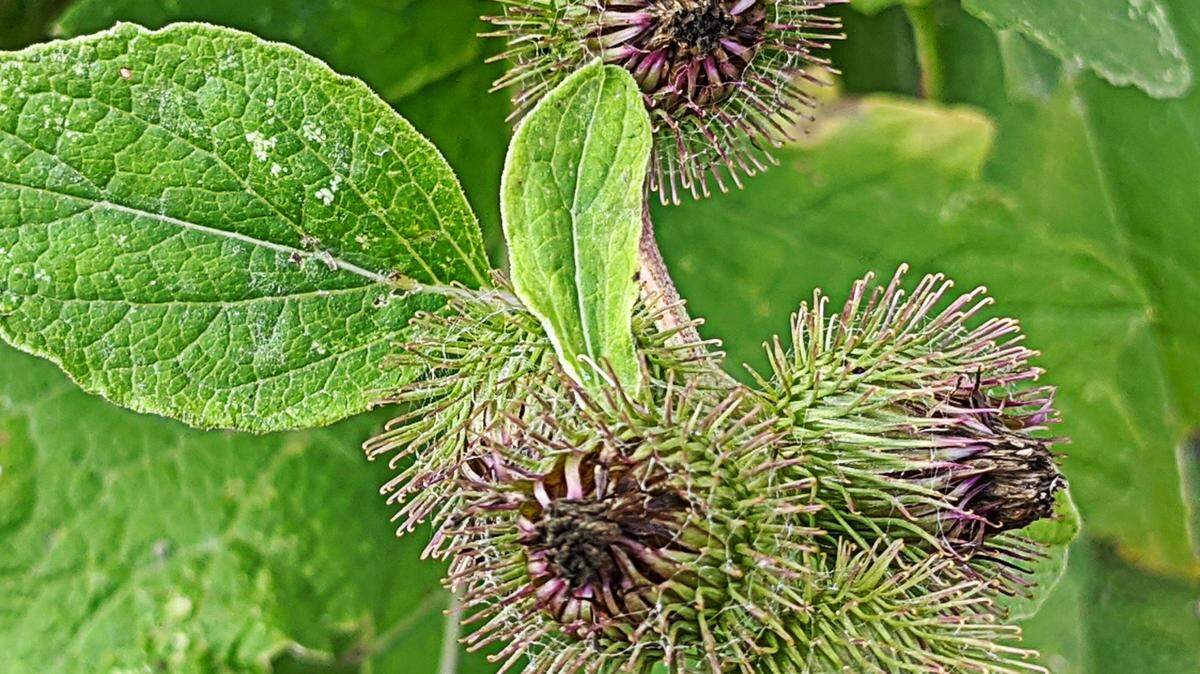
Brush up against a burdock plant that has finished flowering, and you’ll probably acquire an unwanted collection of the sticky burs for which it’s named.
Burdock belongs to the aster family (Asteraceae), along with daisies, marigolds, artichokes, and over 32,000 other species.
In North America, there are several kinds; the most widespread is common burdock (Actium minus). Native to Europe, this species is now found throughout most of the U.S., including the Lowcountry. It’s a common weed in fields, pastures, roadsides, abandoned lots, and other waste areas.
Common burdock is a biennial, taking two years or so to complete its life cycle, after which it dies.
During its first growing season, the plant produces a basal rosette of large, coarse, oval leaves. In the second year, it shoots up to heights of 3-6 feet, forming branches, more leaves, and abundant flowers.
Each burdock flower head is a tight cluster of tiny, pinkish, tube-shaped florets — dozens of them. Enveloping the flower head are numerous green bracts (modified leaves) with inward curving hooks at their tips.
As the florets wilt and form seeds, the flower head transforms into a bur whose minuscule hooks cling to passing animals, including humans, dispersing burdock far and wide.
A single common burdock plant may produce as many as 15,000 seeds. Small wonder, then, that the species is considered an invasive weed in 16 states, including South Carolina.
Invasive but many uses
However, as a “pioneer” plant, tolerant of poor soils, common burdock helps pave the way for other plants to colonize disturbed habitats.
And various burdocks — especially greater burdock (Arctium lappa) — have a long history of culinary use in Asia, Europe and colonial America. The taproot, leaf stalks, and flower stalks of young plants have been eaten as cooked vegetables. Roots were roasted and used as a coffee substitute.
My husband remembers drinking “dandelion and burdock,” a root beer-like soft drink, during his childhood in England. The beverage dates back to the Middle Ages, though commercial versions today may lack extracts from either plant.
Burdock roots and leaves have also been used by herbalists to treat a variety of ailments, from fever and sunstroke to urinary disorders, constipation, arthritis, eczema, and rheumatism.
Preliminary chemical analyses of several species have identified a wide array of bioactive substances. We still have much to learn about the efficacy and safety of burdock as a therapeutic, but the future looks promising.
Burdock has yet another claim to fame. In 1941, after a walk one day with his dog, Swiss engineer George de Mestral took a closer look at all the burdock burs clinging to both of them. He began wondering whether their binding mechanism could be adapted for sticking together cotton or other fabrics.
In 1955, after years of research, de Mestral was granted a patent for a novel hook-and-loop fastening mechanism modeled after burdock burs. It’s now world-famous as the forerunner of “Velcro.”