King tide worsens erosion on south end of Hunting Island State Park
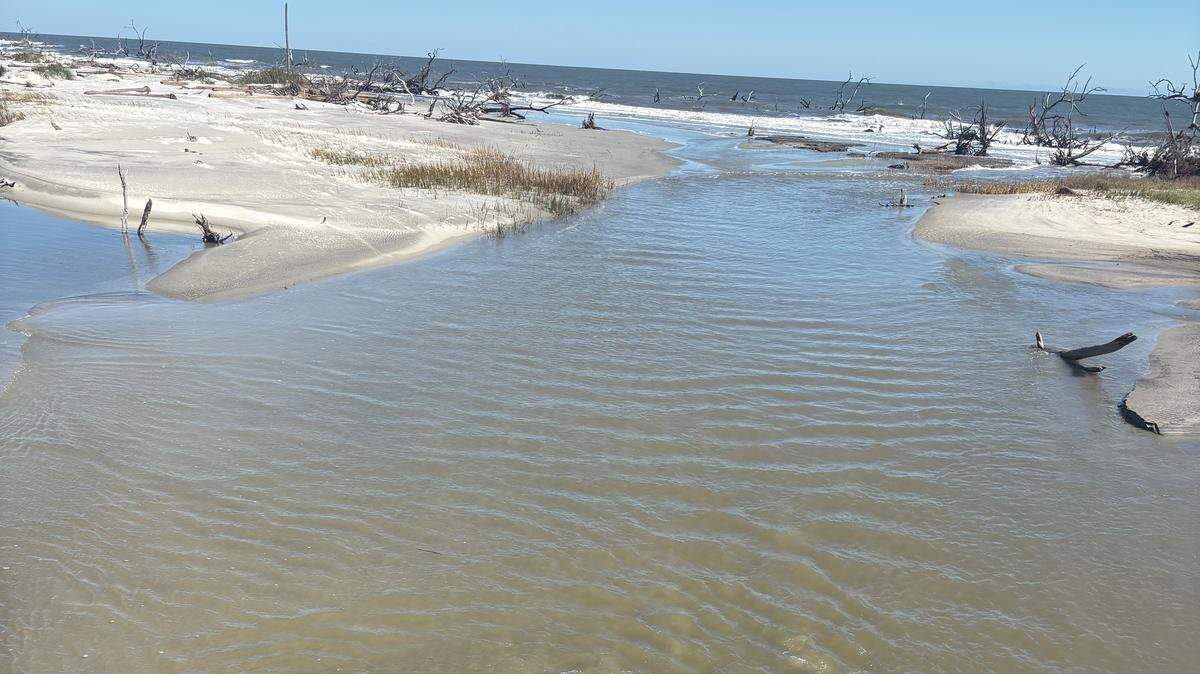
The shoreline at Hunting Island State Park has been retreating for well over a century, but the recent “king tide,” high winds and a low pressure system handed the beach a few more blows.
On the South end’s Boneyard Beach, where the surf is littered with dead trees felled by erosion, the stormy conditions resulted in a new channel cutting through the beach near the bridge over the lagoon, which had filled in partially with sand. Dunes on the central section of the island are also eroded in places.
The erosion on Hunting Island is hardly unique; many of South Carolina’s barrier islands are in the same situation, and sea level rise and increasing storms are accelerating the losses. At South Carolina’s most visited state park, it means some of the most iconic parts of the island are disappearing.
Much of the south end of the island, which constitutes the Boneyard Beach, is at risk of disappearing. Robert Young, a geology professor at Western Carolina University who has studied erosion on Hunting Island, said sometimes channels like the one that formed on the south end of Hunting Island are temporary. But the big picture is that much of what visitors know as the Boneyard Beach will disappear in the coming years.
“The shoreline is moving, and eventually that bridge will be gone, and the new shoreline will be on the landward side of the lagoon,” Young said. “That’s the future for that part of Hunting Island.”
Further north, the beach on Hunting Island is largely held in place by frequent renourishment projects and groins, structures running perpendicular to the beach and preventing the normal movement of sand down the shoreline.
When currents and wind hit the ocean-facing side of a barrier island, they pull sand from the beach and deposit it further south, a process known as longshore transport. Young said the groins prevent the movement of sand from the middle of the island to the south end, possibly causing the south end to disappear quicker than expected.
Further up the island, the dunes along the beach are eroding, with cliffs of sand up to three feet high in some places. The South Carolina Department of Parks, Recreation & Tourism last renourished Hunting Island’s beach in 2020, at a cost of $14.7 million. Since the island was first renourished in 1991, the south end has not received any new sand, which allows the iconic “boneyard” of trees to develop.
The parks department is not actively pursuing any permits or funding for another renourishment project, according to Sam Queen, a spokesperson for the department.