
Woman seeks cat-dissection ban in Beaufort County schools
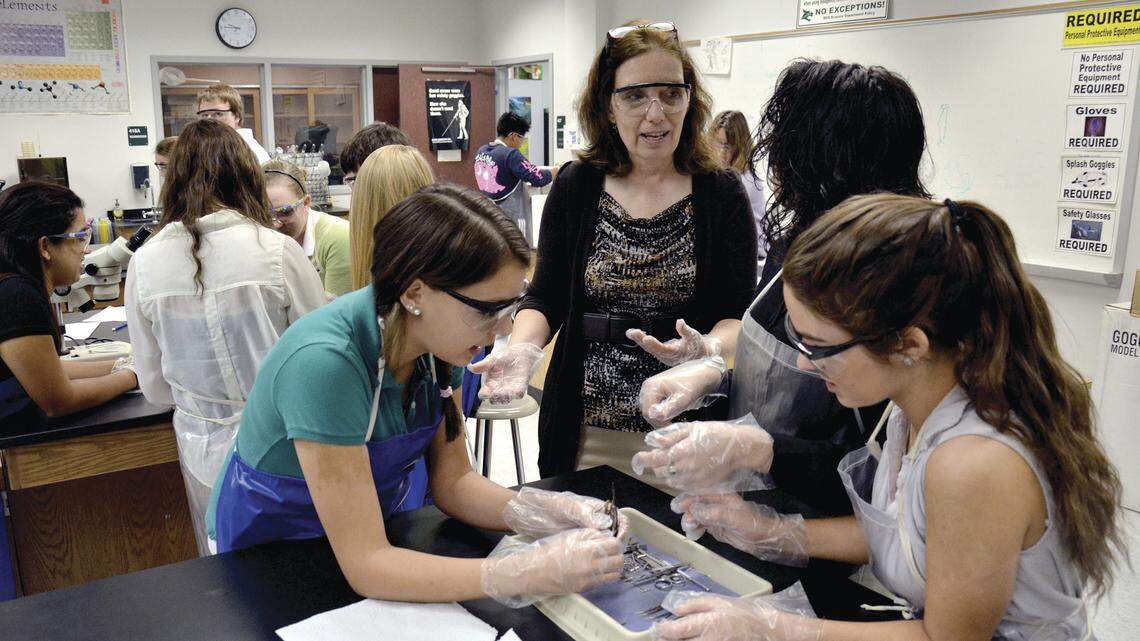
A donation to Battery Creek High School for the purchase of cat cadavers has stirred debate about animal dissection in high schools.
Beaufort resident Kate Zalusky launched an online petition Tuesday to ban cat dissections in Beaufort County public schools.
"Asking students to dissect or watch a companion animal being dissected as part of their class assignments can be a traumatic experience," she asserts.
Zalusky began the petition in response to a photo published Jan. 10 in The Beaufort Gazette depicting Battery Creek High School anatomy and physiology teacher Jeri Williams being surprised with a $500 grant from the Northern Beaufort County Education Foundation. The photo's caption includes a quote from Williams saying, "We're looking forward to dissecting some cats."
"Parents and educators need to be aware that classroom dissections teach students that it's OK to be cruel," Zalusky wrote in an email to school district officials. "Schools should instead be teaching students to respect life by teaching anatomy via many of the humane alternatives that are available."
The Humane Association of the Lowcountry, where Zalusky is a volunteer, shared the petition on its Facebook page. More than 80 people had signed by Wednesday afternoon.
Zalusky, who dissected frogs -- but not cats -- in college biology and zoology courses, argues that students are not mature enough to deal with cutting open a companion animal.
"If the point is to learn of the animal's anatomy, there are virtual, online programs and other alternatives, such as observing college students perform dissections who are training to be doctors or veterinarians, which are a more fruitful way of accomplishing the same thing, and less expensive," she said.
Williams disagrees.
"The reason we chose the particular vertebrate (cat) is to give the students an overall understanding of the human body," she wrote in an email. "The structures of a cat are very closely related to a human, and the size of the cat allows students to see the structures more vividly."
Dissection makes the textbooks real, Williams argues, providing students hands-on experience and allowing them to master the curriculum.
State standards also support the use of dissection in middle and high school science instruction, requiring students to demonstrate an understanding of scientific inquiry and an ability to handle forceps, scissors and preserved specimens, according to Battery Creek science department facilitator and biology teacher Martha Sette.
The college-preparatory class is an elective. Students are informed that dissections will be involved, and they may opt for similar courses that don't require dissection, Williams said.
District spokesman Jim Foster said cat dissections have been done in the past by AP biology students at Hilton Head Island High School, adding this is the first time teachers have encountered complaints from the public about dissections, that they can remember.
"Dissection has been part of high school biology and anatomy courses for a long time, and teachers wouldn't be doing them if they did not think it was an effective instructional practice," Foster said.
The cats have been euthanized by area humane societies in the course of shelters' normal operations, not for dissection, Williams said.
The cadavers are then prepared commercially and ordered through biological supply company NASCO, she said.
Cats are among the most commonly dissected vertebrate animals in the U.S., along with frogs and fetal pigs, according to the Humane Association of the United States.
Related content
- PHOTO: Battery Creek teacher receives education grant: Jan. 10, 2013
- Petition to ban cat dissections in Beaufort County public schools
This story was originally published January 17, 2013 at 7:38 PM with the headline "Woman seeks cat-dissection ban in Beaufort County schools."