Parents say mold at this Bluffton elementary school is making kids sick. Testing may confirm
Parents of Pritchardville Elementary students in modular classrooms say their children have symptoms consistent with mold exposure, and the school district is not responding to their concerns.
Parent Crystal Renee said her emails to school administrators, state legislators and others were ignored.
“[They] just blew us off,” Renee said.
The Beaufort County School District, which tested in February and did not find high mold counts, will test again next week after hearing from parents, Chief Operations Officer Robert Oetting told The Island Packet and Beaufort Gazette on Friday.
The school notified parents of mold testing in September and February, and told parents that they’d continue to test the classrooms periodically.
“We’ve had some parent concerns that have been raised [and] we’re going to test again,” Oetting said. “Outside of the parent concern we haven’t noticed or been able to detect any problems in the area.”
However, parents said the district hasn’t notified them about any new testing, although the district has been transparent about sharing previous test results.
The parents called for the district to test for mold again to ensure the safety of their children. They said in the two months after the February testing, temperatures have gotten warmer and there have been multiple heavy rain storms. They said that while there might not have been dangerous amounts of mold then, there could be now.
“Within those two months, if you already have some remaining mold and it’s constituted as fine, but then we get more heavy rain, what are the chances of that progressing within a certain period?” said parent Nicole Zolzer, who has a fourth grade student in a modular classroom.
The school has two modular, or mobile, buildings, built to accommodate growth in the Bluffton area. The fourth grade building has six classrooms and the fifth grade building has eight classrooms. Both modular buildings were built in 2018, although the fifth grade modular moved from River Ridge Academy in 2022.
Parents questioned what is an acceptable level of mold? There is mold everywhere, according to air quality specialist, Ken Marchi, with Low Country House Detectives, and that doesn’t always mean that it’s harmful. People are impacted by mold differently depending on their immune system and allergies, he said.
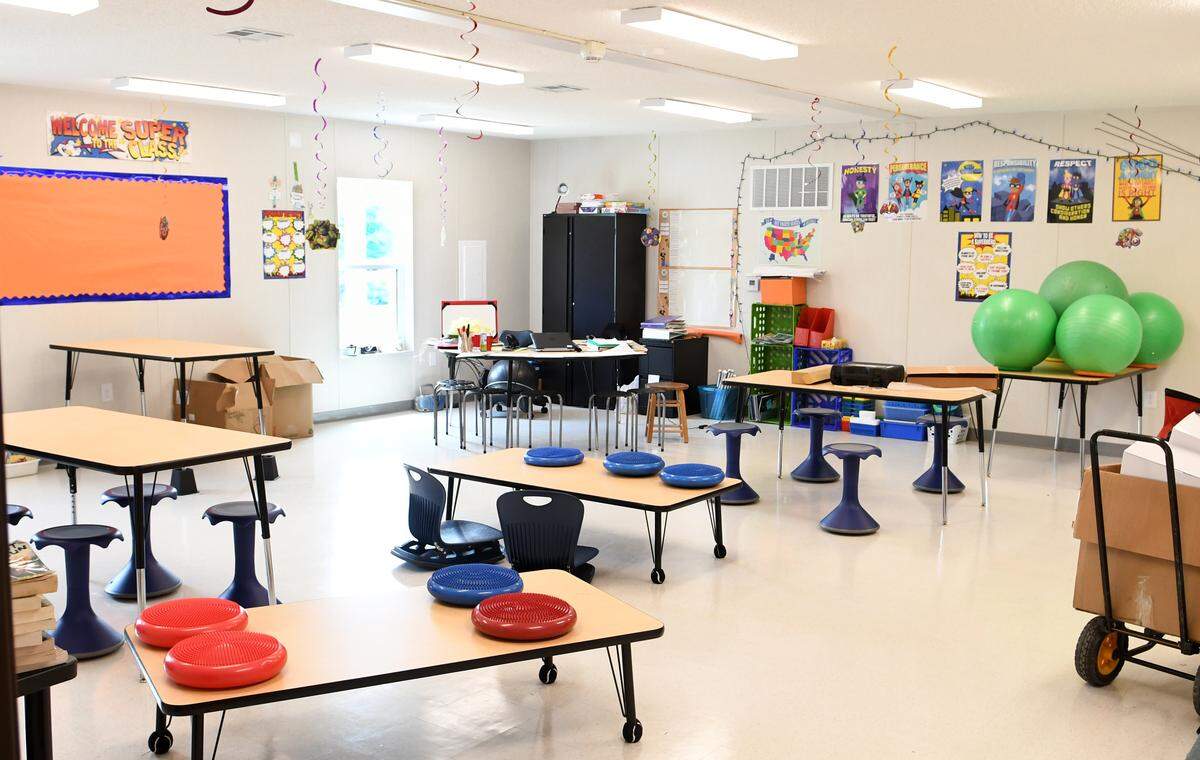
“The standard is you don’t want to see that mold is coming from the building itself,” Oetting said. “That’s why you test to make sure that your indoor [mold] levels are significantly less than your outdoor levels.”
The parents’ complaints follow a September incident at a Pritchardville Elementary fifth-grade modular classroom, where the district tested and found unsafe mold levels. The school moved the fifth graders temporarily while repairing the interior walls and roof.
Oetting said the district hasn’t had mold concerns at any other school this year.
“We have a formal process,” Oetting said. “Whenever anybody has a concern, we ask them to fill out an indoor air quality report.”
He said parents, community members or employees can fill out a report and then they’ll investigate the issue.
“We’ve done everything that we can and whenever we found something we react as quickly as possible,” Oetting said.
However, parents said they’ve put in a lot of effort with little response.
Headaches, fatigue and ER visits
Renee’s fifth grader at Pritchardville Elementary complained about headaches, itchy and watery eyes, throat irritation and fatigue before the September repairs.
These are symptoms consistent with mold exposure, and once the district repaired the classroom, Renee’s 10-year-old stopped showing symptoms. In March, along with about five other children, her symptoms returned.
“She started with constant sneezing again, all the time,” Renee said. “She always complained about her head hurting, her throat sore, and (it’s) very red in the back.”
Renee brought her daughter to a pediatrician, who ruled out other sicknesses like COVID or the flu.
“I have a first grader there as well that’s in the [main] building, and he has no symptoms of anything,” Renee said. “My kids don’t get sick. They take their vitamins [...]and all that. They have great immune systems.”
Parent Stephanie Frazier said her daughter has missed over nine days since March visiting the emergency room, urgent care and her pediatrician.
Her child was diagnosed with allergies to the environment, bronchitis and mesenteric adenitis. The later two can be related to conditions that cause respiratory problems, like allergies.
In the fall, parent Tanya Colucci’s son was diagnosed with asthma and had to start nebulizer treatments, which help with wheezing and breathing problems.
“It became like a pattern [where] he would be out sick for a while and then get better and then since he returned back to school, his allergy-asthma symptoms would flare up almost immediately with him being in school for a day,” she said.
Colucci and Renee are in the process of getting mold allergy tests done on their children at the recommendation of their pediatricians.
“Can I confirm that mold is the issue? No, but it’s the suspicion in my head,” Zolzer said.
What does the testing say?
In September, the district found high amount of “Aspergillus/Penicillium.” The follow-up testing in February didn’t find similar high mold counts in the classroom.
So what’s the problem?
“We have something called allergenic spores, which is what this Aspergillus Penicillium is. If you don’t have allergies and you have a lot of (this mold), it will give you allergies,” said Marchi, the air quality expert. “If you do have allergies and you breathe this in, its going to exasperate your allergic reactions.”
When testing for mold, inspectors send air samples from outdoors and inside the classroom to a lab. Marchi tests hundreds of buildings for mold annually, and has worked in the Lowcountry for 17 years.
“The lab is looking for numbers 10 times greater than the outside,” he said. However, like most states, South Carolina doesn’t regulate or have standards for unhealthy mold levels, according to Marchi.
In February, all of the mold levels at Pritchardville Elementary were less than 10 times greater than the outside air, and there was no toxic mold ever reported in the classrooms, according to Marchi.
However, parents said the school didn’t collect enough air to properly test for mold. The school did a five-minute collection test instead of a 10-minute test, according to Marchi.
“Will it make a big difference? It depends on the system,” said Marchi, explaining that certain systems are designed for five minutes. He said the only systems he uses are for 10 minutes which collect 150 liters of air, instead of the five-minute tests, or 75 liters like the school collected and tested in February.
He said that the February results don’t show anything alarming, but since it was two months ago, new mold could have grown — especially considering the warming and wet weather.
“For sure my recommendation would be to have further testing, more comprehensive testing to find out what’s really going on with the air in there,” he said.
Editor’s note: An earlier version gave an incorrect attribution for Nicole Zolzer’s quotes
This story was originally published April 22, 2023 at 11:02 AM.