
Natural Lowcountry: Bald cypress reinforced by sturdy 'knees'
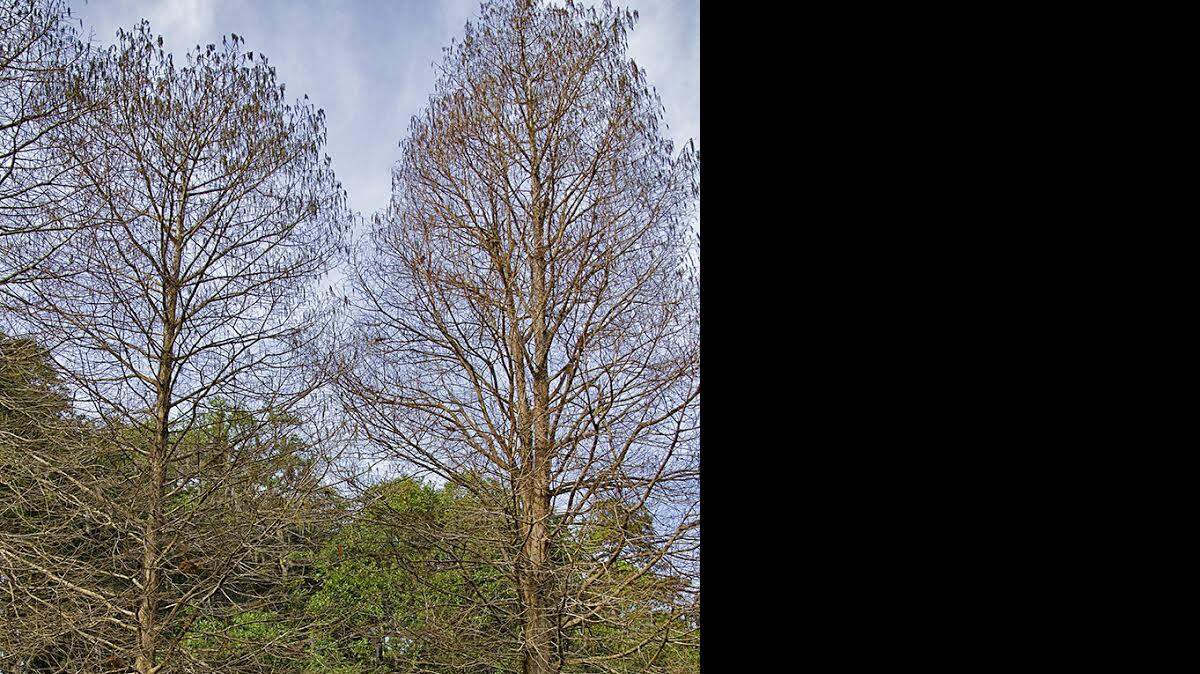
The bald cypress flourishes in southern swamplands.
Bald cypress "knees" are woody, knobby projects that fan out from the tree's trunk.
A cone-bearing tree called bald cypress (Taxodium distichum) once dominated prehistoric swamplands in the Southeast.
This majestic conifer still flourishes in southern swamps and bayous, where it can reach impressive sizes and ages. A specimen in Virginia holds the current height record at over 144 feet. The oldest living bald cypress, in North Carolina, is over 1,620 years old.
Bald cypress loses its needle-like leaves in winter (hence the common name "bald"), though its branches are often draped year-round with long strands of Spanish moss.
But perhaps the most distinctive feature of bald cypress is its "knees" -- woody, knobby projections that fan out around its broad, fluted trunk.
These odd-looking structures, each unique in size and shape, arise from the root system and project up through the soil or swamp water.
Older trees, and trees growing in deep or flowing water, can have knees 8-10 feet or taller. In mature swamps it's hard to tell which knees belong to which bald cypress, since the roots of adjacent trees tend to grow together into an interlocking matrix.
What function do the knees serve? Biologists still aren't sure.
One widespread hypothesis held that knees provided extra oxygen to the roots. But there's scant evidence to support this.
It's more likely that knees strengthen the tree's root system, giving anchorage and support in wet substrates and buttressing the tree against strong winds.
In wetlands, bald cypress trees are of immeasurable importance to wildlife.
Squirrels, Wild Turkeys, and waterfowl feast on seeds from the cones. Ospreys and Bald Eagles build nests in the tree tops, and Prothonotary Warblers nest in knee cavities. Hollow, submerged logs are spawning sites for catfish.
Remnants of native American dugout canoes made from bald cypress trunks are estimated to date back over 4,000 years
Humans have also used the oily resin from cypress cones to make a balm for wounds and rashes. The durable, water-resistant wood has been prized for furniture, shingles, flooring, railroad ties, fence posts, and ornamental carvings.
Because of extensive logging during the early twentieth century, only a few old-growth stands of bald cypress remain. The best examples are in Florida's Corkscrew Swamp and the Three Sisters tract along North Carolina's Black River.
Vicky McMillan, a retired biologist formerly at Colgate University, lives on Hilton Head Island.
This story was originally published December 26, 2015 at 7:47 PM with the headline "Natural Lowcountry: Bald cypress reinforced by sturdy 'knees'."