
‘He’s not a serial killer,’ Harpootlian tells new Murdaugh judge, who shows her stuff
“This guy’s no serial killer. He’s not Ted Bundy,” an animated defense attorney Dick Harpootlian told Judge Debra McCaslin during an hourlong pretrial hearing Monday morning at the Lexington County courthouse for accused double murderer Alex Murdaugh.
“Potential jurors are watching this right now,” Harpootlian told the judge, explaining how the accused killer’s orange prison garb and the three sets of chains and manacles he wore were being live-streamed by Court TV around the state and nation and are highly prejudicial to any future jury.
“Parading him around in a jumpsuit shackled like an animal ... makes it more difficult for us to get a jury,” Harpootlian said.
Harpootlian had Murdaugh stand, then pointed to the three circles of linked metal binding his client
“Chains around the waist, chains around the hands, chains around on the feet!” Harpootlian told the judge, his voice rising.
“He’s not dangerous,” said Harpootlian. “The only thing he’s been convicted of is stealing money.”
Prosecutor Creighton Waters objected, saying it was not the prosecution’s fault that Murdaugh, 58, was wearing a prison jumpsuit and manacled. After all, he put himself in prison for serious financial crimes and will stay there for another 40 years, Waters said.
“This is a basic security consideration,” Waters said, adding that “the first two goals of any escape attempt” are to get rid of restraints and wear civilian clothes.
McCaslin delayed a decision. “I will take it under advisement and issue an order on that,” McCaslin said on the issue of whether Murdaugh will continue to wear chains and prison clothes in pretrial hearings.
A time warp as Judge sets trial date
The 60-minute hearing was like a time warp: In the past, Harpootlian and Waters sparred many times in hearings before nationwide television audiences leading up to Murdaugh’s 2023 double murder trial, then all the time during the six-week trial and at post trial hearings as well.
Now that the S.C. Supreme Court overturned his murder convictions in May, for killing his wife, Maggie, and son Paul, Murdaugh is to go on trial again.
And Harpootlian and Waters are at it again — albeit with a fresh judge and a new set of legal issues mixed with a host of old ones.
Harpootlian and Waters differed on when the trial should start.
“We were trying to do this before the end of the year,” Waters told the judge.
To which Harpootlian replied, “To do it before the end of the year for us to be adequately prepared cannot be done.” The defense team includes eight expert witnesses, all of whom are just beginning to get familiar with the facts of various facets of the case, not to mention DNA studies that have to be done that will be time-consuming, he said.
“What we are comfortable with is late spring or early summer,” Harpootlian said.
Unresolved issues
After some discussion with Harpootlian and Waters, McCaslin set April 5 — early spring and a week after next Easter — as the date for picking jurors and for the trial to begin.
McCaslin made it clear the date was firm. “When I set a trial date, I don’t do continuances.”
But she also indicated if unforeseen circumstances develop, the trial might be delayed. In the world of South Carolina criminal trials, trials don’t always start on the first designated date.
Other issues remain to be decided:
- Where the new trial will be held. Judge McCaslin asked each side for suggestions on where the new trial should be held. Colleton County, the site of the first trial, has not been ruled out. But the defense prefers to have the trial elsewhere, it said in a motion.
- What kind of access Murdaugh will have to a secure laptop full of 20,000 digital pages of documents relating to his case. Harpootlian said Murdaugh needs to review voluminous various evidence and testimony from the first trial, which lasted six weeks. However, Waters said prosecutors don’t want confidential grand jury testimony to be put on any laptop given to Murdaugh. And state prison inmates are prohibited from possessing electronic devices, Waters said. Harpootlian stressed this laptop would have no internet connections or ways to be downloaded and would be accessible to Murdaugh only in a secure conference room, not his cell. The judge wanted more information before making a decision.
- Whether the defense can get DNA from underneath one of Maggie Murdaugh’s fingernails analyzed by a private lab. The DNA is not consistent with DNA from any known party, including her husband or sons, defense attorney Jim Griffin told the judge. In the first trial, SLED was unable to analyze the DNA, but science has made significant advances in the technology since then, Griffin said.
- Although Waters suggested that the DNA issue might be a “red herring,” he agreed to have State Law Enforcement Division DNA experts talk with the private DNA experts that Griffin is recommending and see what both sides say about the feasibility of further analysis.
New judge in town
As the new judge in the case, replacing now-retired veteran Judge Clifton Newman, McCaslin — a former criminal defense attorney — quickly showed her stuff. She speaks in slow, measured tones, and she even brought a checklist of items to deal with at the hearing.
On thorny issues, she said she was ready to wait while attorneys for each side researched facts, filed briefs or otherwise got back to her so she could make an informed decision.
She set Aug. 14 as the next pretrial hearing.
Overall, in a series of rulings and back and forths with Harpootlian and Waters, McCaslin came across as methodical, decisive, in control, a patient listener to attorneys and well-prepared. She revealed she had earlier called the warden of the state prison where Murdaugh is being held to explore whether the defendant’s having a secure laptop computer with a half a terabyte of documents would be a security risk.
McCaslin’s hands-on aggressiveness in contacting the prison warden contrasted with her professed unfamiliarity with the issues — an apparent nod to a display of humility that good judges are expected to have. The attitude is also practical, keeping her from assuming something that might be off-base.
As for the first trial, which was watched by millions, the subject of more than 20 books and wall-to-wall media coverage, McCaslin professed a state of not knowing, saying, “I don’t know anything about the first trial … Don’t assume that I know, because I don’t.”
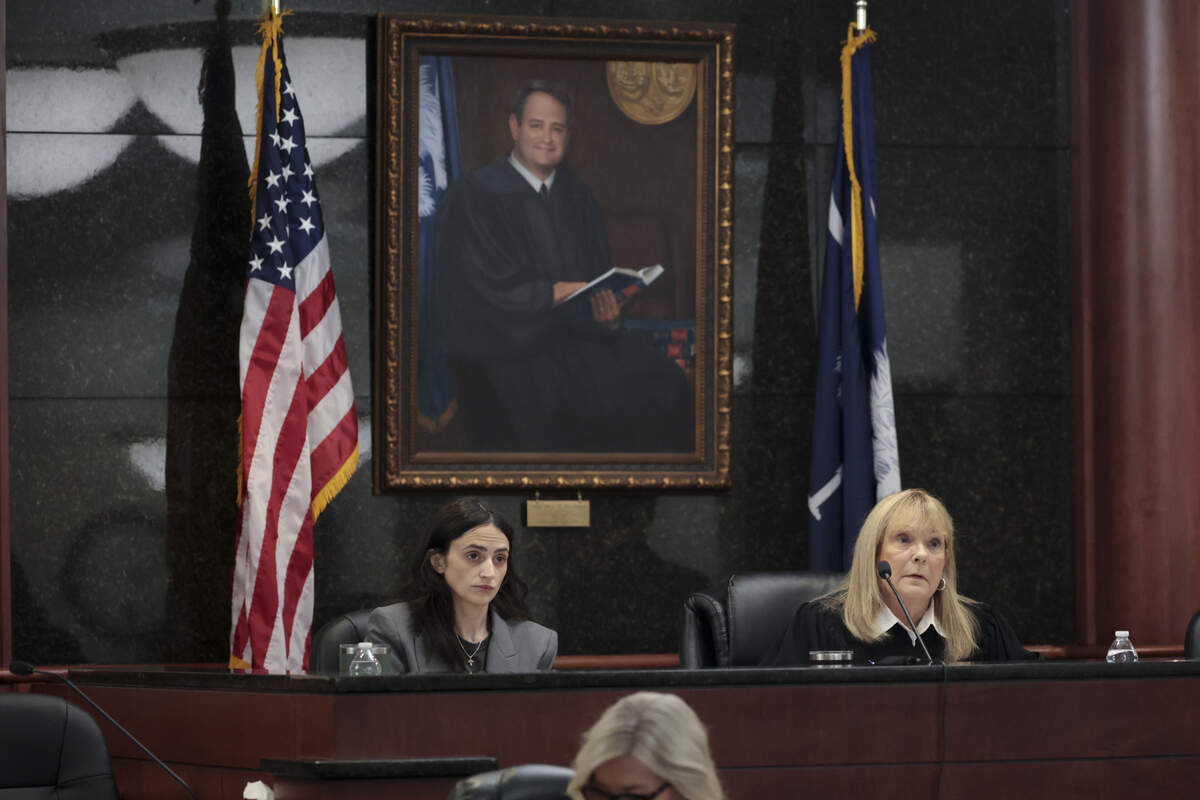
Her claims to know-nothingness aside, McCaslin’s courtroom — packed with more than 100 people, including at least 40 media types — was the model of security. Seven officers lined the back wall. Five more were scattered around the front of the court. Burly guards from state prison Special Operations Response Team were also in the courtroom. The hearing was to begin at 10 a.m., and Murdaugh — tall, gangly and a hint of a smile on his face — was ushered into the room at precisely 10 a.m., shuffling in his chains.
Gasps could be heard as South Carolina’s most famous criminal took his place between Harpootlian and his co-lead attorney, Griffin. Murdaugh did not speak aloud during the entire hearing. He had been brought to the courthouse under conditions of great security, let out in an underground garage and brought upstairs in an inmate elevator, all out of sight of the public.
Although the judge’s voice was amplified and easy to hear, the voices of Harpootlian and Waters were not electronically amplified and at times their words were difficult to follow for those in the courtroom.
The journalists ranged from three University of South Carolina journalism school student interns to two print reporters who’ve written well-received books on the Murdaugh case — Wall Street Journal reporter Valerie Bauerlein (”Devil at His Elbow”) and Post & Courier reporter Jason Ryan (”Swamp Kings”). Major media outlets like CNN, Associated Press, NPR, CBS, NBC, ABC and others were there, as well as the Lexington Chronicle.
The media attention, even at a pretrial hearing where humdrum legal issues were aired, was to be expected in what has been called South Carolina’s most sensational and lurid crime saga — Murdaugh, the powerful fourth generation member of a wealthy socially and politically prominent legal family, in the spotlight for embezzling millions of dollars from clients and his law firm and who stands accused of killing his wife and younger son.
It is the story of a once powerful and rich lawyer who betrayed everyone around him and a rural Southern dynasty’s fall from grace, a story known around the country.
Besides Harpootlian and Griffin, defense attorneys on the case are Phil Barber and Maggie Fox.
State attorney general prosecutors besides Waters in the courtroom included Don Zelenka, John Meadors, Melody Brown, Walt Whitmire and David Fernandez.
Columbia attorney Joe McCulloch, who is involved in various facets of the Murdaugh case, attended Monday’s hearing.
“I’m glad the public got to see Judge McCaslin is well prepared, and she is ready to roll this trial,” McCulloch said.
This story was originally published June 29, 2026 at 5:44 PM with the headline "‘He’s not a serial killer,’ Harpootlian tells new Murdaugh judge, who shows her stuff."