Bluffton protests ICE operation: ‘We’re out here because other people can’t be.’
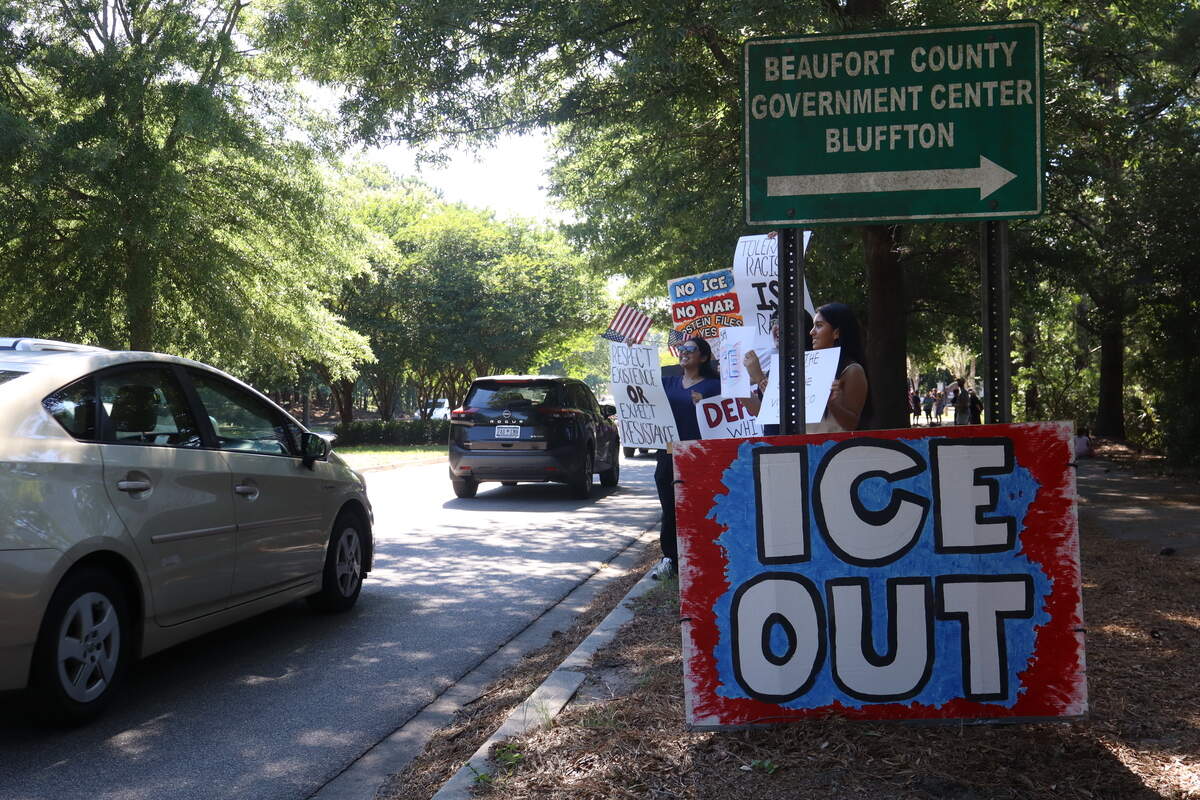
A crowd of about 100 protesters gathered Friday afternoon outside a Bluffton government building, where a week prior over 15 residents had been loaded onto a bus after being detained in an operation by U.S. Immigration and Customs Enforcement.
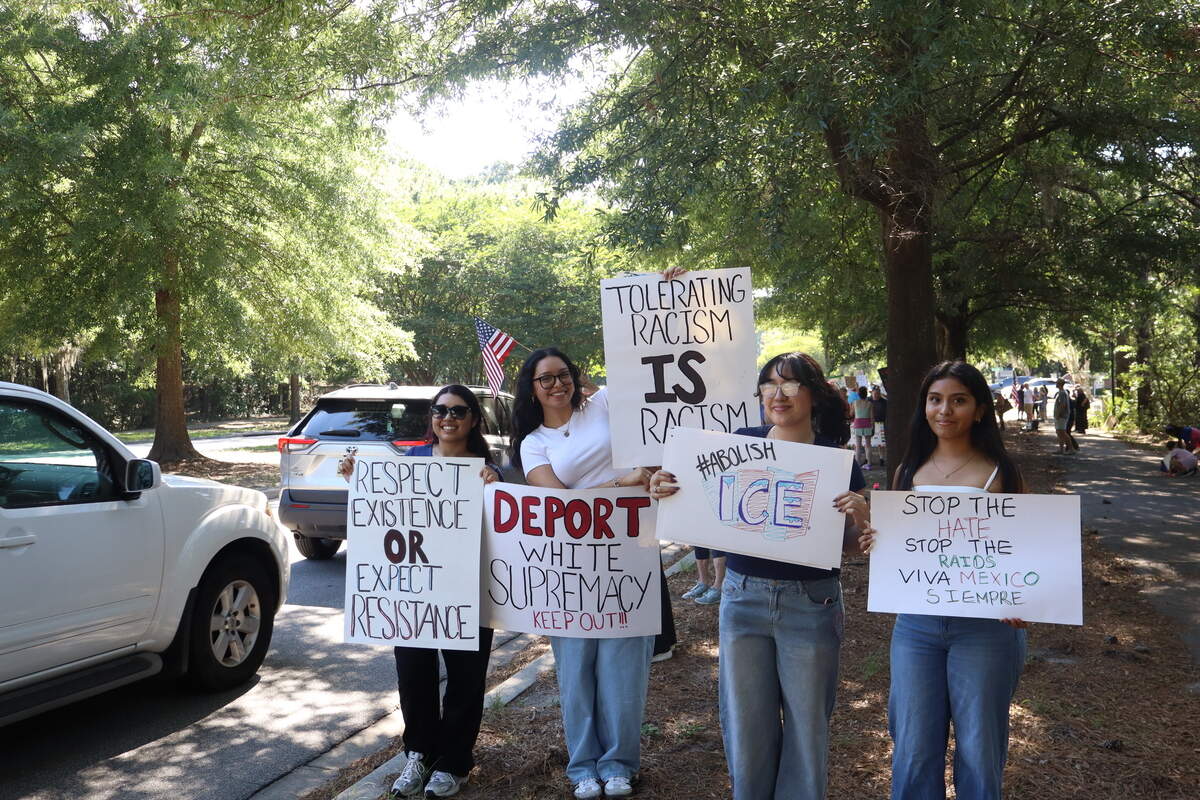
Through their brightly colored signs and in interviews with The Island Packet, the protestors along Bluffton Parkway strongly condemned the actions of ICE during President Trump’s second term. They also criticized the participation of the Beaufort County Sheriff’s Office in the May 29 operation, made possible through a 287(g) agreement with ICE that was signed by Sheriff P.J. Tanner last summer.
“Last week, in this building — that belongs to us, the taxpayers; this is our public government building — this building was used to hold at least 17 men by ICE,” Bluffton immigration attorney Aimee Deverall said as she motioned toward the Myrtle Park Government Center during a speech to protestors.
Spokespeople from the U.S. Department of Homeland Security have not answered questions about how many arrests were made during the Bluffton operation, the detainees’ backgrounds or where they were taken. But Deverall said those arrested “were not charged with any crime.”
“There was a bus waiting out here in the parking lot to take them to the middle of Georgia, to detention facilities where we have absolutely atrocious conditions right now — where men are demanding to be fed, where people are getting sick and they are dying,” said Deverall, who also serves as chair of the Lowcountry Immigration Coalition.
Deverall said several attendees at an LIC event earlier in the week had family members taken and didn’t know exactly where they were.
“They might know the detention centers, but that’s about it,” said Rev. June Wilkins of Christ Lutheran Church Hilton Head, who organized the event alongside Deverall. “They don’t know how to reach them, they can’t talk to them, they can’t visit them or anything.”
‘Brown is not a crime’
Many at Friday’s protest criticized the operation’s apparent use of “collateral arrests,” which means apprehending undocumented immigrants who are not the primary target of any given operation. The practice has been challenged in court as a form of racial profiling. One banner at the Bluffton protest made the same argument to denounce the 287(g) program, saying “brown is not a crime.”
“The collateral damage was the critical thing that Tanner supposedly was not backing,” said Sun City resident and former LIC president George Kanuck. “[ICE] didn’t actually pick up the two people that they were looking for, but collaterally, if you look like some of these kids over here, you’ve got to be very careful.”
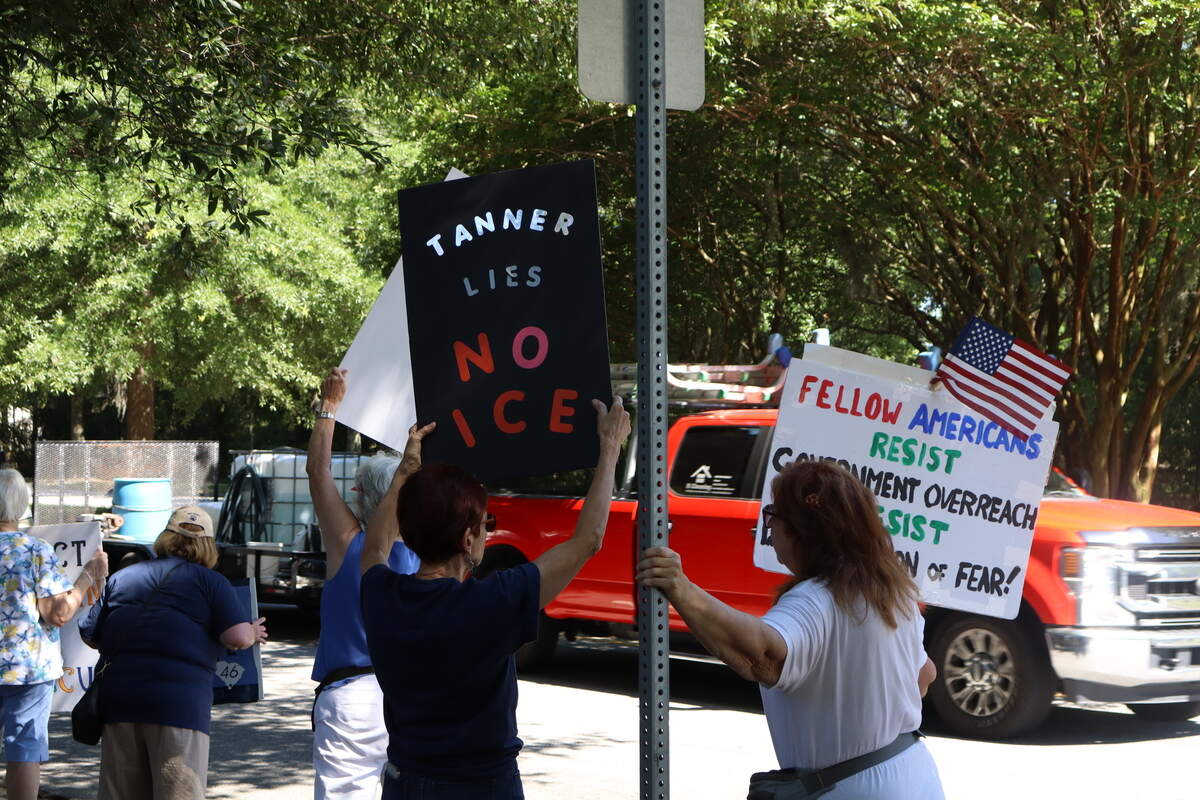
Some residents say that fear of racial profiling has left many in the local Hispanic community too afraid to leave the house or drive to work.
“We’re out here because other people can’t be out here,” Hilton Head Island resident Donald Edwards said, referring to undocumented residents who might not have felt safe attending the protest.
It was a noisy scene at the Friday afternoon protest. Dozens of drivers honked their horns as they passed by, and attendees periodically broke out into chants — “Say it once, say it twice: We will not put up with ICE!”
Alongside ICE’s actions, many protestors criticized Tanner’s decision to sign the 287(g) contract with the federal agency last year, arguing the partnership has weakened the public’s trust in the sheriff’s office.
“We know what’s happening in the [ICE] detention centers, with the care that people aren’t receiving, having worms in their food, being deported to countries other than their country of origin,” Beaufort County resident Russell Snips told The Island Packet. “I don’t think it’s okay that our sheriff’s department supports what happens to these people.”
Snips added that the proposed Bill H. 4764 in the South Carolina legislature, which would require all police agencies in the state to sign 287(g) agreements, was a “major concern.” The bill has passed the House and is now in the Senate Judiciary Committee.
Protest organizers act quickly: ‘We have to do something’
Community organizers said they felt the need for action immediately after the May 29 ICE operation. The LIC held an “emergency meeting” three days afterward to offer counseling and legal resources. At that that meeting, they heard from residents who wanted “their voice to be heard in different ways,” Wilkins said, which led to the quickly organized protest.
“I think there was a sense of ‘We have to do something,’ and Pastor June and I both felt the same,” Deverall said. “Kind of coming back to the scene of where this happened [for the protest location] was an easy decision for us. All we did was say we wanted to do it ... and people responded right away.”
Speaking about the widespread fear and apprehension in the local Hispanic community, Deverall said she talked to a man last week who had been a victim of a crime and was staying at a local shelter. But he had not reported the incident because “he doesn’t know what’s going to happen if he goes to the police,” she said.
“This is what we told Sheriff Tanner last year, when we said ‘Please do not do 287(g). ICE does not need your help,’” Deverall said. “It takes years to build trust with the community, and it takes moments to destroy it.”
ICE comes to Bluffton
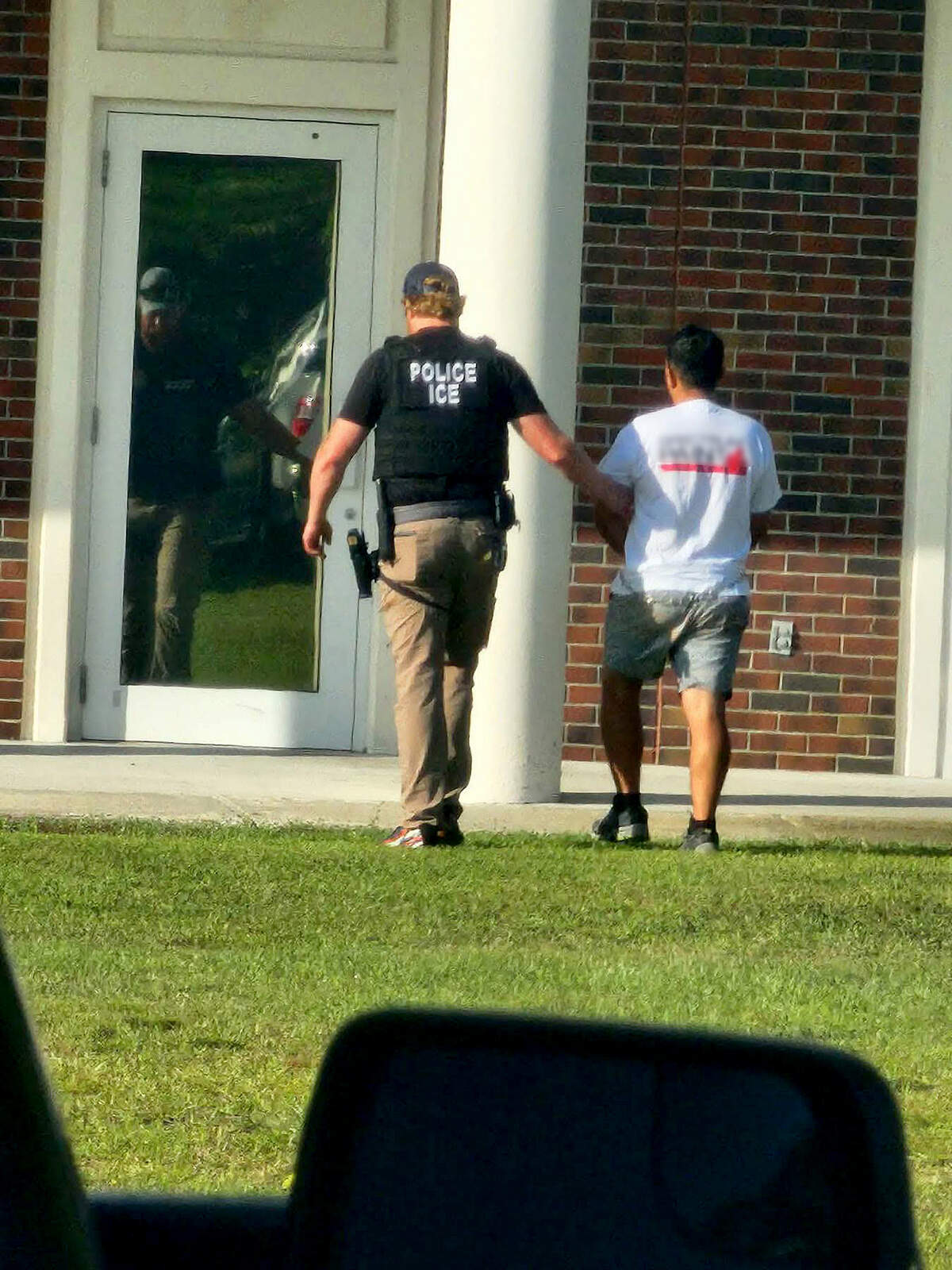
Residents began reporting sightings of ICE agents in the Bluffton area the morning of May 29. One local immigration advocate, Ana Ramirez, traced the activity to the Myrtle Park Government Center, which houses the town’s magistrate courthouse and other Beaufort County offices.
There, Ramirez recorded cellphone footage of over 15 handcuffed men who were led out of the building by police and loaded onto a white bus parked outside, she previously told The Island Packet.
“In my mind, I was like, ‘I can’t know their names, but if I can get their images, then their families can see this and know dad’s not coming home’ ... all the worries that a family can have,” she said.
BCSO described last week’s actions as a “coordinated immigration enforcement operation” targeting people who had not complied with deportation orders. The agency assisted federal agents in the operation through its 287(g) agreement with ICE, which Tanner signed last July despite pushback at community meetings.
The 287(g) contract permits BCSO deputies to be trained to perform some duties that an ICE officer would perform, including enforcing immigration warrants and interrogating anyone suspected to be an undocumented immigrant.
Deputies nominated by BCSO receive training from ICE and must “pass examinations equivalent to those given to ICE officers,” according to the 287(g) agreement. Only these deputies can perform immigration enforcement.
BCSO is the only agency in Beaufort County with a 287(g) agreement. Local police departments such as those in Bluffton, Beaufort and Port Royal do not have them, according to DHS data.
This story was originally published June 6, 2026 at 11:52 AM.